
A Complete Buyer’s Guide to Importing Red & White Onions From India
India produces and exports forty per cent of the world’s onions with extensive export experience and extensive use of both red and white varieties known for their sharp taste, long shelf life, and consistently high quality. Indian onions provide a credible and lower-priced option for importing countries with the high agricultural production, excellent export infrastructure and a network of existing exporters supporting the distribution system.
With the increasing demand for onions in the retail, food service and processing sector, the need for organised guides for importers regarding selecting suppliers, understanding compliance requirements, arranging logistics, and assuring the quality of the product continues to grow. The following guide for buyers provides a complete look at the buying process for Indian onions with key insights and practical considerations for importers to achieve a successful and smooth import experience.
1. Why India Is a Leading Global Supplier of Red & White Onions
Favourable climate, year-round planting system, and strong regional concentration have all added to India’s leading position in onion exports. Most of the major-producing states of India: Maharashtra, Karnataka, Gujarat, and Madhya Pradesh work together to maintain strong availability throughout the world.
The most commonly exported onions are red onions and white onions, which have a high level of acceptance globally due to their flavour, consistent size, and ability to be stored for an extended period. Whether for domestic use or industrial applications, Indian exporters are capable of providing the bulk quantities needed to meet the highest international quality standards.
The combination of strength in volume, diversity in varieties of onions has built India’s foundation as a reliable source for international onion purchases.
2. Understanding Red vs White Indian Onions
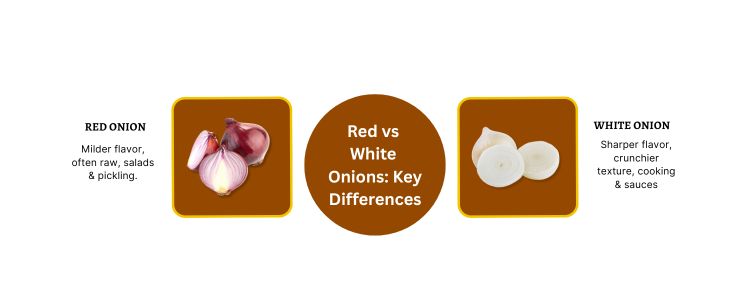
Before beginning a procurement cycle, importers should know the following differences between red and white onions:
- Red onions
- They are used widely in Asian, Middle Eastern and African cuisines.
- They typically have medium to strong pungency levels.
- They store for longer periods of time than white onions, especially in dry climates.
- They are preferred in markets that are seeking onions with a deeper colour and stronger flavours. Many buyers specifically request Indian red onions because they have a very sharp, pungent aroma.
- White onions
- White onions have a milder flavour and are often used in Western-style cooking or in food processing, such as freeze-drying and canning.
- They tend to have higher water content than red varieties.
- They are most often sold as dehydrated products (flakes and powders).
3. Major Export Grades and Quality Standards
When selecting the right onion variety, market demand, distribution channels and intended use should be taken into consideration.
In order to maintain uniformity, Indian onion exporters have established a grading system based on the following:
- Size (25–35 mm, 35–45 mm, 45–55 mm, 55 mm+)
- Skin thickness and colour
- Firmness and absence of cuts
- Absence of sprouting or internal decay
- Moisture content level (the lower the moisture content, the longer the shelf life)
Importers should specify detailed specifications on their orders, as the grade of onions will directly affect the price they pay for the onions and their appropriate use in the various markets; i.e. a customer could request a grade 1 onion to make prawn crackers, while another customer may want to buy a grade 4 onion for fresh salad preparation.
4. How to Choose Reliable Indian Onion Exporters
To ensure the quality, consistency, and timely delivery of products, it is important to carefully choose the right exporter. When searching for an exporter, buyers should look for:
- The exporter has been registered with government agencies, e.g. APEDA Certification.
- The exporter has had prior export experience to international markets.
- The exporter has developed facilities for sorting, cleaning and packing products.
- The exporter has established strong partnerships with logistics companies.
- The exporter provides clear and concise documentation of shipment and offers full transparency to buyers.
A reliable supplier network of Indian Onion Exporters typically offers Pre-shipment images, Lab Reports, and current Tracking updates to build confidence with their buyers.
5. Steps for Importers : How to Buy Onions from India
Many buyers question the way to simplify purchasing onions from India. There are five steps to simplify purchasing Indian onions:
- Initial Inquiry. Buyers should request price quotes, grades available, and packing requirements from several exporters.
- Sampling. Buyers should request sample shipments or factory videos to assess quality.
- Negotiation & Finalize Terms. Buyers should discuss expected volume, pricing, Delivery Timelines and Payment Options.
- Signing Contract. Buyers should ensure that contracts specify grade, size, Packaging and Moisture Percentages.
- Shipment & Inspection. Buyers should use a Third Party Inspection Agency for additional assurance.
6. Understanding Indian Onion Wholesale Prices
The pricing of onions fluctuates due to several factors:
- Seasonal harvest cycles
- Weather conditions
- Domestic market demand
- Transport and storage costs
- Export policy changes
Monitoring Indian onion wholesale prices regularly helps buyers plan procurement cycles and avoid unexpected cost spikes. Exporters typically provide weekly market updates to assist large-volume buyers.
7. Packaging Options for Export Shipments
Exporting companies follow internationally accepted standards for exporting onions and packaging onions in order to protect the onions during transit. Examples of typical onion packaging include:
* 5 kg, 10 kg, 20 kg, and 25 kg mesh or jute sacks
* ventilated containers to promote best air flow for the onions;
* palletizing consignments for large buyers; and
* good packaging practices that result in less onion spoilage, better freshness of onions, and compliance with country of import regulations.
8. Shipping and Logistics Considerations
The primary port of export for Indian onions are Mumbai, JNPT, Mundra and Chennai. Additionally, buyers importing onions to markets that are located relatively far away from Mumbai, JNPT, Mundra and Chennai should look for:
- Purchasing Reefer containers when shipping to far away destinations;
- Shipping short transits for sensitive onion varieties;
- Utilizing temperature-controlled storage during trans-loading;
Using export companies with expertise in exporting onions to the U.A.E. and South East Asia to take advantage of pre-established logistics routes and many frequent shipments for quicker lead times.
9. How to Export Onions from India : A Quick View for Buyers
Exporters manage the processes related to exporting onions from India including APEDA registration, obtaining Phytosanitary certificates, performing fumigations and quality checks on the products, handling Customs paperwork, arranging for Port Handling and Shipping.
By understanding how export onion in India will improve the ability of both Having the ability to communicate back and forth, as well as ensuring the buyer (Importer) verifies that the Vendor (Exporter) complies with all applicable laws, rules, regulations and requirements, the chances of delays when clearing Customs at the buyer’s (importer’s) destination are minimized.
10. Market Demand Trends & Opportunities
The strong demand for Indian onions continues to increase, primarily based on the following:
- Significant exports to the Middle East and South East Asia, which markets are experiencing rapid growth due to the increased demand.
- The growth of food processing in India, also the growth of Retail and Bulk consumption.
- The lowest price levels of Indian onions compared to worldwide competing suppliers.
Additionally, the Importer can capitalize on this continued growth and demand for Indian onions by developing long-term contracts with reliable and reputable Vendors, resulting in a more stable supply and a predictable price point.
Conclusion
Whether you are an importer, distributor, or wholesale buyer, sourcing Indian onions offers excellent value, strong supply reliability, and broad product versatility. With experienced Indian onion exporters supporting smooth documentation, consistent grading, and timely delivery, international buyers can navigate the complexities of global procurement with confidence. As onion export from India continues to strengthen, the country remains a strategic sourcing destination for both red and white onion varieties across global markets.