


Basmati Rice Demand in UAE During Ramadan 2026 : Buyer’s Guide
Ramadan is considered a major milestone for the food import business in the United Arab Emirates, with the upcoming month of Ramadan creating increased demand on supply chains through changes in consumption patterns, increased household stockpiling of food products, and increased demand for institutional catering services. In addition to being a staple food, the commodity Basmati rice plays an important role culturally and commercially during Ramadan.
As we approach Ramadan 2026, food buyers across retail, hospitality and food service sectors are evaluating their sourcing strategies for basmati rice to assist them in managing the anticipated increase in demand efficiently while continuing to provide quality and stable pricing.
This guide provides a structured overview for food buyers in the UAE to help them navigate the seasonal changes that occur in demand for rice, with an emphasis on identifying the sources of basmati rice, identifying opportunity for risk management, and preparing strategies to respond to seasonal market trends.
Why Does Ramadan Drive Higher Rice Consumption in the UAE?
During Ramadan, the day-to-day lifestyles of many individuals in the UAE are transformed. The need for household meal preparation grows, as the need for family gatherings, community iftar meals and charitable food distribution drive more food preparation; consequently, there will be more opportunities for individuals to purchase a higher volume of rice.
With the expansion of operations of hotels and larger catering companies, the demand for rice-based meals is heightened due to the expanded offerings of iftar buffets. Thus, retail and institutional demands are converging to create a temporary but significant increase in procurement needs.
Why Is Basmati Rice Preferred During Ramadan?
The characteristics that make Basmati rice unique include a distinct flavor, a long grain length and good cooking qualities. During the month of Ramadan, these qualities are important because shoppers preference is given to smoothness of the rice grain, uniformity of cooking, as well as its flavor and how it looks when served.
During periods of Ramadan, buyers look for long-grain Basmati rice because it has proven to be a dependable type of rice for cooking in large quantities and it does keep its texture when it has been prepared several hours ahead of time. This characteristic makes long-grain Basmati rice ideal for high-volume, fast-paced food service operations during the Ramadan holiday season. This could result in a larger amount of Basmati rice being purchased than other rice varieties during peak demand
How Is Demand Expected to Evolve in Ramadan 2026?
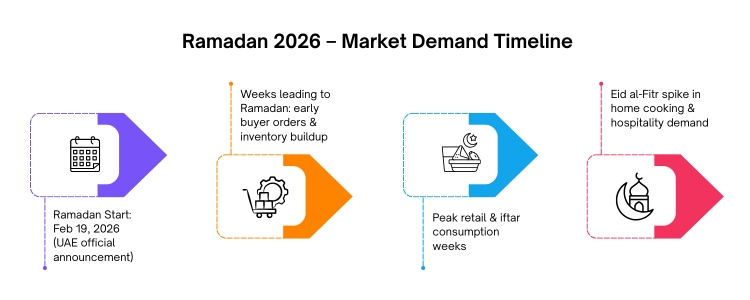
It is predicted that due to continued population growth and future events on the hospitality calendar in the UAE, Ramadan 2026 will experience an increase in consumption; however, the growth is not expected to be exponential. Retail and food service channels should see continued incremental increases in consumption.
Due to the popularity of the health-focused niche segment of Brown Basmati Rice in premium retail channels, buyers are also expected to expand their product offerings.
This broadening of the product assortment complicates the overall procurement planning process.
What Role Do Retailers and Food Service Buyers Play?
As Ramadan approaches, retailers see rising demand, as families prepare additional food items in their homes. Retailers use promotions and bulk packaging to ensure they capture excess demand.
Conversely, food service customers normally procure raw material products using a contract-based procurement method. Hotels and caterers purchase their raw material requirements in advance of Ramadan, allowing them to hedge against potential price fluctuations and shortages related to demand. While multiple vendors will be supplying food to retail stores, most food service buyers will also be competing for those food products prior to Ramadan, making coordinated efforts between these channels very important.
How Important Is Supplier Reliability During Ramadan?
During the month of Ramadan, suppliers must provide reliability; any stop in supply or failure to deliver food products as promised could result in operations shutting down or being severely affected. Because of this, food service buyers must take extra care in choosing suppliers that can demonstrate proven logistics capabilities and provide adequate inventory planning support.
By utilizing a reliable Basmati rice supplier in Dubai, food service buyers can better manage their short lead times, making it easier for them to respond to increases and/or decreases in demand. The ability to warehouse locally and have established distribution channels also reduces the likelihood of last-minute supply disruptions.
What Is the Role of Imports in Meeting Seasonal Demand?
Basmati rice is a staple food in India, but the UAE is dependent on India for all its basmati rice supply. In addition to the established export systems and volume commodity nature of India, basmati rice from India is also produced at a larger scale. Due to Ramadan, which is observed in the Middle East and North Africa, as well as some European countries, demand for basmati rice increases, and thus, basmati rice exporters from India often secure forward contracts for these customers during these high-demand periods, as opposed to relying solely on spot purchases.
Additionally, exporters from India can allocate basmati rice volumes for markets specifically requiring basmati rice during Ramadan. After securing a forward contract with Indian exporters, buyers should immediately contract this rice, otherwise they may face increased prices or limited supply when Ramadan approaches.
How Do Buyers Manage Price Volatility During Ramadan?
Another primary concern for buyers is price volatility. Seasonal buyers are always concerned with availability, and thus employ different methods to hedge against price and volatility. Factors such as freight charges, currency movements, and upstream procurement policies all play a role in determining the final price paid for rice.
To combat this issue, many buyers use staggered purchasing, as well as fixed pricing contracts, to reduce their exposure to potential price volatility. Furthermore, buyers that purchase premium segments of the market, such as royal basmati rice, will generally have less price sensitivity, but may require careful volume planning due to the higher price per
What Packaging and Grade Preferences Dominate the UAE Market?
Preferred packaging format is influenced by channel. Retail consumers generally prefer branded smaller packages with clear indications of origin and quality, particularly in metropolitan areas like Dubai, where consumers often purchase based on brand recognition.
On the other hand, food service channel buyers often prefer bulk packages with a consistent specification of grain characteristics. Uniformity in length, aging, and moisture content are generally of higher importance than branding in this channel.
How Does UAE Product Sourcing Strategy Influence Procurement?
The procurement process for Ramadan has moved away from being viewed as a ‘stand alone’ event, and is now part of a larger UAE Product Sourcing strategy, where buyers are focusing on creating deals that take into consideration both seasonal product needs and the year-round product supply agreement.
The combined strategy allows for increased leverage with suppliers and more efficient operations, and creates a longer-term exporter/distributor partnership that reduces the dependence on short term market conditions. Additionally, this strategy allows buyers to improve their forecasting and optimise their inventory levels.
What Risks Should Buyers Anticipate for Ramadan 2026?
The potential for risks include delays in shipments, congestion at ports, and regulatory changes that occur without notice to the buyer. There is limited availability of basmati rice during the month of Ramadan, which means that timing to get it delivered prior to Ramadan is extremely important due to the short time frame of demand.
Buyers will have to consider their competitors in the regional market who will also be purchasing basmati rice of the same quality grade during the same time period. The best ways to protect themselves are to contract with suppliers as early as possible and to have contingency plans in place.
How Can Buyers Prepare Effectively for Ramadan Demand?
Buyers will need to begin their procurement planning several months before the start of Ramadan. At a minimum, buyers will need to establish their volume forecasts, confirm their grade specifications, and set their logistics arrangements before the beginning of Ramadan.
Working with suppliers early on allows for more accurate alignment between buyer and supplier on delivery and quality expectations as well as reduce the risk of making last-minute adjustments. As a result, both buyers and suppliers may have a more efficient execution of their plans during the peak demand period.
Conclusion
The rice supply chain for the United Arab Emirates will once again be tested during the month of Ramadan in 2026. Basmati rice would be the most heavily consumed variety due to its flavour and cultural value.
To successfully navigate Ramadan, buyers must plan ahead, source responsibly, and build strong relationships with suppliers. Buyers who view Ramadan purchasing as a strategic process rather than a reactive one will be in a better position to control costs, quality, and continuity in a very competitive marketplace.

1. Why does basmati rice demand increase during Ramadan in the UAE?
Because rice-based meals are central to iftar gatherings and institutional catering.
2. When should buyers secure supplies for Ramadan 2026?
Ideally several months in advance to avoid price and availability risks.
3. Is brown basmati gaining popularity in the UAE?
Yes, particularly among health-focused consumers in premium retail segments.
4. Do foodservice buyers require different grades than retail?
Yes, foodservice prioritises consistency and bulk packaging over branding.
5. Are imports sufficient to meet Ramadan demand?
Yes, provided buyers plan ahead and secure allocations early.