

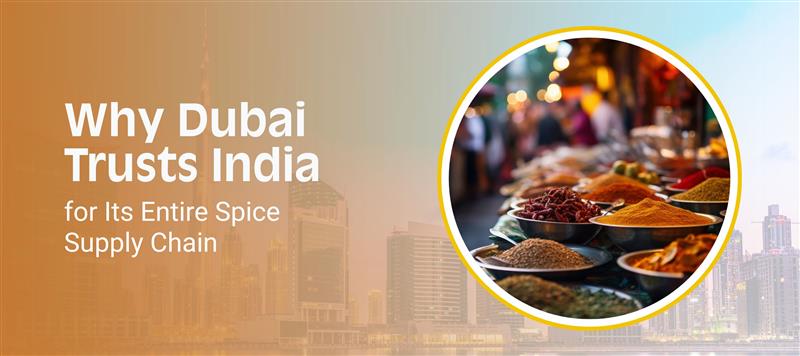
Why Dubai Trusts India for Its Entire Spice Supply Chain
Dubai has established itself as a leading global trading center based on the following primary but complicated principal: “Reliability at Scale”. Regardless of whether the traded item is energy, electronics, or food products Dubai, like many other global trading centers has been established through the development of Supply Chain networks that are Efficient, Resilient and Globally Competitive. A particular group of products that has been an integral part of Dubai’s supply chain(s) for a long time are Spice Products. Currently, Dubai receives a large volume of the Spice Product it requires from India, as this is a relationship based on Trust, Consistency and Long Term Economic Logic established through centuries of trading history.
The Spices Exporters that are located in India play a very important role in the Dubai Spice Supply Chain as they do much more than simply supply Raw Ingredients. They serve as an integral and supportive element to the Retail, Food Service, Manufacturing and Re-Export Ecosystem in Dubai.
Dubai’s Strategic Need for a Reliable Spice Partner
Dubai’s Food Economy differs greatly from the Economy in most other Cities. Due to limited agriculture within the Emirate and the fact that Dubai’s population includes people from many different countries, practically all of the Staple Ingredient Products that are used in the Food Economy must be imported. This also holds true for Spice Products. Spice Products are used by households, restaurant kitchens, and industrial food processors and distributors that are located across the region and use Dubai as a distribution hub.
Given this high level of dependence on Spice Products, Spice Sourcing Partners must be able to meet three different but equally important conditions (simultaneously) – Volume, Consistency and Compliance. India’s Spice Export Sector has built upon the traditional approaches that were developed over centuries, and has adapted over the last few decades to meet all of these three criteria.
India’s End-to-End Spice Ecosystem
Indian suppliers provide an ecosystem rather than just spice product(s) to Dubai. The cultivation, processing, grading, sterilization, packaging and export logistics are combined into a singular, fully developed ecosystem. Essentially, Indian exporters offer Dubai based importers a decreased number of intermediaries, increased levels of accountability and predictable results.
The primary reason that Dubai has built a level of trust with Indian spice suppliers is because of their ability to provide product(s) that are consistent in nature. Due to the sensitivity of spices to climatic changes, harvesting practices and improper post-harvest handling, any inconsistencies in colour, aroma and moisture content can negatively impact food manufacturing processes as well as ultimately affect consumer acceptance of the food products.

Consistency as a Commercial Advantage
To eliminate any uncertainty related to spice product consistency, Indian suppliers use diversified growing regions and carefully controlled processing methods to reduce these risks. By providing the same spice product from multiple agro-climatic zones, exporters limit their exposure to the effects of seasonal volatility. Consequently, Dubai buyers can expect to have continuous and reliable access to stable supply chains as well as consistent quality across all supply shipments.
Supporting Dubai’s Re-Export Economy
As a redistribution hub for the Middle East, Africa, and Europe, Dubai exports spice (raw material) to secondary markets through import. Therefore, the need for dependable sourcing is very important when exporting spices into Dubai, as it provides the opportunity to serve not only the domestic market but other countries.
Exporters from India understand the significance of Dubai’s position as a regional trade centre. They therefore tailor their shipments to meet the needs of both the international market and Dubai’s domestic market through their customized specification and packaging options.
Evolving Consumer and Retail Dynamics
The growth of modern retail and digital commerce in the UAE has led to an evolution in how customers purchase spices. In addition to traditional outlets, online marketplaces now provide an alternative way for customers to purchase spices in Dubai, as well as a way for them to receive their orders without the need to visit a physical market in person.
To support the Dubai retailers in catering to an increasing number of customers who prefer convenience, exporters from India have adopted various options for convenience, including retail-ready packaging, private labelling and consistent brand image across their products.
Premiumisation and Ethical Sourcing
Although volume remains critical, Dubai’s spice industry is also starting to go towards the premium segment. The affluent consumer segment and the competitive hospitality industry are more focused on the quality and differentiation of the product by way of the origin and sustainability.
Thus, this new focus on quality and differentiation has opened up possibilities for some niche markets (i.e., Organic Spices UAE) where Indian producers with certified organic farming practices have started to gain a foothold. While this segment represents a small percentage of the total imports, it represents a trend toward value-added sourcing.
Cultural Familiarity and Culinary Trust
With respect to spices, their cultural associations have a deeper impact on relationships between two traders than on just a commercial basis. For centuries, Indian spices have played an integral role in Middle Eastern cuisine; this shared heritage has helped develop a level of understanding, trust and acceptance between Indian spice manufacturers and Middle Eastern traders.
The wordings used in describing Indian spices exemplifies the incorporation of Indian spices into Middle Eastern cuisine. Green cardamom is widely used in Arabic coffee and sweets, and the Indian variety of this spice has created an expectation for quality with respect to both aroma and taste. This cultural connection creates a unique bond that cannot be measured in monetary terms.
The Role of Traditional Wholesale Markets
The growth of modern shopping has resulted in retail dominance, however Traditional Trading Centres remain important. For example, the wholesale spices market in Dubai continues to show retailers and wholesalers how much spice they need based upon what is in high demand, pricing trends and the types and qualities of spices they prefer to use.
In Dubai, Indian suppliers have a very strong presence within the wholesale market, as they provide trader-to-trader transactions which then supply restaurants, caterers and smaller retailers. Because they have long standing relationships and are able to react quickly to changing needs, they continue to maintain a central role within the supply chain
Conclusion
By working with Indian suppliers, Dubai has recognized that trust is developed as a function of consistency, transparency and long-term partnerships. Indian exporters have demonstrated their ability to enable Dubai’s complex supply chain for spices, from farmers through to processors and from ports through to retailers.
As supply chain reliability is a competitive advantage, India is now considered a strategic partner in Dubai’s food economy.