


How Generative AI is Transforming Global Supply Chain Management in 2026
2026 is shaping up to be the inflection point in the evolution of world trade. Supply networks stretched across geographic regions, currencies, and regulatory frameworks are creating a level of complexity that existing forecasting and planning systems can no longer accommodate. Against this backdrop, the emergence of the generative AI supply chain is not just timely; it is game-changing. Generative systems are no longer merely a technological fad; they are becoming part of the fabric of planning, decision-making, and risk intelligence.
The difference is the ability of generative systems to synthesize vast datasets and create structured guidance for planners, supply chain teams, and procurement teams. Disruptions ranging from extreme weather to trade adjustments are more frequent, and Global Supply Chain Management is maturing from historical analysis to anticipatory models. The result is a supply chain that is proactive instead of reactive, and that anticipates disruptions with an unprecedented level of forethought.
Understanding the New Supply Chain Landscape
Today’s global supply system is a tightly knitted web of suppliers, manufacturing plants, logistics aggregation points, distributors, and retail distribution systems–with each node dependent on the node before it, so that even a delay in one time zone can resonate around the globe. Many professionals still find themselves explaining what a global supply chain is, particularly as the concept and function continue to be reshaped by digitalization.
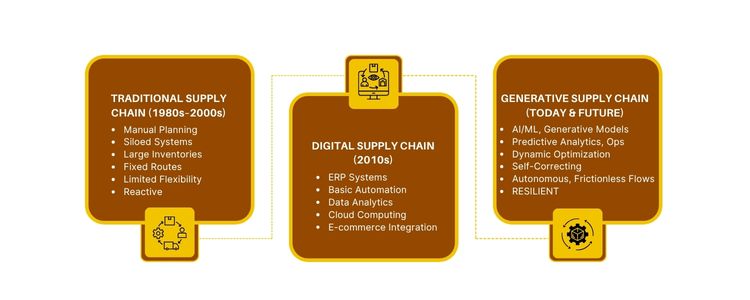
In 2026, the modern supply chain becomes less a linear pipeline and more a continuously fluid ecosystem. As customers continue to expect quick fulfilment and regulators step up compliance with norms, companies must now create visibility across all layers. Traditional technologies, ERP systems, spreadsheets, and rule-based planning tools are designed for stability, but even the slightest detours can sometimes lead them to fail in the current era of volatility.
Generative systems, on the other hand, are implicit adaptive engines that leverage historical and live data in order to both predict and simulate possibilities, advocate for logistics alternatives, and expose waste that is hidden at the human scale.
Where Generative AI Makes the Greatest Impact
1. Elevated Forecasting and Scenario Modelling
Early forecasting models could describe trends but would struggle to detect unknown shocks. Generative models recreate and examine multiple imaginations of possible realities weather interruptions, shipping port congestion, demand spikes, shortages of raw materials, and test the solidity of the chain in each circumstance. This allows companies to develop mitigation strategies prior to the disruption getting out of hand.
2. Intelligent Inventory Planning
One of the largest costs in global logistics is the balancing act of shortages and excess inventories. Generative systems will study consumption patterns, reliability of suppliers, and the variability of transport to reduce this imbalance. Manufacturers and retailers are reporting warehouse costs down and service levels accuracy up as a result.
3. Strengthened Supplier Intelligence
The rise of ethical sourcing, sustainability regulations, and compliance rules is requiring companies to rethink their supplier ecosystems. Generative models create clarity in this area by looking at supplier performance, exposure to risk, and value of relationships with much greater detail. Some companies are even starting to embed generative AI supplier management into their procurement strategies over the long term to reduce volatility and enhance readiness for audits.
4. Enhanced Logistics Planning
The development of global trade necessitates logistical decision-making that encompasses weather, geopolitical uncertainty, freight rate volatility, and live activities at ports. Generative systems can simulate ideal routing remarkably quickly allowing logistics managers to receive actionable insight and detailed planning long before any bottlenecks develop. This is a valuable way to increase the resilience of the whole value chain, particularly as firms look to realise large-scale initiatives for generative AI logistics optimisation.
5. Real-Time Exception Management
Today’s supply chains face an endless flow of exceptions, whether it is a missed pickup, customs delay, damaged shipment, or any last-minute change in demand. Generative systems are able to give real-time recommendations for ideal workarounds, diagnose disruptions, and inform what action to take next. This ultimately enhances many organisations’ ability to serve customers through increased manpower resource recovery speed and less human anxiety.
How Generative AI Is Reshaping Strategic Decision-Making
Making decisions about sourcing, manufacturing, outsourcing, and logistics on a high level is frequently an experience-based exercise of assessing market opportunity and risk and then acting on those assessments based on imprecise and constantly evolving market conditions and contractual arrangements. These approaches are imperfect, however, and sometimes leave us without considering hidden dependencies or an emergent risk.
Generative methods can uncover these blind spots, including:
- Simulating potential supplier defaults and bankruptcies
- Mapping alternative sources or production options
- Attempting to quantify losses due to geopolitical realignment or destruction of the company’s supply portfolio
- Identifying risks to sustainability
Offering options to manage dependency and risk through supplier reallocation or multimodal approaches to address a single logistical The depth of information offered allows for the ability to elevate decision-making from the province of operational scheduling to the sphere of formalized planning and decision analysis, where decisions reflect time-cycles of extended and multi-year horizons.
Similarly, the strategic side of Vendor Management receives significant value, and it is no longer entirely dependent on the experience and principles of contract compliance and evaluations across all vendor relationships. Generative methods assist organizations by documenting vendor-related reporting compliance to contract delivery and performance-related quality scores, risk ratings, and delivery inconsistencies, which allows organizations to better understand which vendor relationships are capable of and deserving of long-term and multi-year contracts, and which may require adjustments
Technologies Behind the Shift
Generative models operate alongside three major enablers:
1. Integrated Data Lakes
Organizations are now utilizing one source of truth to aggregate logistics, sourcing, warehouse and finance data, providing generative systems visibility across the chain.
2. Natural Language Interfaces
Now teams can engage with supply chain data using conversational prompts, which is more convenient for planners in urgent situations, who may not have enough time or could be overwhelmed by visualizing dashboards.
3. Predictive–Prescriptive Engines
Not only can generative systems forecast the future, they can also suggest possible actions for a company to consider, whether “delay shipments,” “expedite orders,” “change shipping modes,” or “renegotiate terms” for delivery or contracts. This prescriptive action is causing widespread adoption of generative AI tools in organizations across many supply chain verticals.
Benefits Enterprises Can Expect in 2026
• Greater Operational Agility
Any company that historically would take hours or days in providing answers to disruptions can now provide tactical solutions in a few minutes. When companies operate in competitive markets, speed of solution becomes a differentiator.
• Cost Rationalisation Without Compromising Reliability
Generative models also assist companies in identifying in their supply chain unnecessary freight costs, high risk suppliers and inefficient inventory management processes, creating value for their organizations by reducing total cost or spend without service level compromise.
• Reduced Environmental Impact
Generative models also support emission and sustainability reduction goals by providing visibility into older routes, more efficient loading plans, and enabling alternative sourcing options.
• Improved Workforce Productivity
Manually analyzing data is no longer part of planners’ work lives, and instead, they have the opportunity to work strategically, with negotiations and cross-functional coordination.
The Road Ahead : What 2026 and Beyond Will Demand
The longer-view is that generative systems will be part of the fabric of global operations. Organizations must, however, guard against three areas.
1. Data Quality Discipline
Incomplete, or poorly structured data, diminishes the power of generative systems. Organizations must develop a focus on repeated data governance.
2. Ethical and Responsible Use
Supply chains reflect commercially sensitive relationships. Organizations must understand the importance of discretion, fairness and responsible automation.
3. Strengthening Human Oversight
No algorithm will supplant context, wisdom, or opportunistic negotiation experience. Human judgment will remain the bedrock.
As organizations continue the work of modernizing their systems, the likelihood of strengthening their relationships with consulting firms, technology integrators, and the global nature of firms will suggest that transformation continues to be worthwhile, secure, and, through collective practice, strategically aligned.
Conclusion
The rise of the generative AI supply chain represents a distinctive transition in how organisations forecast risk, manage resources, and design more resilient operations.

In 2026, the leap is not a replacement of human capacity, but rather a supplement to enhance our ability to comprehend the uncertainties of Global Supply Chain Management with clarity, pace, and confident action. Organizations willing to take advantage of this leap now will be in a much stronger position to compete, innovate, and succeed over the next decade.
Frequently Asked Questions (FAQ)
Sourcing services companies are professional firms that assist businesses with supplier relationship management, with an emphasis on efficiency and compliance, enjoying a long-term relationship and collaboration.
Agents usually manage single transactions, whereas sourcing companies create a working relationship with suppliers by employing a complete supplier relationship management process with strategic oversight.
Because trust and compliance help assure quality, minimize risk, and ensure delivery performance.
Technology provides transparency, risk monitoring, and automates and enables collaboration between buyers and suppliers across borders.
Sourcing services firms help mediate disputes, enforce contractual obligations and formalize a corrective actions plan, whilst assuring business continuity.
No. Small and medium-sized enterprises will also leverage the knowledge of sourcing services companies and access to their network to connect to global suppliers without excess overhead.