

How to Import Corn from India: A Complete Buyer’s Guide
India has increasingly become an important global supplier of agricultural commodities, especially maize. When considering purchasing corn products from India, international purchasers should be aware of how the export process works in order to ensure that they are purchasing from legitimate suppliers who provide high-quality products and meet any necessary standards for importing products into their country.
The guide provides a detailed overview of the corn export process for purchasers seeking more information about their options as they navigate this aspect of the business.
Understanding India’s Position in the Global Corn Market
India has proven to be one of the leading global producers of maize due to having great agricultural land combined with ideal growing conditions (climate). Most of the maize exported out of India goes to either Southeast Asia, the Middle East, and Africa.
The export of corn from India is based on a very competitive price, availability of non-genetically modified organisms (GMO) varieties, and most importantly the ability to deliver products to buyers on a consistent basis. In contrast to many Western agricultural producers, smallholder farmers in India are typically involved in the production of maize therefore contributing to the appeal of maize produced in India when sourcing products that must meet strict buyer specifications for quality.
Types and Grades of Corn Available for Export
Prior to entering into a purchase agreement with an Indian supplier for imported corn, buyers should be aware of how corn grown in India is categorized for export purposes. The yellow maize variety is the predominant export from India and is widely utilized in both feed and industrial applications.
Key Types of Corn Exported by India
- Feed grade – Poultry & Livestock Feed
- Industrial grade – Starch & Ethanol Production
- Food Grade: Limited Demand, but Growing
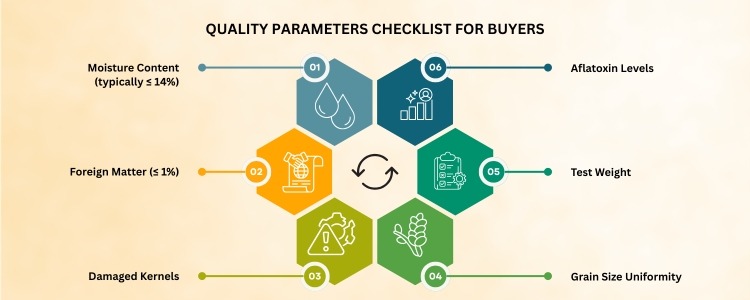
Generally Accepted Quality Assessments Include
Moisture Content, Foreign Matter, Damaged Kernel, and Test Weight. Buyers should obtain a copy of the specifications before confirming the order.
Identifying Reliable Corn Exporters in India
Choosing the appropriate supplier may be the most important part of importing. There are many large exporting companies in India as well as a number of smaller trading companies.
There are many things you need to ensure before choosing your supplier. Some examples are:
- Export Certificate / License.
- Export Experience.
- Pricing Transparency.
- Ability to Deliver Good Quantities Consistently.
To minimize the risks or issues in buying corn from an Indian exporter, verify that the exporter has been verified and that the exporter can provide third party inspection reports for additional assurance regarding the quality of the product and/or packaging.
Export Regulations and Compliance Requirements
Several international regulatory agencies oversee agricultural exports from India, including APEDA (The Agricultural and Processed Food Products Export Development Authority).
Many things must be complied with to meet the requirements of importing corn from India. Some examples of compliance regulations are:
- Phytosanitary Certification.
- Fumigation Regulations.
- Quality Inspection Reports.
- Export Documentation (Invoice, Packing List, or Bill of Lading).
Importers also must comply with their respective importing regulations, such as the regulations regarding pesticides and GMO issues.
Pricing Dynamics and Cost Considerations
Pricing for corn being exported from India is determined by a variety of factors, such as:
- Seasonal Production Cycles.
- Changes in Domestic Demand for Corn in India.
- Freight Costs and International Shipping Rates.
- Exchange Rate Movements.
Corn grown and exported from India is typically priced lower than corn grown in the United States or South America. However, when comparing your total purchase price, you need to include the costs associated with transporting and handling the corn
Logistics and Shipping Process
India’s large ports including Kandla, Mundra, and Visakhapatnam can handle bulk agricultural exports with great efficiency.
Shipping Choices:
Bulk shipments (for large volumes)
Containerized shipments (for small quantities)
Shipping times will vary depending on where they are going; however, generally they will be between 10 and 25 days. Proper coordination with freight forwarders is critical to prevent delays.
Quality Assurance and Inspection
Importers rank quality consistency as one of their top concerns. To help reduce the risks, buyers should:
- Request pre-shipment inspections
- Use third-party inspection companies
- Validate moisture levels and contamination levels for imported products
Inspection certificates will not only confirm compliance but also provide buyers with protection against disputes.
Payment Terms and Trade Practices
Importing from India generally follows normal International trade regulations.
Common Payment Methods:
- Letter of Credit (LC)
- Telegraphic Transfer (TT)
- Documents Against Payment (DAP)
Buyers should begin with smaller orders until They establish trust and necessary payment options.
Comparing Indian Corn with Global Alternatives
While the United States and Brazil dominate global maize trade, India offers a distinct value proposition.
Factor | India | USA | Brazil |
Price Competitiveness | High | Moderate | Moderate |
GMO Status | Mostly Non-GMO | Predominantly GMO | Mixed |
Freight Advantage (Asia) | Strong | Moderate | Weak |
Buyers evaluating wholesale yellow corn suppliers may find Indian corn more suitable for markets demanding non-GMO produce at competitive rates.
Risks and Challenges in Importing Corn from India
There are several obstacles to consider when importing from India, despite the many advantages:
Crop quality can be highly variable and often contingent on the monsoons; additionally, infrastructure bottlenecks can create delays and issues due to limited capacity during peak harvest seasons. Changes to the regulatory environment that may influence export policies could also contribute to various risks.
Working diligently to prepare for the aforementioned risks, as well as developing reliable supplier relationships, will mitigate the likelihood of encountering problems as you grow your businesses.
Role of Maize in India’s Agricultural Export Basket
India is recognized internationally for its export of vegetables; however, maize is becoming an increasingly important commodity with respect to export revenues. The rapid growth of maize production in India is contributing to a growing global demand for maize production.
There has been steady growth in the export of maize from india over the last few years largely due to an increasing demand for feed for livestock internationally, particularly in Southeast Asia.
Best Practices for First-Time Buyers
If you are new to importing maize from india, there are several things that you should keep in mind:
- Begin by doing a test shipment;
- Perform supplier audits;
- Become familiar with Incoterms;
- Establish clear lines of communication on how you and your supplier will conduct business;
As you grow, creating a dependable supply chain takes time but can produce long-term benefits.
Future Outlook of Corn Export from India
The future looks bright due to an enhancement in agricultural supply chains globally and rising demand for Agriculture in India. The creation of more storage, better Logistics and implementing improved Quality Controls will continue to drive Export opportunities.
Many Exporters to India are adapting to International standards as Sustainability/Traceability become more important.
Conclusion
Importing corn from India presents a strong opportunity for all buyers around the world that want to save money and buy products that are not Genetically Modified Engineered. However, being selective in identifying Suppliers, fulfilling Regulations and having a good understanding of market trends are critical to being successful.

Diptanshu
Leading research and marketing at Inductus Global, Diptanshu drives the company’s vision to transcend traditional trading through thought leadership in import-export. He spearheads a research-driven approach that prioritizes quality over price arbitrage, positioning Inductus as a strategic sourcing partner rather than a transactional intermediary. His work spans market intelligence, supply chain innovation, and trade dynamics, while playing a key role in sales and business development.






3 Replies to “How to Import Corn from India: A Complete Buyer’s Guide”
Best Basmati Rice Exporters From India - 2026 Guide
19 Sep 2026[…] Maize Exporters In India can be manufacturers, independent traders, processors, or exporters. Therefore, the capabilities of different suppliers can vary significantly. It is advisable for the international buyer to request relevant documents, such as the company’s profile, the product description, past and current inventory, and references from previous clients, if available. In particular, it is important to obtain sufficient information about the source of the maize and the extent of the supplier’s involvement in the production process. […]
Maize Export from India: Buyer’s Sourcing Guide
19 Sep 2026[…] Maize Exporters In India can be manufacturers, independent traders, processors, or exporters. Therefore, the capabilities of different suppliers can vary significantly. It is advisable for the international buyer to request relevant documents, such as the company’s profile, the product description, past and current inventory, and references from previous clients, if available. In particular, it is important to obtain sufficient information about the source of the maize and the extent of the supplier’s involvement in the production process. […]
Maize Export from India: Buyer’s Sourcing Guide
22 Sep 2026[…] Wholesale yellow sweet corn suppliers may vary considerably in their operating models. Some focus more closely on farms and agricultural networks, while others specialise in processing and international distribution. […]