

Rice Export from India to Australia & New Zealand: Varieties, Pricing, and Import Regulations
The country of India has historically been an exporter of high-quality and low-cost rice to multiple countries on every continent, with Australia and New Zealand as newer markets for Indian produced rice. Growth in the demand for Indian rice continues to come from an increase in South Asian communities as well as a shift in foods consumed in Australia and New Zealand being influenced by different styles of cuisine (Asian, particularly). As such, the India rice export sector has developed into a key opportunity for exporters who are looking for long-term, sustainable, and profitable offshore markets to do business with.
While both Australia and New Zealand have very strict biosecurity and food safety regulations, Indian exporters continue to reinforce their position within these countries through quality assurance programs, value pricing, and a variety of types of rice available to meet local market needs and consumption preferences.
Growing Demand for Indian Rice in Australia and New Zealand
There has been a definite increase in rice consumption in Australia and New Zealand over the last 10 years, with urban consumers purchasing more aromatic long-grain rice at home and in restaurants. This growth has been aided by an increase in popularity for the Indian restaurants now found in cities such as Sydney, Melbourne and Auckland.
Indian rice exporters are well-positioned to take advantage of this change, as there is a consistent supply from India, a well-developed milling sector, and globally accepted quality. The growth of Indian grocery stores and Asian supermarkets has enabled exporters to access new markets.
In addition, e-commerce food distribution channels have enabled importers to buy directly from Indian producers and processors. Therefore, the potential for exporting rice from India is expanding into new markets beyond the traditional Gulf and African markets.
Popular Rice Varieties Exported from India
Australian and New Zealand consumers can purchase several different varieties of rice from India; both high-quality and low-quality options are available to suit each buyer.
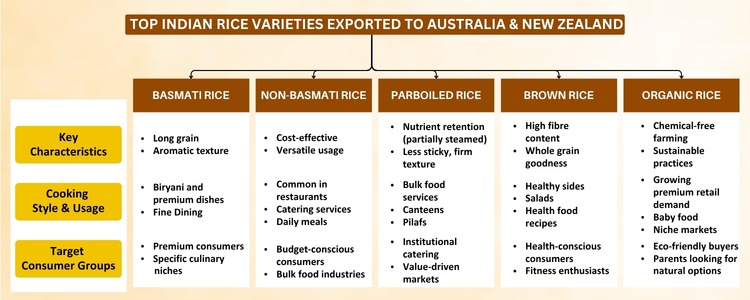
Basmati will always continue to be the dominant rice export item as a result of its long grain, distinct smell, and soft feel after cooking. This rice has been in demand from India-Pakistani’s, as well as people in the Middle East and increasingly the general Australian public as a result of biryani, pilaf, and restaurant-grade dishes. The Basmati rice segment has grown in Australia as a result of its increased popularity among consumers. The premium varieties of Basmati that command high shelf prices include 1121 Basmati, Traditional Basmati, and Pusa Basmati.
Non-Basmati Rice
In addition to aromatic rice, Indian exporters provide white rice, parboiled rice and broken rice varieties. The demand for Non-Basmati Rice exports from India to Australia is driven mainly by the food processing industry, restaurants and inexpensive retail grocery chains.
Because Non-Basmati varieties are less expensive than Basmati varieties, they are typically used in large-scale catering operations and commercial food production.
Specialty Rice
As well as non-Basmati and specialty, organic rice has become more popular in Australia and New Zealand; brown rice, red rice, low GI rice are examples of this rice type. More and more health-conscious customers in Australia and New Zealand are looking for organic food products that are “traceable” and have “sustainable” production methods.
Pricing Trends and Export Economics
In the rice export sector, there are many factors affecting pricing, including crop yield, freight rates, government policy, currency fluctuations, and international demand.
Compared to Thai, Vietnamese and Pakistani products, Indian rice is also competitively priced due largely to India’s vast agricultural production base and efficient processing capabilities.
Premium basmati rice exported to Australia and New Zealand tends to command higher margins because of Basmati rice’s positioning in the retail and hospitality marketplace. However, the cost of freight transportation plays a significant role in determining the final landed price of these products. Recently, escalating shipping costs have led exporters and importers to negotiate long-term supply contracts to ensure stable pricing.
Another factor that can impact export economics is the type of packaging used. Retail-ready consumer packs, which include current branding, nutrition info labels, and compliance certification, generally result in greater profitability than do shipments of bulk commodities.
Typically, a reliable basmati rice supplier takes into consideration factors such as competitive pricing, consistent grain quality, moisture control, and packaging quality, rather than only competitive pricing.
Import Regulations in Australia
Australia has one of the world’s strictest biosecurity systems. Rice imports are regulated to prevent contamination and the introduction of pests or diseases.
Importers are generally required to comply with regulations laid down by the Department of Agriculture, Fisheries and Forestry (DAFF).
Key requirements include:
- Proper phytosanitary certification
- Clean and contamination-free consignments
- Accurate product labelling
- Compliance with food safety standards
- Packaging declarations and traceability
Australian authorities may inspect consignments at ports to ensure they meet quarantine regulations. Exporters failing to comply can face shipment delays, rejections, or additional treatment costs.
Food Standards Australia New Zealand (FSANZ) also mandates clear labelling regarding allergens, nutritional values, and country of origin.
Indian exporters working with experienced distributors usually face fewer compliance issues because documentation processes are handled more efficiently.
Import Regulations in New Zealand
Australia boasts one of the strictest biosecurity systems globally. Rice is imported in accordance with regulations that protect against contamination, pest introduction, and disease transfer.
Importers must generally adhere to the requirements set by the Department of Agriculture, Fisheries, and Forestry (DAFF).
The most essential regulations for all imported rice include:
– Appropriate phytosanitary documentation
– Units free from all forms of contamination and considered clean
– Accurate labels on all products
– Compliance with food safety regulations and standards
– Packaging declarations and traceability for shipments
In order to comply with Australia’s quarantine system, the Australian Government can examine shipments arriving at the Port of Australia to verify their compliance with quarantine rules. Exporters may be delayed or denied shipment if they do not comply with Australian quarantine rules and regulations, and they may also incur additional costs associated with the treatment of non-compliant shipments.
Food Standards Australia New Zealand (FSANZ) also requires clear labelling for all imported foods regarding allergens, nutrition information, and country of origin.
Exporters from India who work with established distributors tend to encounter fewer issues or challenges with compliance, as the process of documenting shipments is handled more efficiently.
Challenges Faced by Indian Exporters
As a result of a high demand for their goods, exporters face various operational and market challenges.
Freight Logistics
Freight rates are unstable because of global unrest and fluctuations in oil prices. Delays at the port can also damage the quality of products stored in containers before they leave the port; therefore it is important that all parties are working together to avoid this type of damage (importer/exporter).
Regulatory Compliance
Regulatory compliance requires careful coordination between exporters, freight forwarders and importers, as exporters must pay close attention to documentation and the biosecurity standards set forth by various countries.
Competition from Other Countries
Thailand and Vietnam are competing aggressively in the premium and mid-range rice segments. Basmati rice is also facing stiff competition from Pakistani exporters.
Currency Fluctuation
Fluctuations in exchange rates between the Indian rupee, Australian dollar and New Zealand dollar can affect profitability for both exporters and buyers.
Opportunities for Future Growth
Indian rice export projections to Australia and New Zealand are still quite good. Long-term expansion is supported by many factors, including:
- The abundance of multicultural demographics
- increased acceptance of Indian cuisine
- The increased growth of organized retail/online grocery platforms
- The demand for healthier/organic foods
- The expanding growth of food service industries
In addition, Indian exporters are pursuing modern new technologies, branding strategies, and premium packaging formats that assist in raising their market profile.
A professional wholesale supplier of rice, selling these products, will begin to develop a focus on customized packaging, private labeling and long-term retail partnerships compared to simply selling on the basis of a commodity.
Government programs that support the promotion of agricultural exports and trade facilitation will also have a positive impact on the continued growth of this industry sector.

Conclusion
India continues to be among the world’s top rice-exporting nations, and the recent rise of Australia and New Zealand in their capacity to export is indicative of a growing global food demand. In order to satisfy the needs of their international buyers, Indian exporters provide everything, from high-end Basmati rice to more economical non-Basmati varieties. To meet the trade laws that govern these countries and ensure their future competitiveness, Indian exporters will have to adapt to changing market demands.
With demand remaining relatively stable and an overall availability of Indian Rice in these markets (through competitive prices and multiple varieties), the Indian Basmati Rice export industry is well-positioned to take advantage of these two markets. However, maintaining suitable quality levels, streamlining supply chain processes, and staying in sync with evolving regulations and buying characteristics will determine their long-term success.
Ultimately, exporters from India who have the willingness to invest in product compliance, branding, and reliable distribution networks will have significant opportunities for sustainable growth in the future in both of these countries.

Diptanshu
Leading research and marketing at Inductus Global, Diptanshu drives the company’s vision to transcend traditional trading through thought leadership in import-export. He spearheads a research-driven approach that prioritizes quality over price arbitrage, positioning Inductus as a strategic sourcing partner rather than a transactional intermediary. His work spans market intelligence, supply chain innovation, and trade dynamics, while playing a key role in sales and business development.