

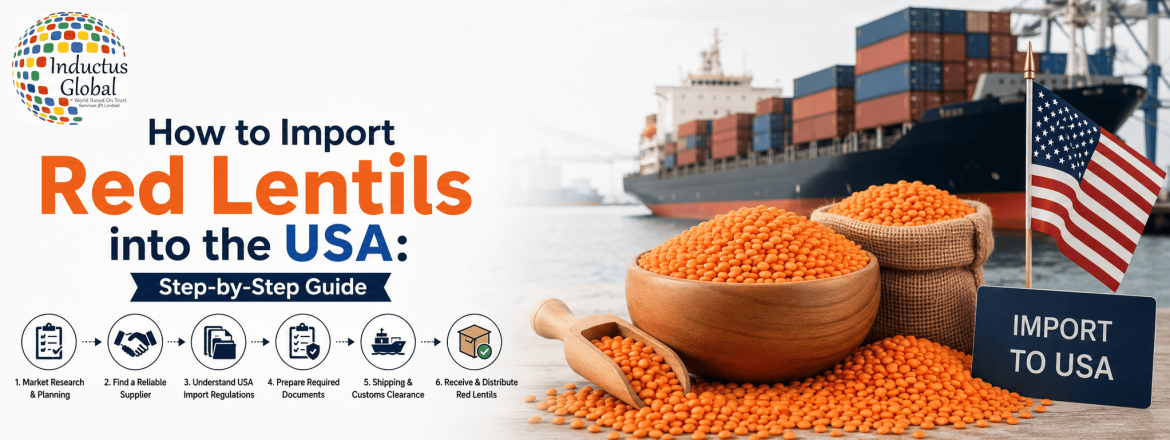
How to Import Red Lentils into the USA: Step-by-Step Guide
Why Import Red Lentils (Masoor Dal)?
“Red lentil varieties are defined by their red cotyledon and moderate to thin seed coat. Red lentil varieties tend to be smaller than those of their green/brown counterparts, with large red lentil varieties meeting a similar size to small green lentil varieties.” Wikipedia Red Lentils aren’t just a mere variety of pulses in markets, they are essentials of a holistic development of the human body, ranging from cereals to infants to stews and gluten-free breads for adults, it carries utmost nutrition and benefits.
With the rise in demand for protein in the Health sector, people are obsessively trying to find alternatives of nutrition rich Protein products, among which Red Lentils lead the way. With produce of 1.6-1.8 Million Metric Tons of Red Lentils per year, India becomes one of the top most producer and exporters of red lentils worldwide. What was staple to the Indian diet has gained recognition among health enthusiasts.
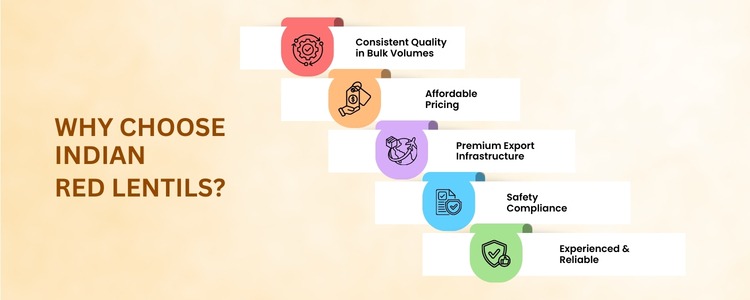
Why Choose Indian Red Lentils?
“Pulses are an important component of the food basket in India and are a major source of protein for the population.” Press Information Bureau
Government of India, India is among the major suppliers of pulses, specifically Red Lentils, as the statement suggests the population of India drives pulses on a daily basis. The following are the reasons one should import Indian Red Lentils,
- Cleaning and grading infrastructure
- Processing capabilities
- Export logistics
- Quality certification
- Bulk shipment handling
- Supply chain scalability
Why do US Buyers Choose Indian Red Lentils?
The U.S. consumer market has moved considerably toward functional nutrition. People are consuming more protein than ever before, moving away from traditional meat and instead seeking out plant-based options that are both healthier and more budget-friendly.
Red lentils work wonderfully during this transition.
- They offer A high content of plant-based protein
- Are naturally gluten-free, packed with iron and folate
- Low in fat
- Gentle on the digestive system
- Prepare quickly
- Ideal for both vegan and vegetarian meals
Red lentils are really easy to cook. They work well in lots of different dishes. They do not need to be soaked for a time like some other legumes. This is why big food companies and restaurants like to use them. In the United States market, people want ingredients that are good for them and also good for the environment. They like lentils because they are a good source of protein, and they are not too expensive.
The U.S. market particularly prioritizes ingredients that enable Clean-label formulations, high-protein product positioning, sustainable sourcing, and cost-effective nutrition. Consequently, importers are increasingly collaborating with seasoned Pulse suppliers who can provide large-volume shipments while maintaining consistent quality.
Indian exporters understand the requirements of international buyers at a granular level:
- Moisture specifications
- Grain uniformity
- Color consistency
- Packaging standards
- Food safety compliance
- Shipment timelines
- Import documentation
For U.S. importers, this operational maturity reduces sourcing risk significantly.
How to Import Red Lentils into the USA: A Step-by -Step Guide
When you are new to this, it is really important to understand how to import things. If you want to bring agricultural products into the United States, you have to work with a lot of people and groups. They are in charge of rules and operations. Getting things from one place to another. Here is a simple guide that explains the import procedure for agricultural products step by step. The import procedure for products is not easy, so it is good that you can follow these steps to understand the import procedure for agricultural products.
Step 1: Find Trustworthy Red Lentil Exporters. Choosing the right supplier at this stage is crucial to the overall success of the import process. Assess exporters using these criteria: Export history, Processing infrastructure, and Quality certifications
- Packaging capabilities
- Shipment capacity
- Market reputation
- Documentation expertise Reputable exporters must supply – Product specifications
- Sample approvals
Step 2: Complying with U.S. Import Rules. Red lentils brought into the United States must meet FDA standards and fulfill necessary customs documentation requirements.
- Importers typically need a commercial invoice
- Packing list
- Bill of lading
- Phytosanitary certificate
- Certificate of origin
- Fumigation details
Step 3: Finalize Product Specifications. Bulk agricultural procurement must always be specification-driven. Important parameters include:
- Grain size
- Color consistency
- Foreign matter percentage
- Damaged grain percentage
- Moisture level
- Splits tolerance
- Packaging material
Step 4: Planning the shipping and logistics for the goods. The time it takes to ship the goods depends on things like:
- Port congestion is one of them.
- Seasonal harvest cycles also play a role.
- Container availability is another factor.
- Then there are the destination port schedules.
Importers need to work with suppliers on a few key things:
- They need to talk about FOB pricing.
- They also need to discuss CIF pricing.
- Freight coordination is important, too.
- Insurance coverage is something they should consider.
- They need to think about transit timelines.
Shipping and logistics can be complicated. Reliable exporters can make it easier. They provide shipment tracking and documentation support throughout the shipping process, for the shipping and logistics. This helps importers stay on top of the shipping and logistics.
What are the key-challenges US Buyers Face When Importing Pulses?
Some of the major challenges include,
- Typical industry challenges encompass Price volatility
- Unreliable product quality
- Delayed shipments
- Inaccurate documentation
- Spoilage due to moisture, lack of transparency
For these reasons, buyers are increasingly favoring long-term supplier partnerships over one-time transactions, which India offers to the US. Established Red Lentil Exporters like India address these challenges by:
- Implementing structured quality control measures
- Ensuring transparent communication
- Planning supply efficiently
- Fielding dedicated export teams
- Offering long-term contracts
What Makes Indian Suppliers Strategically Strong?
India’s strength in the global pulse industry comes from decades of agricultural expertise, advanced processing infrastructure, and export scalability. Pulse cultivation is deeply rooted in Indian farming, where growers understand crop cycles, storage, and quality preservation through generations of experience. Leading Red Lentils Exporters maintain extensive procurement networks across multiple regions, ensuring stable inventory, diversified sourcing, and uninterrupted supply chains even during seasonal disruptions.
Modern day facilities now incorporate Automation and AI-driven sorting tools, automated cleaning, precision grading, and import-export. Technologies to meet international quality standards. Beyond supply, Indian Pulses Suppliers also offer private labeling, customized packaging, contract manufacturing, and bulk shipment planning tailored for U.S. buyers.
In order to meet the demands of plant-based protein, vegan foods, and high nutritional value, Red Lentil exporters in India are gaining Global attention. The majority of US importers rely heavily on India for this, as India offers cost-effective, strategic logistics, premium quality, advisory compliance, and a stable supply chain sustainability.

Diptanshu
Leading research and marketing at Inductus Global, Diptanshu drives the company’s vision to transcend traditional trading through thought leadership in import-export. He spearheads a research-driven approach that prioritizes quality over price arbitrage, positioning Inductus as a strategic sourcing partner rather than a transactional intermediary. His work spans market intelligence, supply chain innovation, and trade dynamics, while playing a key role in sales and business development.






2 Replies to “How to Import Red Lentils into the USA: Step-by-Step Guide”
India's Robusta Edge: Indian Coffee Beans for Italian Importers
14 Sep 2026[…] red lentil importers, an important question is not only whether India is capable of providing red lentils but also […]
Indian Red Lentils Exporter: A B2B Guide for UAE Buyers
14 Sep 2026[…] red lentil importers, an important question is not only whether India is capable of providing red lentils but also […]