

Swarna Rice Export from India: Sourcing Guide, Quality & Global Markets
India’s rice industry serves a wide range of international markets, supplying varieties suited to different consumer preferences, food-processing requirements and price segments. Among the non-basmati varieties, Swarna rice has commercial relevance for buyers seeking an affordable staple for household consumption, wholesale distribution and institutional food services.
For international importers, sourcing Swarna rice involves more than comparing prices. Grain quality, consistency between shipments, supplier credibility, export regulations and transportation arrangements all influence the final commercial outcome. A competitive quotation offers little value if the consignment fails inspection or arrives with quality issues.
A structured procurement process helps buyers make informed decisions and establish dependable supply relationships. This guide examines the key considerations for sourcing Swarna rice from India, from evaluating suppliers to managing shipments and understanding international market requirements.
Understanding Swarna Rice and Its Commercial Appeal
Swarna is a non-basmati rice variety widely associated with eastern and parts of southern India. It is valued in several markets for its everyday cooking applications and comparatively accessible price positioning. Its commercial suitability depends on the variety, processing quality, grain specifications and preferences of the destination market.
For importers, Swarna may serve retail wholesalers, food distributors, catering businesses and institutional buyers. However, demand and customer expectations vary by country. Buyers should assess local preferences for grain appearance, texture, packaging and price before committing to a large order.
The phrase swarna rice export from India covers a sourcing process that requires attention to product specifications and applicable trade rules. Export availability should always be confirmed against current Indian government policy rather than assumed from historical trade activity.
1. Define Your Product Specifications Before Requesting Quotes
The first step is to establish precisely what your business intends to purchase. Clear specifications allow suppliers to prepare comparable quotations and reduce the risk of misunderstandings.
Your purchasing brief should cover:
- Grain quality: Specify acceptable grain appearance, uniformity and processing standards.
- Broken percentage: Define the permitted proportion of broken grains.
- Moisture content: Agree on acceptable limits to support safe storage.
- Purity: Establish limits for foreign matter and damaged grains.
- Packaging: Identify required bag sizes, materials and private-label needs.
- Quantity: Confirm the initial order volume and expected frequency of repeat purchases.
Buyers should also clarify whether the rice is intended for retail sale, food service or wholesale distribution. Each channel may have different packaging and quality expectations.
A written specification provides a common reference for quotations, inspection and contractual discussions. It also makes it easier to identify differences between competing offers.
2. Verify Supplier Credentials and Export Capability
Supplier verification is essential in cross-border trade. A professional website or attractive quotation does not independently demonstrate that a business can fulfil an international order.
Review the company’s legal identity, relevant registrations, export experience, and references where available. Establish whether it operates its own milling facilities, works with third-party processors or sources rice through trading networks.
Experienced exporters should be able to explain their sourcing arrangements, quality-control procedures, production capacity and shipment timelines. Ask whether they have supplied your destination market and understand its documentation requirements.
For substantial orders, consider a warehouse visit, video inspection or independent business verification. Buyers should also check payment instructions carefully and verify unexpected changes through an established communication channel.
A supplier’s ability to provide consistent product specifications and communicate problems early can be as important as its quoted price.
3. Assess Quality Through Samples and Inspection
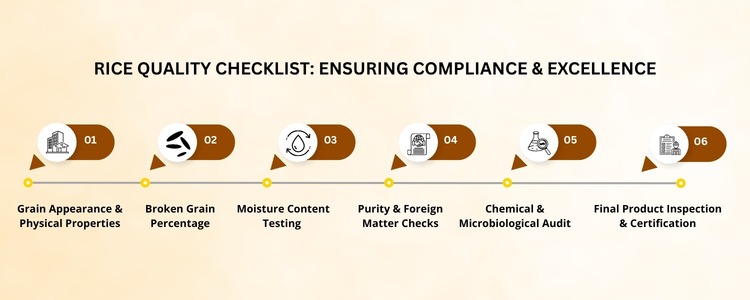
Request a representative sample before confirming a bulk purchase. Examine grain appearance, colour, odour, cleanliness and the proportion of broken grains against the agreed specification.
Depending on the destination market and intended use, additional testing may be required for moisture, contaminants or other food-safety parameters. Independent laboratory testing can provide greater assurance where commercial or regulatory requirements justify it.
For large consignments, agree on pre-shipment inspection procedures before signing the contract. Establish how samples will be collected, which standards will apply and who will pay inspection costs.
The contract should specify acceptable tolerances and the process for handling non-compliant goods. Retaining an approved sample and inspection report provides a useful reference if a dispute arises after delivery.
Buyers should avoid relying solely on sample photographs or verbal assurances. Quality must be assessed against documented criteria that can be checked objectively.
4. Compare Prices and Calculate the Landed Cost
The lowest quotation is not always the most economical choice. Importers need to calculate the full cost of receiving the rice at the destination, including charges that may not appear in the supplier’s initial offer.
A landed-cost assessment should include:
- Product price and packaging.
- Inland transport and export handling.
- Ocean freight and cargo insurance, where applicable.
- Customs duties, taxes and inspection fees.
- Port handling, storage and final delivery.
- Banking charges and currency conversion.
Request itemised quotations and compare offers using the same grade, quantity, packaging and delivery terms. If suppliers quote under Incoterms such as FOB or CIF, clarify the costs and responsibilities covered by each offer.
Agricultural commodity prices can fluctuate with harvest conditions, domestic demand, exchange rates and government policy. Buyers should confirm quotation validity and product availability before arranging payment or shipping.
5. Confirm Export Regulations and Import Documentation
Regulatory checks are especially important when sourcing agricultural commodities. Indian export policy may change in response to domestic supply and food-security priorities, so importers should verify the current position through official government sources before committing to an order.
Confirm whether the specific product can be exported and whether any permissions or conditions apply. Separately, check the destination country’s rules governing rice imports, food safety, labelling and plant-health requirements.
Common commercial shipping documents include the commercial invoice, packing list and bill of lading. Depending on the transaction and destination, buyers may also need a certificate of origin, phytosanitary documentation, inspection certificates or laboratory reports.
Ensure that product descriptions, quantities, weights and consignee details match across all documents. Agree on which party is responsible for obtaining each certificate and when it must be available.
6. Plan Shipping, Storage and Delivery
Rice must be protected from moisture, contamination and physical damage during storage and transportation. Buyers should discuss packaging strength, loading procedures and container suitability with the supplier before dispatch.
Confirm the loading port, destination port, expected transit time, and responsibility for freight and insurance. Allow sufficient time for vessel schedules, customs clearance and onward distribution.
At destination, inspect the shipment and packaging condition promptly. Maintain clean, dry storage conditions and follow appropriate stock-rotation practices. Poor handling can undermine product quality even when the rice met the original specification.
Importers should also consider whether their warehouse capacity and distribution network can accommodate the shipment when it arrives. Planning these details in advance can help avoid unnecessary storage charges and delivery disruptions.
7. Identify Suitable Global Markets and Build Repeat Business
Swarna rice may appeal to markets where buyers prioritise affordable staple foods and consistent bulk availability. However, demand depends on local consumption patterns, competition, tariff structures and the availability of comparable rice varieties.
Importers should assess the destination market before selecting an order volume. Review local pricing, customer preferences, competing suppliers and any restrictions that could affect market entry. Small trial orders may help establish demand before a business commits to larger consignments.
Buyers considering Non Basmati rice export from india should evaluate each variety on its own commercial merits rather than assuming that all non-basmati rice serves the same market.
After delivery, review supplier performance against quality, quantity accuracy, documentation, and shipment timing. Consistent results can support better planning and more predictable repeat orders.
Businesses sourcing premium aromatic varieties may also evaluate Basmati rice suppliers separately, since customer expectations, pricing, and product specifications differ from those for Swarna rice.
1. What is Swarna rice commonly used for?
It is generally used as an everyday staple for household consumption, food service and wholesale distribution, depending on local preferences.
2. What should buyers check before purchasing Swarna rice?
Assess grain specifications, broken percentage, moisture, purity, packaging and suitability for the destination market.
3. How can importers verify an Indian rice exporter?
Review business credentials, export experience, references, sourcing arrangements and quality-control procedures.
4. What determines the landed cost of imported rice?
Product price, packaging, freight, insurance, duties, taxes, inspection and destination handling all affect the final cost.
5. Which documents may be required for rice imports?
Common documents include the invoice, packing list and transport document. Additional certificates depend on current rules and destination requirements.
6. How can importers establish long-term supply relationships?
Use written specifications, review each shipment, communicate forecasts and resolve quality or delivery issues through documented procedures.

Diptanshu
Leading research and marketing at Inductus Global, Diptanshu drives the company’s vision to transcend traditional trading through thought leadership in import-export. He spearheads a research-driven approach that prioritizes quality over price arbitrage, positioning Inductus as a strategic sourcing partner rather than a transactional intermediary. His work spans market intelligence, supply chain innovation, and trade dynamics, while playing a key role in sales and business development.