


Top Pulses Wholesalers in India - How To Get Bulk Pulses From Trusted Suppliers
India’s position in the international marketplace for pulses is advantageous for overseas importers, processors, wholesalers and distributors. The country generates extensive supply chains that accommodate buyers’ needs for food-grade and commercial pulses. The wide range of chickpeas, lentils, pigeon peas, mung beans and other legumes plays a major role in India’s domestic cuisine, as well as its commercial food production.
However, when buying large quantities of pulses, buyers should consider more factors than just price. The commercial grade and seasonal availability, as well as export documentation, are equally important elements of a successful transaction. Addressing these aspects can become complicated, especially for overseas buyers that have never purchased agricultural goods in India.
For those looking to make bulk purchases of pulses, the following guidelines will help select reliable Indian suppliers and understand the commercial aspects of such transactions.
Why India is a Popular Source of Bulk Pulses
India is one of the largest producers and consumers of pulses in the world. The country’s agricultural sector covers extensive growing regions and hosts thousands of processing facilities. These elements contribute to the supply chains of growers, processors, aggregators and trading companies, all of which facilitate the export of India’s domestic crops.
Pulses are a popular source of plant-based protein in the Indian diet and are consumed in various forms, from vegetarian meals to commercial food products. Domestic and overseas buyers have access to a wide range of legumes, including split and whole lentils, chickpeas, pigeon peas, mung beans and others. For many buyers, the variety of pulses available in India is a decisive factor in choosing this country as a supplier.
At the same time, potential buyers should understand that the supply of agricultural goods in India depends on seasonal conditions, local demand and government regulations. Therefore, prior to making a substantial purchase, importers should verify the availability of the desired commodity.
How To Source Bulk Pulses From India
Sourcing bulk pulses from India can be a practical choice for international importers, wholesalers, food manufacturers, and distributors looking for a consistent supply of quality agricultural products at competitive prices. India has a well-established pulse production and trading network, offering a wide range of varieties to meet different international market requirements.
Popular options include chickpeas (Desi and Kabuli), red lentils (Masoor Dal), green gram (Moong Dal), pigeon peas (Toor Dal), and black gram (Urad Dal). Buyers can source these pulses in bulk quantities according to their preferred quality grades, packaging specifications, and delivery requirements. To make the sourcing process easier, buyers should follow these essential steps:
1. Define Your Requirements Before Requesting a Quotation
When requesting a quotation, purchasers should provide suppliers with exact specifications. This will enable the buyers to identify the most competitive offers, which will, in turn, help avoid disagreements after the goods have been shipped.
Prior to submitting a request for proposal (RFP), buyers should determine their requirements. Depending on the applicability of the purchased commodity, the specifications will differ for food-processing companies, distributors, caterers and other types of buyers.
A purchasing request (PR) should state:
- Variety and grade: The variety refers to the type of legume, whereas grade indicates its commercial standard.
- Size and appearance: Define the acceptable color, size, and percentage of damaged seeds.
- Moisture: Specify the level of humidity that is permissible for the given variety.
- Purity: Determine the maximum percentage of foreign matter and damaged seeds.
- Packing: Indicate the bag size and packaging material.
- Order size: Specify the initial order size as well as the frequency of repeat orders.
Additionally, prior to submitting the RFP, buyers should make sure that their requirements are compatible with the destination country’s regulations. Some countries impose strict rules on imported food items. For example, specific legislation may be in place for organic, non-GMO and food-safe commodities.
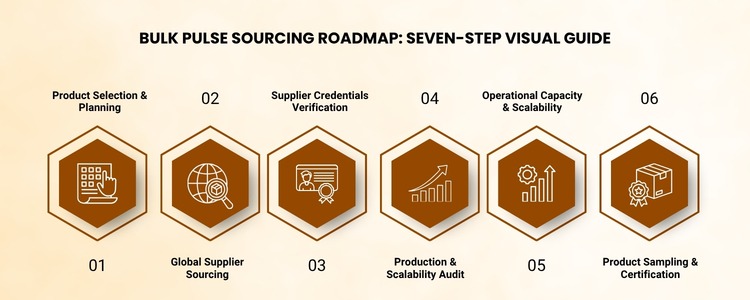
2. Research a Supplier’s Credibility and Trading Experience
Although price is a critical factor in international trade, buyers should examine more parameters when identifying a reliable trading partner. The overseas purchaser should inquire about the supplier’s legal status, experience and references. Additionally, buyers should learn more about the supplier’s transaction process, including its documentation and payment terms.
India hosts numerous trading companies that facilitate the international sale of agricultural goods. Some companies specialize in processing legumes, whereas others act as intermediaries between overseas buyers and domestic growers. Although these firms have different areas of expertise, they all address the needs of international clients. When evaluating a potential supplier, buyers should keep in mind that experience matters.
Experienced pulse wholesalers in India will be able to provide information on their supply chains, specifications, and quality-control procedures. Additionally, it may be a good idea to conduct an on-site inspection, which will help verify the company’s capabilities and adherence to the agreed-upon standards. This is even more important for large-volume buyers that intend to submit substantial orders.
In addition, buyers should request information on markets and documentation requirements from the destination country. A seller’s capability to comply with these aspects should be taken into account as well.
Photos and documentation can help identify potential trading partners, but verifying their credibility is essential, especially if a buyer intends to make a prepayment. In some cases, independent investigations may be necessary for verifying a supplier’s credentials. This step becomes even more critical when a buyer intends to make substantial prepayments.
3. Confirm the Product Specification Through Samples
Before requesting a consignment, buyers should ask for a sample to ensure that the product complies with the given specification. The sample should be examined for appearance, size, color, level of damage, odor and other relevant characteristics. Additionally, buyers may want to take advantage of laboratory testing, which can identify the moisture content, foreign matter, and other characteristics.
The purchase contract should stipulate the agreed-upon specification and inspection instructions. If a buyer intends to make a large purchase, it may be a good idea to hire an independent inspection service.
When discussing sampling procedures, buyers and sellers should reach an agreement on the sampling methodology. In case of a dispute, it should be determined whether a pre-shipment inspection will take place. Finally, a representative sample, as well as the inspection report, should be retained by the buyer as proof of conformity.
These documents may come in handy if a disagreement arises between the trading parties regarding the quality of the given commodity.
4. Compare Pricing and Calculate the Landed Cost
When comparing quotations, buyers should pay attention to the offered price, as well as the payment terms, shipment size and Incoterms. The most competitive price may not always take into account the expenses that a buyer may incur when importing the given commodity. Therefore, it is essential to calculate the landed cost, which represents the total expenditure related to a shipment.
When calculating the landed cost, buyers should consider the following expenditures:
- Commodity price and packing.
- Inland transportation and export procedures.
- Shipping and insurance.
- Customs duties, taxes, inspections, and certifications.
- Port handling, warehousing, and delivery.
- Banking and currency conversion fees.
By comparing several offers, buyers will be able to identify the most competitive option. When assessing quotations, buyers should rely on the following factors: variety, grade, quantity, packing and Incoterms. If multiple suppliers offer different Incoterms, clarify whether the price includes all expenses or not.
Since agricultural commodities are subject to price fluctuations, buyers should make sure that the quotation is valid. It is also a good idea to discuss how the price changes will be addressed if the exchange rate moves against the buyer after the contract has been signed.
5. Confirm Export Documentation and Import Regulations
The documentation requirements may vary depending on the destination country, as well as the given commodity. Prior to making a purchase, overseas buyers should contact the local customs office or an approved customs broker to identify the applicable documentation. Some of the most common documents include the invoice, packing list, and transport document (bill of lading).
Depending on the commodity, buyers may also need to provide the certificate of origin, phytosanitary certificate, inspection certificate, mill test, analytical report, and other documents. Indian pulses suppliers should be able to advise their overseas buyers on documentation requirements. At the same time, the description, weight, and destination should align across all documents.
Buyers should also make sure that the destination country does not prohibit any variety, which may add extra costs associated with certification and inspections. By addressing these concerns, buyers can avoid complications that may arise once the cargo arrives at the destination port.
6. Discuss Packaging, Shipping and Storage Requirements
Pulses should be packed in appropriate material to avoid moisture, foreign matter, pests, and other sources of contamination. In addition, the bag size, as well as the manner in which the bags are sealed, should be discussed with the supplier. The packaging should also be compatible with the shipment duration, as well as the storage conditions at the destination.
It is also advisable to discuss shipping and storage conditions. When making long-distance shipments, buyers should ensure that the containers are dry and clean. Additionally, buyers should clarify who will be responsible for freight and insurance, as well as the loading and discharging ports.
When receiving the shipment, buyers should conduct an inspection to ensure that the packaging and storage conditions are appropriate. The goods should also be stored in a dry, clean warehouse, whereas the rotation of inventory should be controlled to avoid spoilage.
7. Establish a Long-Term Trading Relationship With a Supplier
A successful trading relationship is not established after a single transaction. After receiving the first order, it is a good idea to analyze the product quality and quantity, as well as the correspondence and adherence to the agreed-upon timelines. Buyers of red lentils and green lentils should pay particular attention to the product’s quality and consistency.
Buyers should also provide the seller with demand forecasts, if possible, and identify the lead time, as well as the order frequency. In case of a shortage, having an alternative supplier may be beneficial, especially for buyers that deal in high volumes. A reliable trading relationship should be based on honest and open communication, as well as verifiable product specifications.

1. Why do international buyers source pulses from India?
India has extensive agricultural supply chains and diverse legume varieties, including chickpeas, lentils, pigeon peas, mung beans and others. These factors, along with the country’s competitive pricing, account for the popularity of India as a source of agricultural goods.
2. How can buyers verify an Indian pulse wholesaler?
Buyers should confirm the company’s legal status and trading references, as well as conduct independent research. In addition, buyers should ask for samples and request documentation from the target supplier.
3. What affects the cost of importing pulses?
The price of a given commodity, packing, shipping and insurance, duties and taxes, inspection, and destination handling should be taken into account when estimating the cost of importing pulses.
4. Which documents may be required for pulse imports?
Some of the most common documents include the invoice, packing list, and transport document (bill of lading). Other required documents depend on the commodity, as well as the destination country.
5. How can buyers reduce quality-related disputes?
By stipulating the measurement and specification requirements, as well as utilizing representative sampling and inspection. Disputes can also be avoided when a procedure for handling non-conforming goods is established.
6. How can importers secure consistent bulk supplies?
By sharing demand forecasts and following up on the fulfillment progress, importers can make sure that the ongoing supply of goods is uninterrupted.

Diptanshu
Leading research and marketing at Inductus Global, Diptanshu drives the company’s vision to transcend traditional trading through thought leadership in import-export. He spearheads a research-driven approach that prioritizes quality over price arbitrage, positioning Inductus as a strategic sourcing partner rather than a transactional intermediary. His work spans market intelligence, supply chain innovation, and trade dynamics, while playing a key role in sales and business development.