

Wheat Export from India: A Complete Sourcing Guide for International Buyers
India has a strong agricultural economy that involves numerous grain traders, millers and commercial businesses. For overseas buyers, this creates potential sourcing opportunities for wheat, flour, and other products. However, there are special considerations for purchasing agricultural commodities such as wheat.
Compared to some other goods, wheat export from India can be affected by domestic supply and demand. Government policies on food security and export restrictions may impact the availability of wheat for overseas buyers. As a result, an international buyer must carefully evaluate both suppliers and the wider commercial environment prior to making a commitment.
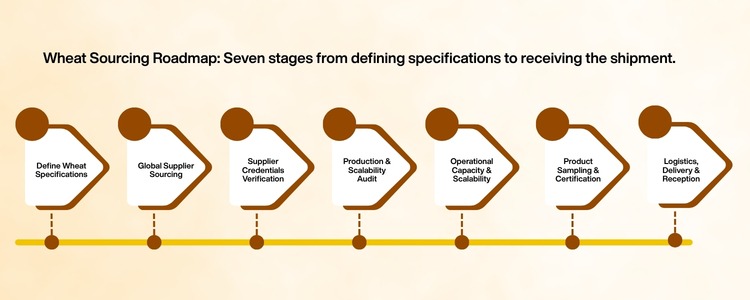
A well-structured sourcing plan enables the importer to make informed decisions, negotiate effectively, and build reliable long-term relationships. Following are seven essential steps to source wheat from India.
Why Buy Wheat from India?
India’s wheat production capabilities and domestic supply chains lend support to its status as a competitive international supplier. This product is used in a variety of commercial applications, including flour, bakery goods, and pasta. The key factors affecting wheat export from India to another country are the specific commercial needs of the buyer, the quality and availability of the product, and current export regulations.
International buyers should consider these factors before identifying an Indian supplier. It is important to understand that just because a seller offers the product for export does not mean that it is available for purchase.
Importers should research the current export situation to ensure that the proposed deal is possible according to local regulations and that the wheat meets the requirements of the destination market.
7 Essential Steps to Source Wheat from India
Sourcing wheat from India requires more than comparing supplier prices. International buyers need to consider wheat quality, supplier reliability, export regulations, and shipping arrangements before placing an order. A clear sourcing process helps avoid unexpected costs and ensures the product meets the buyer’s requirements.
Step 1: Clarify Your Requirements
In order to obtain competitive offers, it is vital to specify the purchase requirements. A detailed list of specifications will help potential suppliers provide relevant quotes and ensure that the expectations match the actual quality of the wheat.
Among the most common buyer requirements are:
- Variety: The type of wheat suitable for the proposed application or end-use
- Moisture: The level of wheat moisture suitable for storage and the proposed application
- Protein content: The desired level or range of protein, if the wheat is to be used for flour, baked goods, or other products
- Test weight and condition: The desired wheat purity, density, and integrity
- Foreign matters and damaged grains: The acceptable proportion of impurities and broken kernels
- Quantity and packaging: Volume, bulk requirements, bag size, or other packaging specifications
Depending on the type of buyer, the requirements will include different specifications. For example, a flour mill will want the wheat to meet certain standards, while a commodity trading company will look at the price and availability. It is therefore necessary to prepare a detailed list of requirements and expectations to help choose the best option among potential suppliers.
Step 2: Identify Reliable Suppliers
A low-price quote does not necessarily indicate a trustworthy supplier. Buyers must ensure that the supplier can actually provide the product and complete the transaction successfully.
To identify such a company, an importer should investigate the business, its reputation, and the quality of its goods. It is important to obtain a copy of the company’s credentials, references, and details of similar previous deals, if available. An importer must also understand how the supplier obtains the wheat: from direct sources or other traders.
A reliable agricultural commodity supplier will be able to provide information and documents that confirm its legitimacy as a business and its capacity to meet the requirements of a potential buyer.
In the case of large deals, it is recommended that buyers complete an independent background check and possibly visit the warehouse to ensure the quality and quantity of the goods. It is also useful to find out if the supplier is able to handle the required documentation in the destination country and provide references from other buyers who have purchased from them.
Step 3: Evaluate Product Quality
The quality of wheat plays a significant role in its commercial application and subsequent resale. Prior to finalising a large purchase, the buyer should obtain a sample of the product and examine its quality characteristics.
Depending on the intended use, it may be necessary to conduct laboratory tests to ensure that the wheat meets the required specifications. This is especially important if the end-user requires a specific type of wheat, flour, or baked goods.
A sample should be compared to the written description provided by the seller. Ideally, the contract should specify tolerances and address the possibility of rejecting the shipment if the product does not meet the specified requirements.
It is advisable for large-scale wheat buyers to hire an independent third party to conduct a pre-shipment inspection. An inspection plan should outline the parties’ responsibilities and include instructions for taking samples. It is also necessary to clarify who will bear the costs and at what point the inspection can be carried out.
Prior to the arrival of the wheat cargo, the buyer should retain the approved sample, a copy of the inspection report (if available), and a contract with specifications to address any quality concerns.
Step 4: Determine Export Readiness & Destination Requirements
When buying agricultural goods, the ability to export the product should be investigated early in the sourcing process.
Indian wheat export regulations can fluctuate depending on the prevailing market situation and food security needs. Before finalising the deal, the buyer should consult official resources or a trade advisor to confirm the current conditions and any special restrictions.
This is an essential step, and it is advisable to double-check the information against multiple sources. Buyers should determine whether it is possible to export the specified wheat product, what special permissions (if any) are required, and whether the proposed shipment schedule is realistic.
When buying wheat from India, it is important to understand the documentary and customs requirements of the destination country, as well as any additional entry requirements. Among the most common documentation requirements are phytosanitary inspection, food safety, and fumigation. The documents normally required for commercial shipments of wheat also include the invoice, packing list, and bill of lading.
Depending on the type of product, shipment, and the laws of the country of destination, additional documents and certificates may be required. It is essential to agree with the seller on which documents will be provided by whom and ensure that all accompanying papers contain identical descriptions and quantities.
Step 5: Compare Offers & Land Cost
When selecting a supplier, the lowest price is not necessarily the most attractive option. The main advantage of a particular supplier will depend on the total cost of importing the goods, also known as the landed cost.
In order to determine the most cost-effective option, it is necessary to obtain itemised quotes from potential suppliers and compare them.
Wheat quotes in India can vary depending on the variety, quality, and season. If the supplier specifies the price per metric ton, it is important to clarify whether this price includes costs associated with transport and documentation. If the Incoterms (i.e. FOB, CIF) are specified, it is necessary to understand what they entail in terms of costs and liabilities.
Suppliers may indicate the cost of shipping, insurance, and other expenses. However, it is also necessary to take into account port costs, duties, taxes, and other expenses associated with importing goods into the destination country.
For each supplier, the total cost of shipment, documentation, and duties must be compared in order to select the most attractive option. It is also useful to ask the supplier if they are willing to provide a quote for the entire wheat shipment at once or in smaller batches.
Wheat prices depend on the harvest, which means that prices may change between the time the deal is agreed and the time the wheat is actually shipped.
Importers must determine how long a given price quote will be valid and whether the supplier will be able to reserve a certain amount of wheat for the prospective buyer.
Step 6: Coordinate Storage & Shipment Logistics
Wheat requires appropriate storage and transportation conditions to avoid quality loss. In order to prevent spoilage during transit, it is vital to take measures to exclude the risk of insect infestation and moisture damage.
The buyer should discuss storage conditions, loading and unloading, and packaging with the supplier. For bulk wheat shipments, it is important to clarify the loading and unloading plan, transport vessel size, and approximate delivery time.
The importer must also specify the loading and destination ports, the party responsible for freight costs, and the insurance policy.
It is advisable to allow enough time for shipping and customs inspections. The buyer should ensure that all necessary export permits and documents are in place to avoid unexpected delays.
Prior to delivery, the buyer should inspect the cargo and packaging to ensure that they are undamaged. Upon arrival of the wheat shipment, it should be stored in appropriate conditions. If discrepancies are found, the claim must be submitted in accordance with the terms of the contract.
Step 7: Establish Long-Term Relationships
The first transaction is a trial for both the supplier and the buyer. In order to ensure stable quality, quantity, and timely delivery in the future, it is essential to build long-term relationships based on loyalty and transparency.
Following the transaction, the buyer should assess product quality, quantity, delivery time, documents, and overall cooperation. Any issues that arose should be discussed with the supplier to ensure that they will not recur in future deals. In the future, it will be necessary to provide feedback on the quality of the wheat received.
When looking for new potential suppliers, it is advisable to examine their ability to provide consistent quality and stable supply. This is especially important for buyers with seasonal needs, as well as those operating in a competitive environment where prices are of utmost importance.
It is also worth considering partnership opportunities with more than one supplier, provided that the budget allows for it. This will allow the buyer to obtain more attractive offers while reducing the risks associated with a single supplier.
1. Can international buyers currently import wheat from India?
Export eligibility depends on the current Indian government policy and any applicable conditions. Before making an order, it is vital to confirm the regulations.
2. How can importers verify an Indian wheat supplier?
An importer may want to review the company’s credentials, export experience, resource base, and references. For large deals, it is advisable to conduct a third-party investigation.
3. Should buyers test samples before purchasing?
Yes, they should. Samples and, if necessary, laboratory tests will confirm that the supplier’s wheat meets the specified requirements.
4. Which documents may be required?
In addition to the invoice and packing list, transport documents may be required. Specific certificates depend on current regulations and the entry requirements of the country of destination.
5. How can buyers reduce shipment delays?
Before finalising the deal, it is essential to confirm export eligibility, documents, and schedules.
6. What affects the total import cost?
The product cost, as well as transport, freight, insurance, duties, taxes, and documentation, should be taken into account.

Diptanshu
Leading research and marketing at Inductus Global, Diptanshu drives the company’s vision to transcend traditional trading through thought leadership in import-export. He spearheads a research-driven approach that prioritizes quality over price arbitrage, positioning Inductus as a strategic sourcing partner rather than a transactional intermediary. His work spans market intelligence, supply chain innovation, and trade dynamics, while playing a key role in sales and business development.