

How to Import Parboiled Rice from India: 7 Steps Every Buyer Should Know
India has established itself as a major supplier of rice to international markets, with parboiled rice serving buyers across Africa, the Middle East and other regions. For importers, wholesalers and food distributors, the Indian market offers access to commercial volumes, established milling infrastructure and a range of product specifications.
However, successful sourcing requires more than comparing quotations. Buyers must assess grain quality, verify supplier credentials, understand import regulations, and calculate the full cost of delivery. A competitive price can quickly lose its appeal if the shipment fails inspection or arrives later than expected.
For international businesses, a structured purchasing process reduces these risks. The following seven steps explain how to import parboiled rice from India while maintaining control over quality, costs, and delivery.
1. Understand Your Market and Select the Right Rice
Before approaching exporters, identify the specifications your customers expect. Parboiled rice undergoes soaking, steaming and drying before milling. This process changes the grain’s physical characteristics and helps retain certain nutrients during milling.
The appropriate specification depends on the destination market and intended use. Importers supplying retail outlets may require consistent grain appearance and packaging, while institutional buyers often prioritise price, cooking performance and dependable volume.
Consider these factors before requesting quotations:
- Rice variety: Select a variety suited to your customers and local market preferences.
- Broken percentage: Commercial grades may include different broken-grain proportions, depending on availability and buyer requirements.
- Moisture content: Agree on acceptable limits to support safe storage and minimise quality deterioration.
- Grain colour and appearance: Establish expectations for colour, foreign matter and overall consistency.
- Packaging: Choose suitable bag sizes and materials for transport, storage and distribution.
Put these requirements into a written product specification. It gives suppliers a clear basis for quoting and makes competing offers easier to compare.
2. Research and Verify Indian Rice Exporters
Supplier selection is among the most important decisions in an international rice transaction. An attractive quotation does not necessarily indicate that a company has the capacity, experience or financial stability to fulfil an order.
Start by examining the exporter’s business history, product range, processing arrangements and experience serving your destination market. Ask for company registration details, export-related documentation and references where available.
Review the supplier’s ability to handle the required order volume and maintain consistent specifications across shipments. If possible, arrange a factory visit or use an independent inspection service to assess the facilities.
Experienced Parboiled Rice Exporters should be able to explain their quality-control procedures, production capacity, packaging options and shipment timelines without making unsupported promises.
Buyers should also establish who is responsible for inspection, loading supervision and resolving quality disputes. These responsibilities should be recorded in the contract rather than left to informal discussions.
3. Request Samples and Check Product Quality
A sample provides an initial indication of whether the product matches your requirements, but it should not be treated as a guarantee of shipment quality.
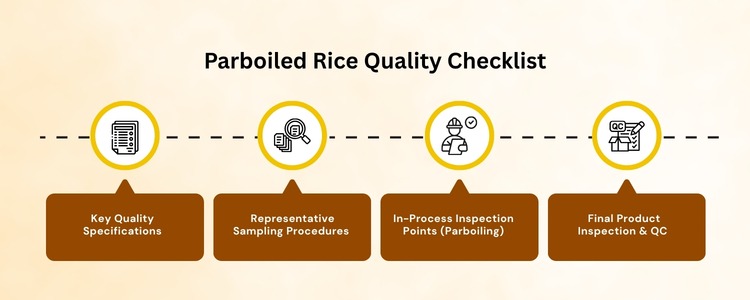
Request a representative sample before committing to a large order. Assess grain uniformity, colour, odour, visible impurities and other characteristics relevant to the agreed specification. Where necessary, arrange laboratory testing through a qualified independent facility.
Testing requirements may cover moisture, broken grains, foreign matter and food-safety parameters. The exact tests should reflect destination-country regulations and the terms agreed with the exporter.
For larger consignments, consider pre-shipment inspection and specify how samples will be collected. A contract can establish acceptable tolerances, inspection procedures and the action to take if results fall outside the agreed limits.
Buyers should also confirm whether the supplier can maintain the approved specification throughout repeat orders. Consistency matters particularly for distributors selling under their own brand or supplying institutional customers.
4. Compare Quotations and Calculate the Landed Cost
The lowest quoted price is not always the most economical option. International buyers should compare offers using the same product specification, quantity, packaging and delivery terms.
Request a detailed quotation covering the rice price, packing costs, inland transport, export handling and other applicable charges. Clarify whether the quotation covers delivery to the destination port or another agreed location.
Your landed-cost calculation should account for:
- Product value and packaging.
- Inland transportation and port handling.
- Ocean freight and cargo insurance, where applicable.
- Customs duties, taxes and inspection fees.
- Destination handling, storage and local delivery.
- Banking charges and currency-conversion costs.
Compare quotations under clearly defined Incoterms, such as FOB or CIF, where appropriate. These terms allocate specific costs and responsibilities between buyer and seller; they should not be treated as interchangeable pricing labels.
Also review quotation validity, payment milestones and the consequences of shipment delays. A slightly higher offer may represent better value if it includes clearer specifications, reliable scheduling and stronger quality controls.
5. Confirm Import Regulations and Export Documentation
Documentation requirements vary by destination country, so buyers should check the rules with their customs broker or relevant authorities before placing an order.
Common documents in rice export transactions include the commercial invoice, packing list, bill of lading and certificate of origin, where required. Depending on the destination and transaction, authorities may also require phytosanitary documentation, inspection certificates or other food-safety records.
Indian exporters must meet the applicable export requirements, while importers remain responsible for understanding the rules governing entry into their own markets. Product eligibility, labelling, packaging and food-import permits can differ considerably between countries.
Buyers sourcing through an IR 64 Parboiled Rice Supplier should confirm that the precise variety and specification are acceptable in the destination market before finalising the contract.
Ensure that names, quantities, weights, product descriptions and shipment details match across documents. Errors can create customs delays, additional charges or problems with payment processing.
6. Agree on Payment Terms, Shipping and Delivery
Payment arrangements should balance the buyer’s need for security with the exporter’s commercial requirements. Depending on the relationship and transaction size, options may include advance payment, documentary credit or other mutually agreed banking arrangements.
New buyers should conduct appropriate due diligence before transferring funds. Verify bank details through an established communication channel, particularly if payment instructions change unexpectedly.
Next, agree on the shipment schedule, loading port, destination port and responsibility for freight and insurance. Confirm container suitability, cargo protection and the loading process. Rice must be protected from moisture, contamination and unsuitable storage conditions during transit.
Buyers should also account for vessel schedules, port congestion, customs clearance and possible delays at destination. Allowing reasonable time between the expected arrival date and onward distribution commitments can reduce commercial disruption.
7. Inspect the Shipment and Build a Long-Term Relationship
The purchasing process does not end when the vessel departs. Maintain a complete record of the order, including the approved sample, contract, inspection reports, shipping documents and supplier communications.
When the shipment arrives, check the quantity, packaging condition and documentation. If a discrepancy appears, document it promptly with photographs, inspection findings and relevant records, then follow the claim procedure specified in the contract.
Once the order is completed, evaluate the supplier against measurable criteria: specification compliance, delivery performance, communication, documentation accuracy and response to problems.
Importers purchasing from non-Basmati rice exporters may find that a long-term relationship helps improve order planning, price discussions and production scheduling. Nevertheless, repeat business should remain subject to regular quality checks and commercial review.
A dependable supplier is one that delivers consistently, communicates clearly and addresses problems professionally—not simply one that offers the lowest initial price.

1. Is India a suitable source for parboiled rice imports?
India offers established rice-processing and export infrastructure, but suitability depends on the destination market’s import rules, required specifications and supplier availability.
2. Can importers order parboiled rice in bulk?
Yes. Order quantities depend on supplier capacity, packaging requirements, shipping arrangements and the buyer’s commercial needs.
3. Which documents are required to import parboiled rice?
Common documents include the commercial invoice, packing list and bill of lading. Certificates and permits depend on the destination country’s regulations and the specific shipment.
4. How can buyers verify rice quality before shipment?
Request representative samples, agree on written specifications and consider independent laboratory testing or pre-shipment inspection.
5. What determines the final import cost?
Product price, packaging, freight, insurance, duties, taxes, handling fees, inspection costs and inland transportation can all affect the landed cost.
6. How can importers reduce shipment delays?
Confirm import permits and documentation requirements early, check document consistency, book shipping in advance and maintain regular communication with the exporter and customs broker.

Diptanshu
Leading research and marketing at Inductus Global, Diptanshu drives the company’s vision to transcend traditional trading through thought leadership in import-export. He spearheads a research-driven approach that prioritizes quality over price arbitrage, positioning Inductus as a strategic sourcing partner rather than a transactional intermediary. His work spans market intelligence, supply chain innovation, and trade dynamics, while playing a key role in sales and business development.