

How to Import Non-Basmati Rice from India: Complete Guide for Global Buyers
Non-Basmati Rice: India's Everyday Grain With an Outsized Export Role
Ask most international buyers what India exports, and basmati’s aroma and restaurant-menu fame usually come to mind first. But behind that fragrant, premium image sits a far larger, quieter export category: non-basmati rice, the everyday medium and long-grain varieties like IR64, Sona Masoori, and Ponni that feed households from West Africa to Southeast Asia.
Much of that volume traces back to IR64 itself, released by the International Rice Research Institute in the Philippines in 1985 and subsequently adopted across India for its high yield, disease resistance, and reliable cooking quality. Decades later, with India’s non-basmati export restrictions now fully lifted, the strategic push is to re-establish the country as global bulk buyers’ default, most dependable non-basmati source.
How Indian Non-Basmati Exporters Are Winning Buyers Back
For nearly 14 months, global buyers didn’t have India as an option at all. On July 20, 2023, the Indian government banned non-basmati white rice exports to protect domestic supply, exempting only shipments to a handful of friendly nations. Buyers who had depended on Indian IR64 and Sona Masoori had little choice but to build new sourcing relationships with Thailand, Vietnam, and Pakistan, and global rice prices spiked to their highest level in more than 15 years as a result, according to industry body USA Rice.
That friction is now resolving fast. India began easing restrictions on September 28, 2024, replacing the ban with a $490-per-tonne minimum export price, then removed that floor price entirely on October 20, 2024, alongside eliminating export duties on parboiled, husked, and paddy rice. By March 2025, even the broken-rice export ban dating back to 2022 had been lifted.
Specialized exporters milling IR64 and parboiled rice across Punjab, Haryana, and Chhattisgarh, alongside Sona Masoori from Telangana and Andhra Pradesh and Ponni from Tamil Nadu, are now shipping through Chennai, Tuticorin, Kandla, and Mundra to rebuild the buyer relationships lost during the restriction period.
Mordor Intelligence’s Rice Market report values the global rice market at $372.3 billion in 2026, projecting growth to $505.32 billion by 2031 — a scale of demand India’s non-basmati rice exporters are now free to compete for again. Inductus Global’s own trade conversations with African and Southeast Asian wholesale buyers reflect the same shift, with renewed inquiries for Indian supply now that restrictions have fully cleared. Backing that ambition nationally, India’s Ministry of Commerce has set a $100 billion agricultural export target for 2030, with non-basmati rice — anchored by roughly 152 million tonnes of annual national rice output — positioned as a core volume driver.
| Parameter | India | Thailand | Vietnam | Pakistan |
|---|---|---|---|---|
| Cost of Operations (FOB) | White rice near $350–354/ton; IR64 parboiled around $466/MT | Prices pressured near $410/ton by a strong baht | Competitive at around $360–367/ton | Comparable at around $365–369/ton |
| Policy Stability | Trade policy fully normalized as of October 2024, following earlier export restrictions | Relatively stable, but currency pressures affect competitiveness | Stable export environment | Gained market share during India’s export restrictions |
| Export Volume & Reliability | Around 152M tonnes national rice output; non-basmati accounts for a significant share of rice export value | 2026 export target reduced 11% to 7.03M tons | 1.3M tonnes exported in Jan–Feb 2026, up around 5% YoY | Smaller export volumes but expanded during India’s absence |
| Buyer Base / Key Markets | Bangladesh, Nigeria, Kenya, Middle East, Indonesia, Senegal and Guinea | Africa, Middle East and Asia | Philippines (47.6% share), China and Ghana | African markets and other destinations competing directly with India |
| Infrastructure Maturity | Major ports including Chennai, Tuticorin, Kandla and Mundra, providing dual-coast access | Bangkok-centric logistics network | Strong Mekong Delta logistics network | Karachi-centric export infrastructure |
| Government Incentives | $100B agri-export target by 2030 and increasingly liberalized trade policy | Currency headwinds can reduce export competitiveness | Regional trade agreements support market access | Export-focused policies, but comparatively less institutional support |
India as Leading Destination for Non-Basmati Rice Imports
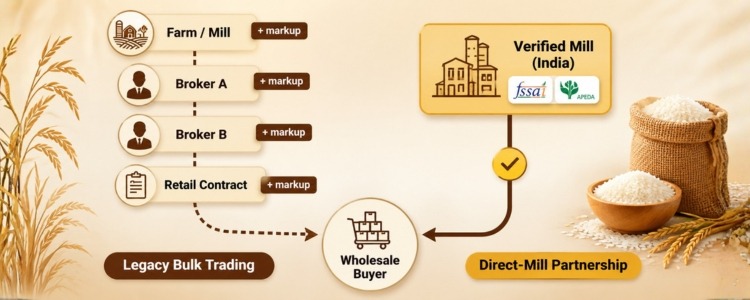
Verified bulk-grain sourcing is fundamentally different from ad hoc spot-market purchasing. Rather than buying whatever lot is available at the moment of need, a verified sourcing relationship ties every shipment to a specific mill and a documented specification — typically around 99.9% purity and under 14% moisture content for parboiled IR64 — giving buyers consistency shipment after shipment rather than quality that varies by trader.
The scale of what was disrupted, and is now reopening, is significant. Industry body USA Rice noted that global rice prices soared to 15-year highs following India’s 2023 export ban, even though India’s own government godowns held tens of millions of tonnes in reserve stock at the time. With that restriction now fully lifted and India’s roughly 152 million tonnes of annual rice production anchoring global supply, the country’s non-basmati Rice exporters have a clear task ahead: converting renewed international attention back into long-term buyer contracts, particularly in African and Southeast Asian markets that spent the past two years diversifying elsewhere out of necessity.
India's Non-Basmati Belt as Center of Scale & Reliability
Geographic Factors
India’s non-basmati rice geography spans Punjab, Haryana, and Chhattisgarh for IR64 and parboiled varieties, Telangana and Andhra Pradesh for Sona Masoori, and Tamil Nadu for Ponni. That spread gives exporters dual-coast port access — Chennai and Tuticorin serving Southeast Asian and Middle Eastern routes, Kandla and Mundra serving African and Gulf-bound shipments — a logistics flexibility few competing origins can match.
Talented Youth
India’s non-basmati rice belt has increasingly turned to flood-tolerant, high-yield hybrid varieties bred for resilience, building on submergence-tolerance breeding work such as the SUB1 gene identified in 2006 and since used to develop varieties like Swarna Sub1. Younger farming families in these regions are adopting these hardier cultivars alongside better market access, giving them a stronger reason to stay in rice cultivation rather than migrate toward city jobs.
Qualified Professionals
India’s rice research network, anchored by the Indian Council of Agricultural Research (ICAR) and its affiliated institutes, has spent decades adapting internationally bred varieties like IR64 for Indian soil and climate conditions, alongside developing indigenous ones like Sona Masoori. That institutional breeding work, not generic farming practice, is what allows exporters to guarantee consistent grain type and cooking quality at export scale.
Innovation First Strategy
Institutional infrastructure has caught up with the trade’s renewed openness. APEDA now maintains exporter databases and monthly rice trade dashboards that give both regulators and buyers greater visibility into shipment volumes and exporter track records. Paired with the full removal of export duties and floor pricing by late 2024, that transparency push reflects a broader effort to make India’s non-basmati trade easier — and more trustworthy — for global buyers to re-engage with.
Conclusion
India’s non-basmati exporters aren’t trying to compete on aroma or premium branding the way basmati or Thai jasmine rice do — that was never the pitch. The differentiated case is scale, price competitiveness, and now, policy stability: a high-volume, dependable grain supply for buyers who need consistent tonnage more than exotic positioning.
The comparison to a maturing, reopened trade relationship isn’t marketing gloss — it’s a trajectory backed by real policy moves. The export ban lifted in September 2024, the floor price and parboiled-rice duties disappeared entirely by October 2024, the broken-rice ban followed in March 2025, and roughly 152 million tonnes of national output stand behind a $100 billion agricultural export target for 2030.
Whether India fully recaptures the buyer relationships built elsewhere during its 14-month absence from the market remains to be seen, but for buyers weighing a reliable, verified non-basmati rice supplier over the alternatives they turned to during the disruption, the direction of travel is no longer in question.

Diptanshu
Leading research and marketing at Inductus Global, Diptanshu drives the company’s vision to transcend traditional trading through thought leadership in import-export. He spearheads a research-driven approach that prioritizes quality over price arbitrage, positioning Inductus as a strategic sourcing partner rather than a transactional intermediary. His work spans market intelligence, supply chain innovation, and trade dynamics, while playing a key role in sales and business development.






2 Replies to “How to Import Non-Basmati Rice from India: Complete Guide for Global Buyers”
Best Red Chilli Exporters in India for Bulk Imports | USA, UK & UAE
07 Sep 2026[…] much of 2023 and 2024, UAE and wider Gulf buyers had good reason to hedge. India banned non-basmati white rice exports outright in July 2023 and layered a 20% export duty onto parboiled rice the following month, both […]
IR 64 Parboiled Rice Export from India to UAE: Import Guide
09 Sep 2026[…] much of 2023 and 2024, UAE and wider Gulf buyers had good reason to hedge. India banned non-basmati white rice exports outright in July 2023 and layered a 20% export duty onto parboiled rice the following month, both […]