

Indian Cloves Exporters: A Complete Guide for Global Importers
Kerala: Backwaters, Houseboats, and a 500-Year-Old Trade Secret
Ask most people what Kerala is known for and the answer arrives quickly: palm-fringed backwaters, houseboats drifting through Alappuzha’s canals, Ayurvedic retreats, and tea gardens rolling down the Western Ghats. It is the postcard version of “God’s Own Country,” and it sells millions of tourism dollars a year on that image alone.
But behind that postcard, the same coastline has spent nearly four decades quietly building a second identity. On 26 February 1987, the Government of India constituted the Spices Board under the Spices Board Act, 1986, headquartered in Kochi.
This city has functioned as one of the world’s principal spice-trading ports since long before it became a houseboat destination. The Board’s mandate: regulate, certify, and promote the international export of 52 scheduled spices, including cloves, through a network of testing laboratories that make quality verification mandatory rather than optional.
Today, that regulatory infrastructure is being redirected toward a specific and unglamorous mission, turning India into the world’s most audited, most traceable address for graded and blended cloves, regardless of where the raw pods were actually grown.
How India Becomes the New & Upgraded Clove Hotspot
For centuries, international buyers looking to secure cloves have defaulted to going straight to the source: Indonesia, Madagascar, or Zanzibar (part of Tanzania). That instinct still makes sense at first glance — these three origins account for the overwhelming majority of global clove production. But sourcing directly from origin has become a harder proposition than it used to be, and the friction is structural, not incidental.
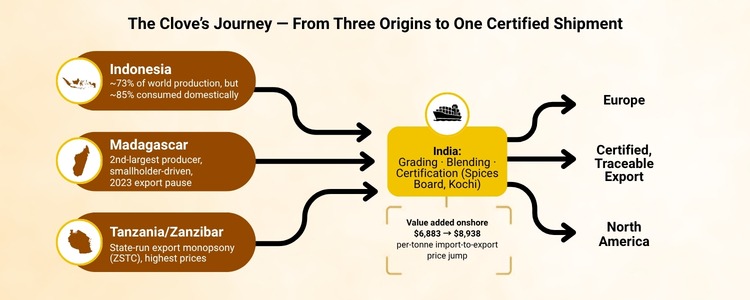
Indonesia produces more cloves than anywhere else on earth by a wide margin, but the bulk of that harvest never reaches export markets — it is absorbed domestically by the country’s kretek clove-cigarette industry, leaving exporters with a comparatively thin and unpredictable surplus in any given year. Madagascar, the second-largest producer, is a smallholder-driven industry vulnerable to weather swings and abrupt regulatory intervention; in late 2023 the country was compelled to pause clove exports altogether while certification compliance was reviewed.
Zanzibar, once the undisputed capital of the world clove trade, now operates under a state-run export monopsony that gives farmers and buyers little room to negotiate outside the official channel — a structure that keeps Zanzibar cloves among the most expensive in the world despite the islands producing a fraction of what they once did.
Into that gap steps India — not as a grower, but as a certifier and aggregator. Kochi’s port infrastructure and Spices Board laboratory network allow Indian trading houses to import raw cloves from Indonesia, Madagascar, and Tanzania, grade and blend them against Indian food-safety and quality standards, and re-export a consistent, documented product.
A 2026 India clove market analysis from trade-data provider IndexBox notes that India’s domestic clove supply is almost entirely import-dependent, and that the gap between India’s average import price and its average export price per tonne in 2024 reflects the country’s growing role in value-added processing and re-export rather than raw production.
Inductus Global’s own sourcing desk has observed a parallel shift in buyer behavior over the past two export cycles: a rising share of inbound inquiries now specifically request Spices-Board-certified, blended-origin consignments rather than single-origin shipments — a preference the company attributes to tightening food-safety scrutiny among importing-country regulators.
India’s ambition here is stated in hard numbers. The World Spice Organisation, the technical partner to India’s spice-exporter community, has set a target of $10 billion in Indian spice exports by 2030, up from roughly $4 billion when the target was announced — and to hit it, the Spices Board estimates India’s share of value-added spice exports needs to climb to around 70%. Cloves, a spice India barely grows, are a direct test case for whether that value-added strategy can work.
| Parameter | India | Indonesia | Madagascar | Tanzania (Zanzibar) |
|---|---|---|---|---|
| Cost of Operations | Higher landed cost due to imported raw material and re-export of finished products | Lowest at origin, but limited exportable surplus | Competitive at source, but costs can be volatile | Elevated due to monopsony pricing |
| Raw Material Base | No significant domestic buffer; largely import-reliant | Dominant crop base, accounting for approximately 70–73% of global output | Second-largest producer; highly dependent on smallholder farming | Small and declining production base |
| Quality Control Infrastructure | Mandatory Spices Board laboratory certification network | Strong domestic grading; export-focused quality control is still developing | Certification gaps highlighted during the 2023 export pause | Primarily state-run ZSTC grading system |
| Trade Predictability | Multi-origin sourcing and blending can help reduce single-origin supply shocks | Approximately 85% of production is consumed domestically by the kretek cigarette industry | Vulnerable to sudden export restrictions | Limited free-market access for exports |
| Infrastructure Maturity | 8 dedicated Spice Parks; Kochi headquarters and 6 regional laboratories | Mature production infrastructure, but comparatively thinner export logistics | Limited processing and testing infrastructure | Legacy trading system with relatively low modernization |
| Government Policy Stance | SPICED scheme and a long-term target of expanding spice exports | Policy emphasis remains strongly focused on domestic demand | Reactive, compliance-driven regulatory approach | State-controlled monopsony through ZSTC |
India as Leading Destination for Certified Spice Trading
Value-added re-export is not the same as traditional commodity exporting. A traditional exporter sells what its own farmers grow. A value-added re-export hub — the model India is building for cloves — imports raw material from multiple origins, subjects it to standardized grading, blending, and safety testing, and exports a product that carries the exporting country’s certification rather than the grower’s. It is a trading and quality assurance function, not an agricultural one.
India’s ambitions for this model were laid out explicitly at the 14th World Spice Congress in Navi Mumbai in September 2023, held under the theme “Vision 2030: Sustainability, Productivity, Innovation, Collaboration, Excellence, and Safety.” Union Minister of Commerce and Industry Piyush Goyal used the platform to set the sector’s $10 billion export target for 2030, framing India’s roughly 3.5 crore-strong diaspora as informal brand ambassadors for the category.
The scale of the underlying ambition is significant: Indian spice exports hit a record $4.72 billion in FY 2024-25, and the sector’s exports are projected to grow at a compound annual rate above 10% through 2033, according to industry trade data compiled by the Spices Board.
Cloves sit inside that national push as an unusually honest test case — precisely because India cannot lean on raw production scale to win the category. Its opportunity is narrower and more specific: prove that certification, blending discipline, and traceability alone are enough to make an import-dependent country a buyer’s first call.
India as Center of Certified Spice Trade & Re-Export Innovation
Geographic Factors. Kochi sits on one of the Indian Ocean’s oldest trade crossroads, historically linking the Malabar Coast to Arab, and later European spice markets since well before Vasco da Gama’s arrival at nearby Kozhikode in 1498. That geography still works in India’s favor: Kochi and India’s other spice-handling ports (with regional Spices Board labs in Mumbai, Chennai, Delhi, Tuticorin, Kandla, and Guntur) sit roughly equidistant between the three major clove-origin countries — Indonesia to the east, Madagascar and Tanzania to the west — and the largest demand centers in the Gulf, Europe, and North America, making India a natural midpoint for aggregation rather than a detour.
Talented Youth. Kerala carries one of India’s highest literacy rates and has historically exported its skilled labor abroad — generations of Malayali professionals built careers in the Gulf rather than at home. That outward pattern is now partially reversing in the trade-compliance space specifically: as India’s export-certification apparatus has grown more technical, a younger cohort of food-safety, quality-assurance, and commodity-trading professionals is building careers inside the domestic spice sector rather than leaving it.
Qualified Professionals. This shift is backed by specialized, not generic, institutions. The Indian Institute of Spices Research in Kozhikode and the Indian Cardamom Research Institute conduct the underlying agronomic and post-harvest science, while the Spices Board’s own laboratory network trains exporters directly in good hygienic and manufacturing practice standards required for international compliance — the specific skill set a blending-and-certification hub depends on.
Innovation First Strategy. The clearest institutional signal is the Spices Board’s SPICED scheme — Sustainability in Spice Sector through Progressive, Innovative and Collaborative Interventions for Export Development — rolled out to modernize post-harvest quality and expand value-added export capacity through the remainder of the current Finance Commission cycle. It operates alongside eight dedicated, crop-specific Spices Parks that give even small exporters shared access to cleaning, grading, and packaging infrastructure they could not otherwise afford to build alone.
Conclusion
India is not trying to out-produce Indonesia, out-price Zanzibar, or claim a clove heritage it does not have. Nearly all of the clove that leaves an Indian port arrived first as an import from somewhere else — that fact isn’t hidden, and pretending otherwise would undercut the entire pitch.
What India is actually offering is narrower and, for many buyers, more useful: a single, audited port of call that absorbs the compliance risk of managing three separate origin countries — each with its own harvest calendar, quality variance, and political exposure — and hands back one certified, traceable, blended product. That is not marketing gloss laid over a familiar reason to buy; it is a trajectory built on specific infrastructure choices made over nearly forty years.
The proof points are concrete: a Spices Board laboratory network that makes export certification mandatory rather than voluntary; eight dedicated Spice Parks giving smaller exporters shared-cost access to grading and packaging infrastructure; a formally stated $10 billion export target for 2030 with an explicit 70% value-added-share ambition attached to it; and a widening gap between India’s average import and export prices per tonne — hard evidence that value is genuinely being added onshore, not just claimed.
Whether the 2030 target and its value-added share are actually hit remains to be seen. But the direction of travel — toward certification, blending discipline, and buyer trust as the basis of competition — is not in question.

Diptanshu
Leading research and marketing at Inductus Global, Diptanshu drives the company’s vision to transcend traditional trading through thought leadership in import-export. He spearheads a research-driven approach that prioritizes quality over price arbitrage, positioning Inductus as a strategic sourcing partner rather than a transactional intermediary. His work spans market intelligence, supply chain innovation, and trade dynamics, while playing a key role in sales and business development.