

Maize Export from India: International Buyer’s Guide
India has established itself as a viable market for sourcing agricultural produce, including maize. However, the buying process for agricultural commodities is more complex than it may appear at first glance. Although the country is an exporter of maize, there are a number of considerations that international buyers must take into account when purchasing the grain.
A well-structured sourcing plan will enable the buyer to obtain the best price, optimise the total cost of ownership and avoid any quality-related disputes that could damage the relationship with the supplier.
Understanding Maize Supply From India
Maize is produced in various Indian states and is available from a number of sources. This can be beneficial to international buyers since it allows them to source the grain from multiple points of origin.
Depending on where the maize is grown, the grain can be of a different quality, variety, and moisture level. The buyer should specify their requirements, including the intended use of the maize, to ensure that the product that they receive corresponds to their quality expectations. The quality of maize can vary significantly depending on the type of grain, so it is better to define precise requirements rather than use general terms, such as premium quality maize.
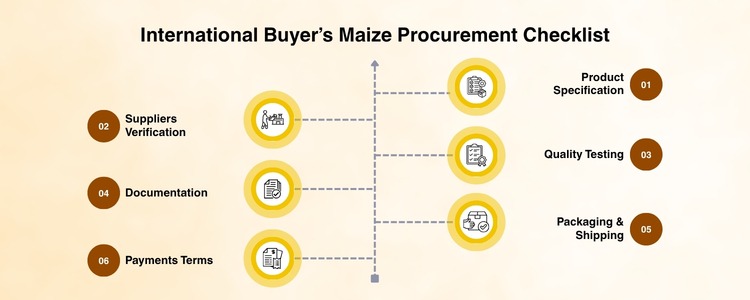
What International Buyers Should Specify
When defining specifications for the purchase of maize, international buyers should provide as much detail as possible. Some of the key elements
they should include are as follows:
Maize variety, grain colour
Moisture percentage
Broken kernels
Foreign matter
Damaged grains
Pest infestation
Aflatoxin content
Crop year
Packaging
Size of the order, delivery schedule
For the purpose of food or animal feed, it is important to ensure that the grain is suitable for the intended use and complies with any relevant safety regulations in the buyer’s country. By specifying their requirements, the international buyer will be able to obtain competitive prices and minimise the risk of a dispute over quality when the maize arrives at the destination port.
Selecting Reliable Suppliers in India
Asking the right questions during the initial stages of the sourcing process is critical to ensuring a reliable supply of quality maize. International buyers should obtain sufficient information about the background of the supplier and their ability to deliver the product on a consistent basis. This will reduce the risk of receiving poor-quality maize or being unable to receive the full order due to the supplier’s inability to provide the grain at the required scale.
Maize Exporters In India can be manufacturers, independent traders, processors, or exporters. Therefore, the capabilities of different suppliers can vary significantly. It is advisable for the international buyer to request relevant documents, such as the company’s profile, the product description, past and current inventory, and references from previous clients, if available. In particular, it is important to obtain sufficient information about the source of the maize and the extent of the supplier’s involvement in the production process.
A reliable supplier will be able to provide the necessary documentation confirming the quality of the goods and the right to export them. When selecting a supplier, international buyers should also consider the terms of the deal, the payment method and the likelihood of future cooperation. If the supplier buys maize from different partners, this may indicate that the company cannot guarantee the quality of the goods.
Pre-shipment Inspection of Maize in India
An independent inspection of the maize before shipment can be an important measure to ensure the quality of the goods. The surveyor checks whether the maize quality meets the specified requirements. The sampling procedure should be appropriate to the size of the order, as incorrect sampling can provide misleading results. In addition, laboratory analysis of the samples can verify the key indicators, such as the level of moisture.
For larger orders, international buyers may want to include the option of a pre-shipment inspection in the contract. This will enable the buyer to obtain objective evidence regarding the quality of the maize and compliance with the specified requirements.
Documenting the Deal and Meeting Regulatory Requirements
Correct and complete documentation is essential for the international sale of maize. In addition to the commercial invoice, the buyer and the seller must prepare a set of shipping documents, such as the bill of lading, the packing list, the certificate of origin, the phytosanitary certificate and any additional documents confirming the quality of the goods.
Depending on the buyer’s country and the type of transaction, additional documents may be required. It is the buyer’s responsibility to ensure that the documentation meets the relevant requirements and that the goods are not detained at the customs in the destination country.
It is important to note that the regulations concerning the import of agricultural goods vary significantly from country to country. In addition to meeting the requirements of the destination country, the seller must also comply with the local regulations, such as the crop protection laws. Therefore, the international buyer should obtain the necessary information from the supplier regarding the documents that the exporter must prepare and submit.
Packaging, Storage and Transportation of Maize
Maize is an agricultural product that requires careful transport and storage. The characteristics of the maize, such as the level of moisture, can affect the integrity of the goods during transit.
The international buyer should discuss the method of transporting the maize with the supplier and the logistics company. The use of bulk cargo or bags can be selected depending on the needs of the buyer and the capacities of the transport. The packing must ensure that the goods are not damaged during transit and are suitable for storage in the warehouse.
In addition, the packaging must also comply with the relevant regulations of the destination country. The buyer should also consider the conditions of storage and transport, including the possibility of using refrigerated containers. International buyers are advised to discuss loading and unloading procedures, as well as the conditions of transport, with the supplier and the logistics provider.
Pricing and Incoterms
When comparing prices, international buyers should ensure that they are comparing similar products. Other factors, such as the cost of freight, insurance, port costs, inspection costs, duties and other expenses, should also be taken into account. It is advisable for the international buyer to obtain prices based on the same Incoterms, such as FOB, CFR, CIF or any other specific terms.
The Incoterms rules define the responsibilities of the buyer and the seller, as well as the costs and risks that each party must bear. The use of different Incoterms can significantly affect the final price of the goods and the responsibilities of the buyer and the seller. In the context of currency fluctuations, international buyers should negotiate the price mechanisms for repeat orders.
Why Due Diligence Matters
The lowest price is not always the most advantageous option for the international buyer. A reliable supplier who provides consistent quality at an acceptable price and complies with all documentation and delivery requirements can be a more advantageous option in the long run. In addition, buyers should not forget about the importance of trial orders. It is advisable to start with a smaller order and then increase the volume in subsequent deals, depending on the results of the first transaction.
Developing a long-term relationship with the supplier is also important, as it can lead to better prices and more predictable terms of trade. In this regard, it is advisable for the international buyer to stay in regular contact with the supplier and monitor the changes in the market. Fluctuations in the price of maize, as well as changes in freight rates and export duties, can affect the terms of trade and be useful for the buyer to know in advance.
Final Notes for Global Buyers
India can be a reliable source of supply of maize for international buyers, but the process of purchasing agricultural goods is more complicated than it may seem at first glance. By adopting a systematic approach to the procurement process, the international buyer will be able to choose a reliable supplier, minimise the risks and costs of quality disputes and obtain the best price. For companies that plan to make repeat purchases, developing a long-term relationship with a trustworthy supplier can be beneficial for ensuring a consistent supply of quality goods.
The correct strategy for sourcing maize from India will depend on the requirements of the buyer and the capabilities of the supplier. However, a well-defined strategy will allow the international buyer to compare the offers of different suppliers and select the most attractive option based on price, reliability, quality and other factors.
1. Is India a major exporter of maize?
India is a significant producer of maize and supplies the grain to different markets. The level of exports can fluctuate depending on the availability of the crop, price, demand and supply.
2. What types of maize can international buyers source from India?
International buyers can purchase different types of maize, depending on their needs. The requirements for the grain, such as the level of moisture, can vary for animal feed, food or starch production.
3. How can buyers verify the quality of Indian maize?
It is advisable for the buyer to define the quality requirements and obtain laboratory test results. For larger or first-time orders, it is possible to request an independent third-party inspection of the goods before shipment.
4. What documents are generally required for importing maize from India?
The necessary documents may include the commercial invoice, packing list, bill of lading, certificate of origin and phytosanitary certificate. The list of required documents may vary depending on the buyer’s country and the requirements of the transport company.
5. How should international buyers select a maize exporter in India?
When selecting a maize exporter, international buyers should consider the exporter’s experience, product quality, processing and storage capabilities, documentation, shipment capabilities and other factors. It is also important to consider the total cost of ownership.
6. What should buyers check before placing their first maize order?
Before making the first purchase, it is important to select a reliable supplier, define the quality requirements, check the documentation and the regulatory compliance in the buyer’s country, obtain references and inspect the product.

Diptanshu
Leading research and marketing at Inductus Global, Diptanshu drives the company’s vision to transcend traditional trading through thought leadership in import-export. He spearheads a research-driven approach that prioritizes quality over price arbitrage, positioning Inductus as a strategic sourcing partner rather than a transactional intermediary. His work spans market intelligence, supply chain innovation, and trade dynamics, while playing a key role in sales and business development.






2 Replies to “Maize Export from India: International Buyer’s Guide”
Yellow Sweet Corn Exporter from India | Buyer Guide
22 Sep 2026[…] buyers sourcing sweet corn regularly should consider supplier selection as a long-term procurement decision. Initial trial […]
How to Choose a Reliable De-oiled Rice Bran Exporter in India
29 Sep 2026[…] well-established wheat processing industry offers international buyers an accessible source of wheat bran. However, the success of a sourcing initiative will depend on […]