

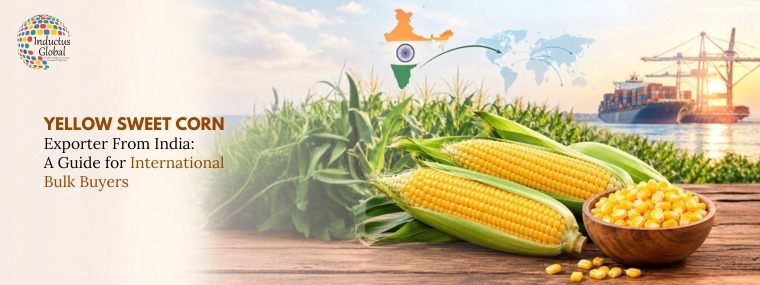
Yellow Sweet Corn Exporter From India: A Guide for International Bulk Buyers
Yellow sweet corn has become a commonplace ingredient in international food supply chains with applications in frozen foods, canned goods, ready-to-eat preparations, snacks, salads, and foodservice menus. For bulk buyers, India emerges as a viable sourcing market due to its agricultural presence, processing opportunities and participation in international food trade.
Sourcing sweet corn internationally involves more than simply identifying a competitive quotation. Buyers need to carefully evaluate the product specifications, processing protocols, packaging, cold-chain, documentation and the exporter’s ability to sustain consistency across shipments.
For companies interested in sweet corn export from India, this guide highlights considerations for evaluating Indian yellow sweet corn suppliers.
Understanding India’s Yellow Sweet Corn Market
India has a broad agricultural sector with sweet corn being cultivated across a number of regions suitable to the crop. Unlike field maize, sweet corn is generally harvested at a younger maturity, where the kernels possess higher concentration of natural sugars and a tender texture.
The product is generally traded in forms to suit different commercial applications. Depending on the buyer’s requirements, it can be supplied as fresh, frozen or processed sweet corn. Fresh yellow sweet corn is relevant to international bulk procurement markets due to freezing extending the shelf-life of the product, while preserving most of its colour, texture and flavour.
Prior to purchase, buyers should identify whether they are considering whole cobs, kernels or other processed formats.
What Global Buyers Should Specify
A precise purchase specification aids exporters in quoting accurately, and prevents misunderstandings on purchase confirmation. Buyers should consider the following parameters:
Kernel size and colour
Sweetness and maturity
Kernel integrity
Moisture content
Foreign matter
Damaged or discoloured kernels
Microbiological standards
Pesticide residue requirements
Packaging format
Shelf-life requirements
Storage temperature
The intended application is highly relevant, as a food manufacturer may have more specific requirements than an industrial buyer who will be using sweet corn as an ingredient in a prepared product.
Destination country regulations should also be reviewed prior to order confirmation.
Choosing the Right Indian Exporter
The exporter’s role goes beyond simply facilitating the shipment. A dependable supplier should possess suitable sourcing arrangements, processing infrastructure, quality control procedures and export documentation.
Wholesale yellow sweet corn suppliers may vary considerably in their operating models. Some focus more closely on farms and agricultural networks, while others specialise in processing and international distribution.
Buyers should inquire with potential suppliers regarding processing facilities, production capacity, cold-storage arrangements, quality certifications and experience with the destination market. It is also pertinent to request recent product specifications and laboratory reports rather than relying solely on general quality claims.
For larger contracts, buyers should consider whether the supplier can maintain product specifications over the agreed supply period.

Quality Control and Food Safety
Quality assurance is particularly important when purchasing a temperature sensitive food product. Fresh and frozen sweet corn requires appropriate handling from harvesting through processing, storage, and transportation.
Buyers should understand where and how the product is processed. Questions regarding washing, sorting, blanching, freezing and storage can provide useful insights into the supplier’s quality control system.
Independent inspection can also be considered for substantial orders. Depending on the contract, an inspection agency may verify product specifications, packaging, quantity and other agreed parameters prior to shipment.
Laboratory testing is another important component. Buyers may request tests covering microbiological parameters, pesticide residues, and other food-safety requirements applicable to their market.
Fresh, Frozen or Processed Sweet Corn?
The preferred product format is largely dependent on the buyer’s distribution network and end use. Fresh sweet corn can offer a close-to-farm product experience, but generally requires faster transportation and carefully managed temperature conditions. Frozen sweet corn, in comparison, offers a longer commercial window, and is more practical for international distribution.
Processed or packaged formats may suit retailers and food manufacturers seeking ready-to-use ingredients. Prior to order placement, importers should consider their own cold-storage capacity, distribution network and expected sales cycle. Selecting the right product format at the procurement stage can significantly impact total logistics costs.
Packaging and Cold-Chain Management
Packaging protects the product during handling and transportation, and helps to maintain its quality. Depending on the product format and market, sweet corn may be offered in retail-sized units or in larger bags and cartons.
The transportation process for frozen shipments requires uninterrupted temperature control. Buyers should discuss required storage temperature, loading procedures, container specifications and expected transit time with the exporter and freight provider.
A competitive product price can quickly lose its advantage if the cold-chain management is inadequate and quality deteriorates. Logistics should therefore be evaluated as part of the product purchase rather than a separate consideration.
Documentation for International Shipments
Food imports are subject to regulatory requirements that vary by country. Depending on the shipment and destination, buyers may need documents such as a commercial invoice, packing list, certificate of origin, phytosanitary documentation, health certificates and laboratory reports.
Importers should verify their country’s requirements prior to order confirmation. The exporter should also be able to provide accurate product and shipment documentation within the agreed timeline.
For recurring procurement, maintaining a standard documentation checklist can help to reduce delays and simplify customs clearance.
Pricing and Bulk Procurement
Price comparisons should always be made on equivalent terms. Factors such as product grade, processing methodology, packaging, order quantity, cold storage, inland transportation and international freight can all influence the final landed cost.
Large-volume buyers may be able to negotiate more favourable commercial terms, particularly if they can provide a predictable order schedule. However, price should not be considered independently of quality and supply reliability.
A slightly higher quotation from a supplier offering dependable quality and consistent delivery may prove more economical than a cheaper offer that leads to repeated rejections, delays or additional inspection costs.
Building a Long-Term Supply Relationship
International buyers sourcing sweet corn regularly should consider supplier selection as a long-term procurement decision. Initial trial shipments can help to evaluate the product quality, packaging, documentation, and delivery performance prior to larger commitments.
Once a supplier has demonstrated consistency, buyers can work towards more defined annual or seasonal purchasing arrangements.
Regular communication is equally important, as crop availability, weather conditions, freight costs and changes in import regulations can all influence the supply environment. Maintaining an open line of communication allows for such changes to be addressed without disrupting the broader procurement plan.

Conclusion
India offers an increasingly relevant sourcing market to international buyers of yellow sweet corn, particularly where competitive agricultural sourcing is combined with suitable processing and cold-chain capabilities.
The right procurement strategy begins with a clear product specification, and continues through supplier verification, quality testing, packing review and logistics planning. Buyers should consider the complete landed cost rather than simply focusing on the initial quotation.
For businesses considering Indian sweet corn suppliers, a carefully evaluated trial shipment can provide valuable evidence of quality and reliability prior to transitioning to regular bulk purchases. In an international food market where consistency matters as much as price, selecting a capable exporter is ultimately a commercial decision made on evidence rather than promises.
1. Is yellow sweet corn available for bulk export from India?
Yes. Indian suppliers can offer yellow sweet corn for commercial and international markets in formats such as fresh, frozen and processed products, depending on their facilities and production capacity.
2. How can international buyers verify an Indian sweet corn exporter?
Buyers can review business credentials, processing facilities, certifications, export experience, laboratory reports, customer references and previous shipment records. Independent pre-shipment inspection may also be appropriate for larger orders.
3. What packaging options are available for bulk sweet corn?
Packaging is dependent on the product format and buyer’s requirements. Commercial shipments may use larger food-grade bags, cartons or other packaging designed for frozen or processed products.
4. What affects the price of bulk yellow sweet corn?
Pricing can be influenced by product format, quality specifications, order volume, packaging, processing, seasonality, inland transportation, cold-chain requirements and international freight costs.
5. What documents are needed to import sweet corn?
Requirements differ between countries. Common documents may include invoices, packing lists, certificates of origin, applicable health, phytosanitary or laboratory certificates. Buyers should verify requirements with their destination-country authorities.
6. How can buyers start sourcing sweet corn from India?
A practical approach is to provide the exporter with product specifications, required quantity, packaging preferences, destination port and applicable quality standards. Buyers can then compare quotations and consider a trial shipment prior to entering into a larger supply arrangement.

Diptanshu
Leading research and marketing at Inductus Global, Diptanshu drives the company’s vision to transcend traditional trading through thought leadership in import-export. He spearheads a research-driven approach that prioritizes quality over price arbitrage, positioning Inductus as a strategic sourcing partner rather than a transactional intermediary. His work spans market intelligence, supply chain innovation, and trade dynamics, while playing a key role in sales and business development.