

How to Choose a Reliable De-oiled Rice Bran Exporter in India
A reliable supplier of rice bran export for animal feed and agricultural commodities international buyers to consider. The de-oiled rice bran is a sought after ingredient, with India boasting considerable opportunities due to its extensive rice processing sector.
However, picking a supplier can be more challenging than it appears. Small differences in the processing, storage, moisture, protein content, and so forth can significantly impact the value of a given consignment.
For international buyers, selecting a De-oiled Rice Bran exporter therefore requires a closer look at the technical specifications and extensive due diligence, as opposed to focusing on price comparison alone.
Understand the Product Before You Buy
De-oiled rice bran is a product which has had the oil removed. It is a common ingredient in animal feed and poultry formulations owing to its nutritional content and availability.
Not all consignments however will be equal. Different processing methods and storage conditions may impact its properties.
International buyers should therefore consider what their end-use for the product will be prior to contacting a supplier. A feed manufacturer for instance may require specific parameters to be met. These should be communicated clearly to any prospective exporter prior to receiving a quotation.
Having a written specification will enable buyers and exporters to work from a common set of criteria, and make it much easier to compare suppliers.
Check the Exporter's Processing and Sourcing Network
When evaluating a potential supplier, the first question to ask should be relatively simple – where does the material originate from, and how is it processed?
A supplier which has reliable access to rice mills and processing facilities will be in a stronger position to ensure continued supply. Buyers should also ask whether the processor owns its facilities, works with contracted third parties or purchases the finished product from another supplier.
This consideration is important, as an exporter with a stable and well organised sourcing network will be better placed to deliver the same level of quality and quantity even if circumstances change.
Buyers should also enquire as to the exporter’s storage capabilities, loading procedure, and experience with international shipments.
Evaluate Quality Specifications
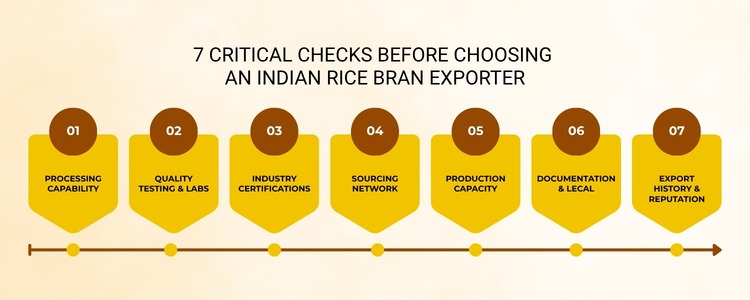
In terms of quality, specifications should be assessed based on measurable criteria, as opposed to generalised language such as high quality or premium grade.
Depending on the buyer’s requirements, these may include:
- Moisture
- Crude protein
- Crude fat
- Fibre
- Ash
- Sand or silica
- Foreign matter
- Free fatty acids
- Aflatoxin and other relevant contaminants
The acceptable limits for each of these should be agreed upon prior to making a purchase. Buyers should also request a recent certificate of analysis, and confirm which laboratory analysed the sample.
In the case of ongoing purchases, it is advisable to establish a standard specification which applies to all consignments, unless otherwise mutually agreed.
Ask for Independent Testing
While a supplier’s test report is a useful starting point, independent verification can be requested for greater confidence, particularly when dealing with a new supplier or high-value consignments.
A pre-shipment inspection can be organised to verify that the product meets the agreed specification, prior to the goods being shipped. Depending on the terms of the contract, an inspector may also be able to verify the quantity, packing, and loading procedures.
In the case of a new supplier, initiating the relationship with a trial shipment can be an effective way of building confidence. This may also provide buyers with the assurance that the supplier will be able to meet their requirements on a larger scale.
Assess the Supplier's Export Documentation
International transactions are highly dependent on proper documentation. A competent exporter will be familiar with the relevant documents, and the requirements of the importing country.
Depending on the transaction, these may include a commercial invoice, packing list, certificate of origin, bill of lading, certificate of analysis and various other certificates. Buyers should request specific requirements prior to shipping, to minimise the risks of issues at customs.
Consider Packaging and Transportation
Packaging will depend on the buyer’s end-use and handling procedures. De-oiled rice bran may be packed in bags, or as part of a bulk arrangement, depending on the size of the consignment and other factors.
Buyers should discuss loading procedures, storage conditions, container or vessel requirements, and expected transit time with the exporter.
Moisture content is a factor which requires particular attention. Storage and exposure to certain conditions can impact the quality of the product during transit. Buyers should therefore be aware of the storage conditions prior to loading, and any precautions which will be taken to prevent damage.
Compare Total Landed Cost, Not Just Price
A low quotation may appear attractive, but it does not necessarily translate into the most competitive overall price.
International buyers should take a closer look at the total landed cost, including the price of the product, inland transport, port costs, inspection, freight, insurance (where applicable), import duties, and any other costs associated with getting the goods to destination.
Commercial terms should also be clearly defined using the relevant Incoterm. A comparison between two suppliers is only useful if both parties outline comparable responsibilities and costs.
In the case of Bulk de-oiled rice bran, volume commitments on the buyer’s part may provide room for negotiation. However, consistency should not be compromised in pursuit of a lower price.
Review Supply Capacity and Reliability
A supplier may offer an attractive sample, but not have the capability to support a large recurring order. Buyers should therefore assess a supplier’s production and sourcing capabilities, based on their own requirements.
Inquiries should be made as to the exporter’s monthly availability, minimum order quantities, lead times, and capacity to accommodate repeat business. It is also worth discussing how the supplier manages seasonal fluctuations or shortfalls in supply.
A reliable supplier will be proactive in communicating any potential issues which may impact the scheduled shipment.
Build a Supplier Relationship Based on Evidence
The most effective supplier relationships are typically established through gradual engagement. Buyers may start by reviewing documentation, specifications and samples, followed by independent testing or a trial shipment.
Performance should subsequently be analysed across a number of criteria, including product quality, quantity, punctuality of shipment, quality of documentation, general communication, and response to any issues which may arise.
For companies assessing DORB suppliers, these practical considerations can be more informative than a glossy catalogue or an attractive low quotation.

Final Word for International Buyers
India presents international feed buyers with considerable opportunities in terms of sourcing rice bran derivatives. However, identifying a reliable supplier requires a systematic approach. Specifications, laboratory testing, sources of supply, documentation, and logistics all play a role in the equation.
The aim is not to simply find an exporter which is willing to provide an attractive quotation, but one which is able to consistently deliver the required product, within the specified parameters.
A well-managed initial transaction, coupled with ongoing quality checks and open communication, can provide the foundation for an ongoing international supply relationship.
1.What is de-oiled rice bran used for?
It is primarily used as an ingredient in animal feed formulations. Its nutritional composition makes it relevant to livestock and poultry feed manufacturers, subject to their formulation requirements.
2. How can I verify an Indian rice bran exporter?
Review the supplier’s business credentials, processing arrangements, export experience, laboratory reports, references and shipment capacity. A trial order and independent inspection can provide further evidence of reliability.
3. Can buyers order de-oiled rice bran in bulk?
Yes. Commercial exporters may handle substantial volumes, although availability, minimum order quantities, packaging and shipping arrangements vary between suppliers.
4. What documents are required for exporting de-oiled rice bran?
Requirements vary according to the destination country and transaction. Commercial invoices, packing lists, certificates of origin, bills of lading and certificates of analysis may be required, along with any destination-specific documentation.
5. What affects the export price of de-oiled rice bran?
Pricing can be influenced by raw material availability, product specifications, order volume, processing costs, packaging, inland logistics, freight rates, currency movements and market demand.
6. What quality parameters should buyers check?
Buyers commonly assess moisture, protein, fat, fibre, ash, foreign matter and other parameters relevant to their application. Contaminant limits should also comply with the buyer’s destination-market requirements.

Diptanshu
Leading research and marketing at Inductus Global, Diptanshu drives the company’s vision to transcend traditional trading through thought leadership in import-export. He spearheads a research-driven approach that prioritizes quality over price arbitrage, positioning Inductus as a strategic sourcing partner rather than a transactional intermediary. His work spans market intelligence, supply chain innovation, and trade dynamics, while playing a key role in sales and business development.