

Wheat Bran Exporter from India – Everything International Buyers Need To Know
Wheat bran has traditionally been a by-product of wheat milling processes, but it has more commercial uses that a company purely involved in producing flour would use. Wheat bran is a product rich in dietary fiber and can find its way into livestock as well as being a component of feeds. Feed manufacturers that operate globally and those that buy directly from third-party suppliers or commodity traders can access a wide sourcing base in India.
To buyers, the country offers the benefit of a well-established milling industry and a significant domestic market. However, choosing a reliable supplier requires more than just comparing quotes. Product quality, moisture, storage, packaging, documentation, and consistency can all impact the final value and reliability of the import consignment.
To companies that intend to buy wheat bran from India, understanding the sourcing process is crucial. The knowledge will help buyers navigate the selection process and establish long-standing relationships with dependable suppliers.
Everything Global Buyers Need To Know About Wheat Bran
Wheat bran is a by-product from milling wheat, and it typically consists of the wheat’s outer layers. Besides being used in animal feed, the product can also be incorporated into food and fiber formulations, depending on the quality and specification.
For feed buyers, the composition of the bran is of paramount importance. The moisture, protein, fiber, ash, and other attributes can vary depending on wheat type, the milling process, and general handling. Therefore, buyers should have a clear idea and specification of the intended use of the product prior to requesting quotations. A grade suitable for one feed formulation might be entirely inappropriate for another.
What International Buyers Need To Specify When Requesting Quotes
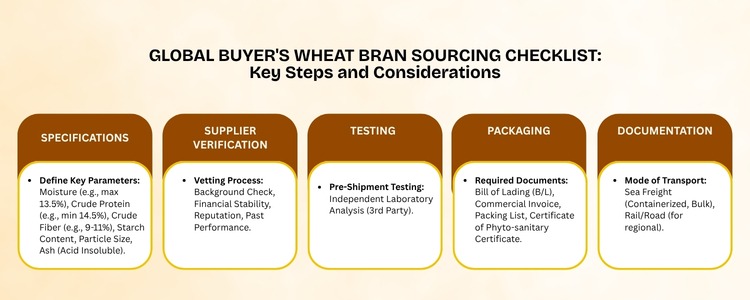
A specification is the basis of any good procurement process. Instead of stating “wheat bran” only, international buyers should define the parameter expectations for the product before requesting a quotation. Some of the criteria to consider specifying or asking about when requesting a quotation include:
- Moisture
- Crude protein
- Crude fiber
- Ash
- Fat
- Foreign matter
- Particle size
- Appearance
- Contaminant limits
- Packaging
- Crop or production period (relevant)
Acceptable limits for the above should be agreed upon before finalizing the purchase order. Having a standard will make it easier to evaluate any material received against the agreed specification.
Finding Reliable Wheat Bran Suppliers In India
India has a vast network of wheat mills, traders, and exporters. The country offers international buyers an extended base of potential suppliers, but each with varying capabilities. Some of the typical areas to consider when shortlisting wheat bran suppliers in India include processing arrangements, sourcing network, storage facilities, and general export experience, particularly with regard to recurring orders.
A reliable supplier should have direct access to milling operations. In addition to processing arrangements, buyers should also consider whether the material is sourced from a single mill or multiple facilities, depending on specification consistency requirements. Experience can also be a good indicator of a supplier’s capabilities. Therefore, buyers should request details of business conducted and, where possible, references or evidence of previous international shipments.
Testing Before Shipment is Essential
Testing is a crucial element in the procurement process, and the product specification or certificate of analysis provided by the supplier should be used as a baseline. Independent laboratory analysis might be required, particularly when dealing with a new supplier or for a large shipment.
The tests should be carried out to determine moisture, protein, fiber, ash, and other attributes relevant to the purchase contract. In some cases and depending on the destination, additional tests for contaminants might be necessary. Pre-shipment inspection can provide further confidence, particularly where an independent agency can inspect the product, quantity, and packaging before departure from the exporting country.
As a first-time buyer, a trial shipment is always a sensible approach. It provides an opportunity to see what material is actually received rather than relying solely on a sample.
Storage And Handling Are Key To Quality
Wheat bran is not a highly processed commodity, and poor storage and handling can significantly impact quality. Moisture, contamination, incorrect warehouse conditions, and exposure can all contribute to lower quality. Therefore, buyers should ask about warehouse conditions and handling as part of the due diligence process. Packaging should also be compatible with the buyer’s distribution system.
Depending on the order and destination, wheat bran can be supplied in bags or other arrangements. The packaging should be appropriate for loading, transportation, and storage while conforming to destination requirements.
Understanding Export Documentation Requirements
Documentation is an often overlooked element of international trade, and errors on commercial or shipping documents can cause significant delays even when the cargo conforms to the contract specifications. Depending on the destination and transaction, buyers may require different documents, including commercial invoice, packing list, certificate of origin, bill of lading, and certificate of analysis. Some certificates or documents may be relevant depending on the destination country’s regulations.
Importers should confirm requirements before finalizing the contract. Documentation requirements can vary greatly between markets, and it is always worth checking, especially for first-time buyers.
Comparing Prices And Landed Costs
The cheapest quotation might not always be the most cost-effective option. International buyers should always look at the landed cost rather than the export price quoted by the supplier. Product grade, order volume, packaging, inland transportation, port charges, freight, insurance, duties, and destination costs can all affect the final price. The quotation should also state the applicable Incoterm.
Comparing FOB with CIF quotations without considering the additional costs involved can be misleading. For buyers looking to source in bulk, larger order sizes might open up better commercial terms, but quality and delivery reliability should always be prioritized.
Looking At Supply Capacity And Delivery Reliability
A supplier might be able to process and deliver a small order without any problems, but the same might not be possible with a large order. Therefore, before finalizing a long-term supply agreement with a supplier, buyers should consider the following:
What is the regular monthly availability?
What is the minimum order size?
How quickly can the shipper arrange the shipment?
Can the supplier support recurring orders?
How do they manage seasonal supply variations?
What happens if they cannot meet the specified specification?
Having clear answers on the above will help buyers understand the capabilities of a prospective supplier. A good supplier will have a proper export operation and will not rely on opportunistic spot purchases to fulfill large-volume orders.
Building A Long-Term Sourcing Relationship
Successful long-term sourcing relationships are rarely built on a single transaction. Therefore, buyers should look at the performance of a supplier before considering long-term or recurring supply agreements. Buyers should evaluate quality performance, accuracy of documentation, timely loading, and general communication and responsiveness in case of any problems. Once a supplier has demonstrated good performance, buyers can consider long-term purchase agreements. The advantage of such agreements is that they offer more supply stability for the buyer while supporting the exporter in having a better idea of anticipated demand.
Market conditions are rarely static, and wheat availability as well as prices, freight rates, and government policies can change. Therefore, commercial agreements should clearly outline pricing, quality, and delivery terms.
Final Thoughts For International Buyers
India’s well-established wheat processing industry offers international buyers an accessible source of wheat bran. However, the success of a sourcing initiative will depend on careful supplier selection and adherence to best sourcing practices.
Prioritizing buyer specifications, verifying capabilities, testing samples, and analyzing the documentation requirements and landed costs can help ensure better value and a reliable supply of wheat bran.
While getting the best price possible is always a priority, a good supplier will offer better reliability in terms of quality and documentation and will be able to support long-term sourcing requirements.
1. What is wheat bran primarily used for?
Wheat bran is primarily used as livestock feed. Its high fiber content makes it ideal for various types of feed depending on the nutritional requirements.
2. How can an international buyer verify an Indian wheat bran supplier?
Buyers can verify business credentials, export history, processing arrangements, storage facilities, certificates of analysis, and customer references. Independent inspection can provide additional confidence for major orders.
3. Can wheat bran be purchased in bulk from India?
Yes. Commercial suppliers can source in bulk depending on their network, available stock, processing capabilities, and logistics. Minimum quantities should be confirmed before negotiations.
4. What documents are required when importing wheat bran?
Documentation requirements will vary depending on the destination country. Common documents are a commercial invoice, packing list, certificate of origin, and bill of lading. The certificate of analysis should also be available. Additional documents may apply depending on local market requirements.
5. What factors affect the price of wheat bran?
Prices can be influenced by a wide range of elements, including wheat availability and milling activity, product specification, order size, packaging, transportation, freight, and overall market trends.
6. How should buyers begin a long-term sourcing relationship?
A practical approach is to define specifications, evaluate suppliers, test samples, and complete a trial shipment. Performance can then be evaluated before increasing order sizes or entering a long-term supply agreement.

Diptanshu
Leading research and marketing at Inductus Global, Diptanshu drives the company’s vision to transcend traditional trading through thought leadership in import-export. He spearheads a research-driven approach that prioritizes quality over price arbitrage, positioning Inductus as a strategic sourcing partner rather than a transactional intermediary. His work spans market intelligence, supply chain innovation, and trade dynamics, while playing a key role in sales and business development.