

Indian Spices Cloves: Complete Guide for Spice Importers
Cloves: From Kitchen Staple to Global Commodity
Cloves are prevalent in cuisines, confectionery, beverage preparation processes, drug formulations, and traditional food practices. Their characteristic aroma, as well as their intense flavor, have made them an essential culinary ingredient for hundreds of years. However, this widely recognized culinary name is part of the established market with specifications.
Buyers of cloves are not simply interested in their name but also their origin, quality, moisture content, color, cleanliness, and the characteristics of their volatile oil. The Indian Spice Market has existed for years. The first relatively formal approach towards taking practices in spices in India occurred in 1987 when the country formed the Spices Board of India by combining Cardamom Board and the Spices Export Promotion Council.
Now the Indian market’s opportunities are higher than the simple use of spices inside India. The country has developed technology that allows Indian spices to be shipped to various countries, including the U.S.
How India Becomes a Strategic Clove Supply Partner
Historically, buyers looking for cloves have naturally looked toward major producing origins, particularly Indonesia, Madagascar, Tanzania, and other countries with established clove-growing industries. That does not make India irrelevant. It changes the sourcing question.
For international buyers, diversification has become increasingly important. Weather volatility, crop cycles, freight disruptions, quality variation, and changing food-import requirements can all affect commodity procurement. A multi-origin sourcing strategy can reduce dependence on one supply corridor.
India’s advantage is its broader spice ecosystem. Major commercial centres across states such as Kerala, Tamil Nadu, Karnataka, Andhra Pradesh, and Gujarat connect growers and traders with processors, laboratories, packaging facilities, exporters, ports, and domestic distribution networks.
The International Trade Centre (ITC) Trade Map identifies cloves under HS code 0907, providing a standardized framework for tracking international clove trade and import markets. The United States is among the world’s significant spice-importing markets, creating a substantial opportunity for suppliers able to meet U.S. buyer specifications.
For Inductus Global, the commercial opportunity lies in coordinating this ecosystem around buyer-specific requirements rather than treating cloves as a generic commodity. Product grade, cleanliness, moisture, packaging, documentation, and shipment planning must be aligned before a commercial order is finalized.
India’s wider spice industry also has a significant export footprint. According to the Spices Board of India, India’s total spice exports reached a record US$4.46 billion in FY 2023–24, demonstrating the scale of the country’s overall spice-export infrastructure.
| Parameter | India | Indonesia | Madagascar | Tanzania | Trend / Buyer Insight |
|---|---|---|---|---|---|
| Supply Ecosystem | Broad spice network | Clove-focused strength | Clove-focused origin | Established spice origin | India favors diversification |
| Processing | Strong | Established | Developing | Established | India favors processing depth |
| Export Infrastructure | Major ports | Established | More route-dependent | Established | India favors connectivity |
| Product Portfolio | Very broad | Spice-led | Clove-led | Spice-led | India favors portfolio breadth |
| U.S. Market Access | Established trade route | Established | Established | Established | India favors supplier choice |
India as a Leading Destination for Global Spice Importers
Quality-controlled spice sourcing entails more than simply determining whether a shipment has the right commodity. It requires defining measurable product specifications and ensuring that the specifications are met by proper inspection, testing, documentation, and supply-chain management.
This is especially significant for U.S. importers, whose foods and spices must adhere to guidelines set by various agencies, including the U.S. Food and Drug Administration (FDA) and U.S. Customs and Border Protection.
The Indian spice-export ecosystem is supported by the Spices Board of India, which functions under the Ministry of Commerce and Industry and handles development and promotion of Indian spices and exports.
Whether it is analyzed on a country basis or in terms of the total value of the opportunities for exports, the Spices Board of India has confirmed that in FY 2023–2024 the total volume of Indian spices’ exports is the highest so far and exceeds previous records in terms of both volume and value. So, this means that the long-term export opportunities for India extend beyond individual commodities like cloves and cover the whole range of high-quality and high-value spices.
India as a Center of Spice Supply, Expertise & Export Capability
Geographical Factors
Being located between major Asian, Middle Eastern, European, and African trade routes, India facilitates international spice trade. Major ports like Cochin, Chennai, Mundra, Nhava Sheva and Kandla link the agricultural and processing centers to global shipping lines. The Sagarmala Programme that was started in India in 2015 has ensured the emphasis on port-led advancement as well as logistics efficiency.
Talented Youth
India has a huge working-age population that results in an increasing number of specialists in different sectors such as food technology, quality management, logistics, international trade, purchasing, and supply chain management. Historically, India has been sending many of its skilled personnel abroad but this is countered nowadays by the inflow of skilled professionals in India.
Skilled Experts
The agricultural and food-processing sector in India is backed up by the Indian Institute of Spices Research (IISR) at Kozhikode, which is engaged in research activities in the area of spices and related technologies, and National Institute of Food Technology Entrepreneurship and Management (NIFTEM), which is concerned with the areas of food technology, processing, entrepreneurship, and food research activities. The involved institutes give a specific knowledge in relation to the modern supply chains of spices.
Innovative Approach
The Spices Board of India has been implementing various initiatives regarding the quality of spices and their productivity, processing, value addition, and delivery to exports. This, with the wider government programmes such as Startup India, started in 2016, forms the basis for the agro tech-technology initiatives connected to traditional commodity businesses.
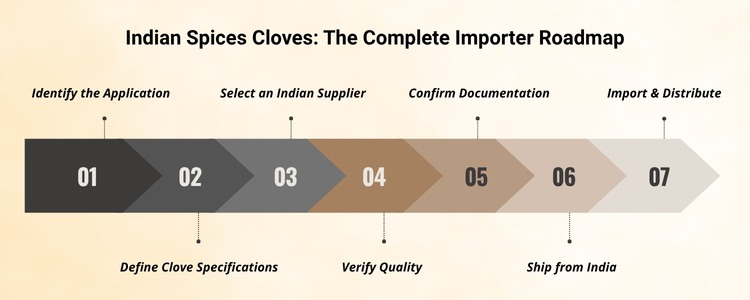
What Global Importers Should Check Before Buying Indian Cloves
When sourcing suppliers, international buyers must first determine their product specifications. Origin and Grade of Product: Buyers must be specific about what type of cloves, size, visual attributes, and uses are needed. The need for whole cloves for retail, as well as for food processing and making drinks and for extraction, can vary.
Quality Factors: Buyers and sellers should come to an agreement on factors such as moisture content, cleanliness, presence of any foreign matter, color of cloves, infestation level, etc., depending on the shipping destination.
Packaging: Commercial requirements vary from bulk sacks to tailored packaging.
Documentation: Depending on the products being shipped, buyers might need commercial invoices, packing lists, origin certificates, phytosanitary certificates or any other applicable certificate, inspection reports and shipping documents.
U.S. Import Compliance: The American buyer must check whether there are any FDA requirements or other obligations of the importer, since the regulatory environment may vary significantly based on what kind of product is being transported, how and for which purpose it is being shipped, as well as who the importer is.
Supplier Verification: A trustworthy Indian spices supplier should be able to explain how the company sources its products, guarantees their quality and what specifications, packaging, lead times and export documents it has.
Lowest price is not always the best option. When it comes to food ingredients, the importance of being consistent with future deliveries is often much higher than having a slightly lower price.
Why Indian Cloves Can Matter to U.S. and Global Buyers
The U.S. market holds enormous interest owing to multiple usage options for cloves. Food producers have included cloves in spice mixtures, sauces, cakes, beverages, processed foods, and seasonal items.
This renders various procurement methods for importers. A distributor may want to obtain the clove in bulk. A producer may require more precise specifications and laboratory results. A retailer may consider packaging and presentation in addition to quality.
Thus, the job of an experienced Indian exporter becomes crucial.
In the global market, a supplier should unite agricultural sourcing and customer requirements which means not only knowing the commodity itself but also the commercial specifications of the commodity.
Thus, buyers who need Indian spices for export to the USA should combine the product selection process with supplier verification, examination of regulations, transport planning, and paperwork.
Conclusion
India has no intention of taking over the established countries producing cloves or suggesting that every buyer from abroad procure their cloves from one and only one country.
The country’s uniqueness lies in the richness of its spice ecosystem: skills in farming, specialized research, production and logistics capacities, quality control systems, and the experience of working with the world spice market.
Thus, the first image of cloves in the context of kitchen spices is not a marketing gimmick; it is rather a reminder of what a common commodity stands for in a complex global retail network.
Several pieces of evidence are available to corroborate India’s position: the formation of the Spices Board in 1987, a record $4.46 billion performance in exports in 2023-2024, expanding port and logistics systems, and numerous organizations like IISR and NIFTEM that are doing research on spices.
For the international buyers, especially those from the USA, the main point is not only finding Indian suppliers of spices but finding those who can meet all the requirements of the products and pack them properly.
Whether India’s clove-sourcing opportunity expands significantly against established producing origins remains to be seen. The broader direction, however, is clear: India’s mature spice-export ecosystem gives international buyers another credible sourcing channel.

Diptanshu
Leading research and marketing at Inductus Global, Diptanshu drives the company’s vision to transcend traditional trading through thought leadership in import-export. He spearheads a research-driven approach that prioritizes quality over price arbitrage, positioning Inductus as a strategic sourcing partner rather than a transactional intermediary. His work spans market intelligence, supply chain innovation, and trade dynamics, while playing a key role in sales and business development.