

Top Spice Exporters from India: Trusted Suppliers for Global Buyers
Spices: India's Oldest Trade Story, Told Through a New Export Machine
To most of the world, India’s spice reputation is a romantic, historical one — the ancient trade routes and Malabar coast ports that once drew European fleets in search of pepper and cardamom. But behind that centuries-old image, India has spent nearly four decades quietly building a formal, regulated export machine. The turning point came on February 26, 1987, when the Spices Board of India was constituted under the Spices Board Act, merging the 1960 Spices Export Promotion Council with the 1968 Cardamom Board.
That single regulatory body helped take India’s spice exports from roughly Rs 298 crore in 1987-88 to over Rs 39,140 crore in FY 2025-26. With global buyers now increasingly wary of opaque, multi-hand supply chains, Indian exporters are positioning themselves as the industry’s most direct, traceable source.
How Verified Indian Spice Exporters Are Becoming Buyers' Direct Source
For years, large food manufacturers and retailers have often sourced spices indirectly, through European processing and trading hubs like the Netherlands and Germany. These hubs import raw spices from Asia and Africa, clean and blend them under EU food-safety branding, then resell at a markup — a re-export model that adds a costly, opaque layer between the buyer and the origin farm.
That opacity became a real liability in 2024, when ethylene oxide contamination alerts on Indian spice-blend brands triggered recalls in Singapore and Hong Kong; even after later testing cleared the products, the episode dented buyer trust in supply chains where origin and processing weren’t independently verifiable.
India’s Spices Board responded by leaning harder into infrastructure that closes that verification gap at the source: eight crop-specific Spices Parks — at Chhindwara, Puttady, Guntur, Jodhpur, Sivaganga, Guna, Mehsana, and Raebareli — now provide shared cleaning, grading, and testing facilities directly in the growing regions, reducing exporters’ dependence on a third-country intermediary to “verify” quality after the fact.
The Business Research Company’s Spices and Seasonings Global Market Report 2026 values the category at $30.98 billion this year, projecting growth to $43.32 billion by 2030 at an 8.7% CAGR. Inductus Global’s own conversations with EU and North American buyers reflect the same shift, with more importers now asking for direct mill and processing-unit documentation rather than accepting an already-blended, re-exported product.
Backing the push nationally, the Spices Board launched its SPICED scheme in May 2025 for FY 2025-26, funding farm-level productivity, technology adoption, and international food-safety upgrades aimed squarely at closing the trust gap that tightened regulatory scrutiny has opened in the US, EU, and UK.
| Parameter | India | Vietnam | Indonesia | China |
|---|---|---|---|---|
| Cost of Operations | Broad multi-spice cost base, competitive across categories | Price-aggressive on pepper, undercuts on volume | Competitive on nutmeg and cloves through natural biodiversity | Low-cost bulk ginger and garlic, with quality concerns at the high end |
| Category Specialization | Leads in chili (37% global output), cumin (70% share), turmeric, and pepper | Concentrated in pepper (~42% share) and cinnamon | Concentrated in nutmeg (75% share) and cloves | Concentrated in bulk ginger and garlic supply |
| Export Volume & Reliability | 17.34 lakh tonnes, $4.43B (FY 2025–26), across 200 destinations | 21,743 tonnes of pepper alone, $139M (Jan 2026) | 148,220 tonnes, $564M (Jan–Nov 2023) | 2.8M tonnes of spice cultivation output, mainly ginger and garlic |
| Certification & Compliance | Spices Board-mandated labs, CRES registration, and EU-compliant residue-control initiatives | VietGAP adoption growing, with less centralized testing | Developing certification and GI framework | Facing steep US tariffs and concerns over quality and counterfeiting |
| Infrastructure Maturity | 8 dedicated Spices Parks and 6 regional testing laboratories | Processing concentrated around Central Highlands trading groups | Fragmented infrastructure across the archipelago | Large-scale infrastructure, but primarily bulk-commodity oriented |
| Government Incentives | SPICED scheme (2025) plus ₹497 crore RELIEF scheme for MSMEs | Navigating US tariff uncertainty | Export financing support, with fewer spice-specific incentives | Facing 100%+ US tariffs that are reducing competitiveness |
Direct-Origin Sourcing Surrounding India as Leading Destination for Global Spice Imports
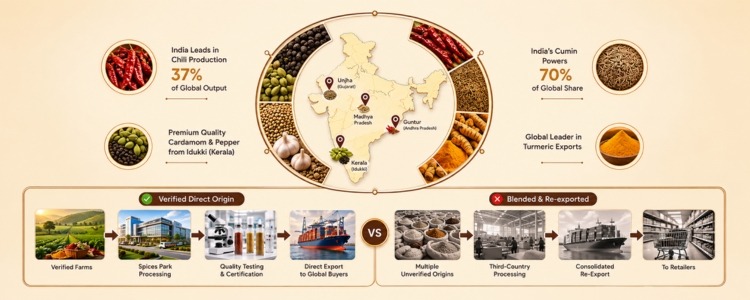
Verified direct-origin sourcing is fundamentally different from blended re-export trade. Rather than buying a spice product repackaged by a third-country intermediary with no verifiable link back to the original farm, a direct-origin contract ties every shipment to a Spices Board-registered exporter, a specific processing facility, and an accompanying test-lab certificate — a distinction that matters far more to buyers now than it did before 2024’s contamination scare.
The institutional weight behind India’s push is well established. The World Spice Congress, founded in 1990 and organized by the Spices Board alongside India’s trade associations, has held 14 editions to date; its most recent theme, “VISION 2030: S-P-I-C-E-S” — Sustainability, Productivity, Innovation, Collaboration, Excellence, and Safety — set out the sector’s own agenda for closing precisely this kind of trust gap.
Nationally, India accounts for roughly 40% of global spice production and shipped a record 17.99 lakh tonnes worth $4.72 billion in FY 2024-25, before a modest cyclical pullback to $4.43 billion in FY 2025-26, according to Spices Board data. The United States alone imported $711 million worth of Indian spices in FY 2024-25, up 15% year-on-year. For Indian exporters specifically, the opportunity is converting 2024’s regulatory scrutiny and trust concerns into a durable buyer preference for verified, traceable, direct-origin contracts.
India's Spice Belt as Center of Verification & Trust
Geographic Factors
India’s spice geography spans Kerala’s Idukki district for pepper and cardamom, Andhra Pradesh’s Guntur belt for chili, Gujarat’s Unjha market for cumin, and Madhya Pradesh for garlic and coriander. The Spices Board’s Kochi headquarters, backed by regional testing laboratories in Mumbai, Chennai, Delhi, Tuticorin, Kandla, and Guntur, gives exporters multi-port access alongside mandatory quality verification before shipment.
Talented Youth
Younger farming families across India’s spice belts are increasingly enrolling in Spices Board-registered farmer and FPO programs that provide traceability tools and direct market access, rather than migrating away from traditional spice-growing regions. With India’s domestic spice market alone valued at roughly ₹45,000 crore and rising per-unit prices for quality-verified produce, the economics are giving the next generation a stronger reason to stay in cultivation.
Qualified Professionals
Behind every certified shipment sits the Spices Board’s own testing laboratory network, headquartered in Kochi with regional labs across six major trade hubs, alongside a base of more than 6,600 registered exporters — including roughly 600 specialized manufacturers focused specifically on value-added, high-end spice processing. That concentrated institutional testing capacity, not informal grading, is what backs India’s verification claims.
Innovation First Strategy
The Spices Board’s SPICED scheme, launched in May 2025 for FY 2025-26 — Sustainability in Spice Sector through Progressive, Innovative and Collaborative Interventions for Export Development — funds farm-level productivity gains, technology adoption, and international food-safety quality upgrades. Alongside it, the Rs 497 crore RELIEF scheme specifically supports MSME exporters facing logistics disruptions, providing insurance support and easing export obligations.
Conclusion
Indian spice exporters aren’t trying to out-compete Vietnam on pepper pricing or China on bulk ginger and garlic volume — that race isn’t the pitch. The differentiated case is breadth and verifiability: the widest multi-category spice portfolio of any origin country, backed by centralized, government-mandated testing that buyers can actually trace back to source. The comparison to a maturing, trust-rebuilding trade sector isn’t marketing gloss — it’s a trajectory backed by real infrastructure.
The Spices Board’s testing lab network and CRES registration system are already in place, the SPICED scheme launched in May 2025 to close the post-2024 trust gap, FY 2024-25 delivered a record $4.72 billion export year followed by a still-strong $4.43 billion in FY 2025-26, and the World Spice Congress has built institutional credibility across 14 editions since 1990. Whether India fully converts 2024’s contamination scare into a lasting reputational edge over blended re-export trade remains to be seen, but for buyers weighing verified, direct-origin sourcing against another opaque intermediary, the direction of travel is no longer in question.

Diptanshu
Leading research and marketing at Inductus Global, Diptanshu drives the company’s vision to transcend traditional trading through thought leadership in import-export. He spearheads a research-driven approach that prioritizes quality over price arbitrage, positioning Inductus as a strategic sourcing partner rather than a transactional intermediary. His work spans market intelligence, supply chain innovation, and trade dynamics, while playing a key role in sales and business development.






3 Replies to “Top Spice Exporters from India: Trusted Suppliers for Global Buyers”
Non-Basmati Rice Exporters in India | IR64 & Sona Masoori
01 Sep 2026[…] procurement through Spices Board-registered testing labs to a Certificate of Registration as Exporter of Spices (CRES) — that follows a consignment all the way to the buyer’s […]
Indian Cloves Exporters: A Complete Guide for Global Importers
04 Sep 2026[…] a national level, spice exports are one of the categories India has explicitly targeted for growth over the coming years, with red […]
How to Import Kabuli Chana (Chickpeas) from India to UAE
10 Sep 2026[…] in 1987 when the country formed the Spices Board of India by combining Cardamom Board and the Spices Export Promotion […]