

Indian Red Lentils Exporter: A B2B Guide for UAE Buyers
Red Lentils: From Staple to Global Trade
The pulses provided by India form a vital part of daily culinary practices ranging from dal served in household settings to mass catering of food.
Red lentils have, however, joined the growing organized international commodity market.
It takes a network of farmers, aggregators, processors, quality testing laboratories, warehousing firms, export firms, shipping organizations, and importers to provide the final food product.
Commercial buyers look into not only the pricing of the product but also its grade, color, moisture, cleanliness, packaging, documentation, and reliability of delivery services.
There was an institutional milestone in India’s formal pulse development system in 1983 with the establishment of an Indian Institute of Pulses Research (IIPR) at Kanpur in order to augment research and development capabilities for pulse crops.
At present, the strategic opportunity is to convert the country’s knowledge in agriculture and processing into a consistent supply for international market players, which include importers and distributors from the UAE.
India's Emerging Pulse Route
UAE buyers have historically engaged in acquiring pulses through specific international commodity channels, with states such as Canada, Australia, Russia, Turkey, and others being significant contributors of multiple pulse categories. However, the source of procurement is witnessing changes.
Weather uncertainty, crop cycles, freight charges, political hurdles, and modification in import policies can affect both the pricing of pulses and their availability. Therefore, the idea of diversification of sources has become an aspect of preference in the supply chain of importers.
India provides a huge domestic ecosystem for pulses. Major production and trade activities are held in states such as Madhya Pradesh, Maharashtra, Rajasthan, Uttar Pradesh, Karnataka, and Gujarat, while whole chain of processing and distribution connects inland markets and large ports. The FAO identifies India as the largest producer and consumer of pulses in the world, confirming its strong position in domestic pulse economy.
According to the Ministry of Agriculture & Farmers Welfare, India’s pulse production was about 27.3 million tons in 2023-2024, confirming the scale of the entire agricultural industry. Inductus Global aims at connecting this agricultural base with the needs of international consumers.
India’s broader pulse ecosystem therefore gives UAE buyers an additional sourcing option within an increasingly diversified global market.
Parameter | India | Canada | Australia | Turkey | Trend |
Pulse Ecosystem | Very broad | Strong | Strong | Strong | India favors diversity |
Domestic Supply Base | Very large | Export-oriented | Export-oriented | Regional | India favors depth |
Processing | Extensive | Established | Established | Established | India favors flexibility |
UAE Connectivity | Strong | Established | Established | Strong | India favors proximity |
Trade Relationship | CEPA framework | Established | Established | Established | India favors bilateral ties |
Role of Pulse Sourcing
Pulse sourcing is more than just procurement of the product at the best price. It refers to connecting the farm produce with the required specifications, quality control methods, documentation, logistics, and conditions necessary for the target market.
It is important to point out that the specificity of its term is relevant for UAE importers, as the country is a substantial consumer market and an important trading and re-exporting food center for the regions of the Middle East and North Africa.
The India-UAE Comprehensive Economic Partnership Agreement (CEPA) that became effective on May 1, 2022, strengthened bilateral business relations.
According to India’s Ministry of Commerce and Industry, the value of the total trade at the bilateral level (with the UAE) amounted to around US$100 billion in 2024–25, which means that the trade corridor is of serious scale.
There is also a long-term strategic goal of the Indian pulse industry at large, as pulses are considered one of the priority crops in the framework of India’s National Food Security Mission which started to operate in 2007, focusing on growing productivity and production level.
In this context, Indian red lentil sellers have the specific task of transforming the vast pulse potential of
The opportunity for Indian red lentils exporters is therefore specific: translate India’s large pulse ecosystem into consistent, specification-led supply for UAE importers.
India's Pulse Advantage
Geographic factors
India’s agricultural geography has endowed it with many pulse-producing regions rather than relying only on a single producing area. Important logistics hubs such as Mundra, Kandla, Nhava Sheva, Chennai connect inland agriculture markets with the global shipping network. The development of various modes of transportation such as roads, railways, warehousing, and ports bolster the movement from producing centres to export locations.
Young skilled workforce
India’s way large working population supports employment in agriculture procurement, food processing, quality assurance, logistics, customs, finance and international trade. The trend of skilled workers emigration from India is more and more balanced out by an opposite movement as food processing, logistics, agritech and export sectors create new opportunities for skilled workers employed in the country.
IPR Experts
The Indian Institute of Pulses Research (IIPR) and agricultural universities in various pulse-rich regions provide expertise in crop science, breeding, agronomy, post-harvest management, etc. Moreover, institutes like ICAR-Indian Agricultural Research Institute play a major role in developing the country’s agricultural research ecosystem.
Innovation First
India’s National Food Security Mission launched in 2007 is a major institutional program aimed at achieving increased crop productivity in crops including pulses. Furthermore, more recent technologies such as digital agriculture, better quality of seeds, mechanisation, storage and supply chain technologies have made a great contribution to the pulse ecosystem.
Buyer Quality Checks
The initial step towards selecting suppliers for buyers in the UAE requires clearly defining specifications for red lentils.
Product Type: Buyers should clarify the type of red lentils they intend to source, be it whole red lentils, split lentils, or specific commercial variety and origin.
Quality: Prior to the shipment, it must be agreed upon the colour, size, moisture, presence of foreign matter, damaged grains, infestation status, and overall cleanliness.
Processing: Processing standards may vary depending on whether the product is for retail, food service, wholesaling, or industrial use.
Packaging: Products can be packed in bulk bags or containers customized to buyers’ demands. A good packaging solution must ensure the product is protected against moisture and mishandling.
Documentation: According to the type of shipment and UAE requirements, the documentation may include commercial invoices, packing lists, Certificate of Origin, where required, Phytosanitary certificate, inspection certificate, and shipping documents.
Supplier Verification: Trusted suppliers of pulses should provide evidence of their sourcing abilities, quality procedures, and experience in The export industry.
Purchasing the product at the lowest price does not always mean that it will be the cheapest product to purchase. For repeat buyers, shipment reliability may be more important.
India to UAE
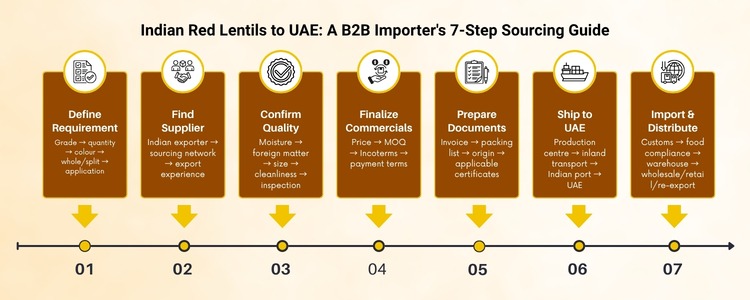
The process of red lentil export from India to UAE starts with requirement compilation on the part of the importer.
The importer determines the grade, quantity, color, packing, etc., that is needed, and accordingly the exporter finds an appropriate Indian supplier. After estimating the quality details, quality verification is carried out as per the contract. The verification process may include quality testing, moisture test, assessment of foreign matter, laboratory analysis, inspection of the third party, etc. After the quality control process, the terms of sale should be defined. Price and incoterms, payment and shipment conditions should be defined.
The cargo moves through India’s inland transportation system from a manufacturing or processing unit to an export port.
The UAE buyers also should ensure whether they comply with current import and food safety and labeling and customs requirements before shipment takes place.
Why Indian Red Lentils Matter
Red lentils make a substantial contribution to the business of pulses because they are characterized by a balanced combination of high demand from consumers and numerous areas of application.
Red lentils are supplied by companies based in the UAE through a retail network of supermarkets, wholesalers, food service providers, processors, and regional re-export.
India’s strength in the global market is based on the sheer volume of its economy, but not on any particular quality of products from its domestic market.
This economy enjoys significant production potential, presence of specialized agricultural research institutions, advanced processing capacities, high level of consumption, and developed exporting logistics.
These factors provide a great opportunity for Indian wholesalers when they need to satisfy clients’ requirements for product quality.
For red lentil importers, an important question is not only whether India is capable of providing red lentils but also whether a specific supplier has capability of delivering red lentils on a regular basis.
Conclusion
India is not trying to supplant Canada, Australia, Turkey, or other established pulse origins.
Its pitch is simple: to harness India’s large domestic pulse ecosystem, its processing capacity, agriculture research, established logistics, and deepen the trade relationship between India and the UAE.
The fact that pulses are and widely recognized as an important food staple has not only marketing value but indicates a direction. It also indicates the direction of evolution of the supply chain associated with this product which is structured around quality, processing, logistics as well as demands from international buyers.
The points which support this claim are: the Indian Institute of Pulses Research was set up in 1983; the country’s pulse production was about 27.3 million tons in 2023–24; CEPA between India and the UAE came into force in 2022; and India-UAE bilateral trade reached about US$100 billion in 2024–25, according to India’s Ministry of Commerce and Industry.
For the UAE customers, the practical benefit of Indian red lentils is to treat them as a good diversification of sourcing strategy and pure price-based purchasing.
The share of India in red lentils purchases by the UAE market remains an open question. It is still evident that there is
Whether India’s share of UAE red-lentil procurement expands substantially remains to be seen. The underlying direction—supported by production scale, research, processing infrastructure, and India-UAE trade integration—is not in question.

Diptanshu
Leading research and marketing at Inductus Global, Diptanshu drives the company’s vision to transcend traditional trading through thought leadership in import-export. He spearheads a research-driven approach that prioritizes quality over price arbitrage, positioning Inductus as a strategic sourcing partner rather than a transactional intermediary. His work spans market intelligence, supply chain innovation, and trade dynamics, while playing a key role in sales and business development.