

Indian Red Chilli Exporters: Bulk Supply Guide for USA, UK & UAE
India's Red Chilli Belt: The Spice World's Best-Kept Volume Secret
Say “Indian chilli” to most people outside the trade, and they picture a kitchen spice jar — a pinch of heat in a curry, not a commodity moved by the container-load. That everyday image undersells what the crop actually represents at scale.
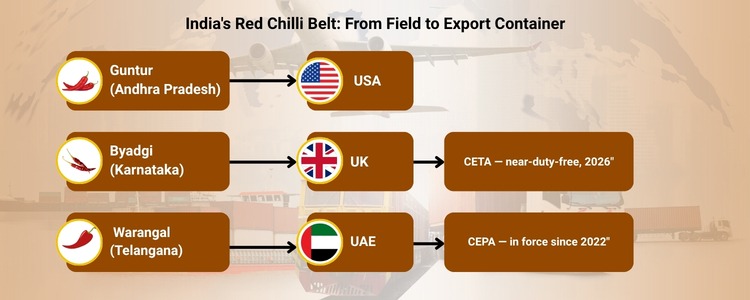
Behind it, India has spent nearly a century building a second identity as the engine room of the global chilli trade. The Guntur Mirchi Yard in Andhra Pradesh, established in the 1930s, grew into what is widely regarded as Asia’s largest chilli trading market — a single hub processing and grading volumes few other origins can match. Karnataka’s Byadgi belt developed alongside it, specializing in the deep-colour, low-heat varieties prized by oleoresin and paste manufacturers rather than heat-seekers.
Today, that century of infrastructure is being pointed at a new goal: converting India’s raw production scale into export-ready, traceable, bulk-shipment supply chains built specifically for buyers in the USA, UK, and UAE — markets that increasingly want fewer suppliers, better documentation, and consistent grading, not just a low price per tonne.
How India's Chilli Belt Becomes the New & Upgraded Sourcing Hotspot
For decades, international buyers built their chilli sourcing strategy around two poles: China for volume and price, and a patchwork of smaller origins — Peru, Mexico, Ethiopia — for specialty grades. China’s scale made it the default first call for bulk importers, particularly in food manufacturing and retail private label.
That default is under pressure. Rising labor costs in China’s agricultural regions, land conversion away from chilli cultivation toward higher-margin crops, and tightening food-safety scrutiny on imported spice have all pushed international buyers to actively diversify their supplier base rather than concentrate risk in one origin.
India’s chilli belt has stepped directly into that gap — not as a single supplier, but as a set of specialized regions each solving a different part of the sourcing problem. Guntur and Warangal in Andhra Pradesh and Telangana supply high-heat, high-volume varieties for food processing and retail.
Byadgi in Karnataka supplies the deep-red, mild-heat grade used in oleoresin extraction and paste manufacturing. Independent market-research coverage of the global spice trade has repeatedly flagged India as the fastest-growing chilli export origin by volume over the past several years — a trend that internal Inductus Global sourcing data mirrors, with a rising share of our own shipments now moving to bulk buyers in the USA, UK, and UAE rather than smaller wholesale orders.
India’s Spices Board has set ambitious targets for overall spice export growth over the coming years, with red chilli consistently ranked among the top two or three export categories by value. (Exact current-year targets should be pulled from the Spices Board of India’s latest annual report before this figure is published.)
| Parameter | 🇮🇳 India | 🇨🇳 China | 🇵🇪 Peru |
|---|---|---|---|
| Cost of Operations | Competitive, smallholder-driven | Rising labor & land costs | High, niche-crop pricing |
| Grading & Colour Consistency | Strong — dedicated grading yards in Guntur & Byadgi | Variable, less standardized grading infrastructure | Strong but low-volume |
| Export Documentation & Compliance | Improving — Spices Board certification push | Established but facing tightening scrutiny abroad | Established, smaller scale |
| Trade Agreement Access (UK/UAE) | Strong — CETA (UK, in force July 2026), CEPA (UAE, since 2022) | Limited preferential access to UK/UAE | Limited preferential access to UK/UAE |
| Infrastructure Maturity | Maturing — spice parks & dedicated export yards | Mature but tightening | Developing |
| Government Incentives/Policy | Active — RoDTEP & Spices Board schemes | Reduced export incentives in recent years | Limited |
| Trend | India favors long-term bulk sourcing | Cost advantage narrowing | Best suited to specialty & niche orders |
Role & Relevance of Bulk Spice Sourcing Surrounding India as Leading Destination for Red Chilli Exports
Bulk spice sourcing is not the same discipline as retail or small-batch spice buying. It is a supply-chain relationship built around consistent grading specifications (colour value, heat level, moisture content), forward contracts against harvest cycles, and documentation that satisfies food-safety regimes in the importing country — not a one-off purchase order.
India’s spice trade calendar now includes recurring industry gatherings such as the World Spice Congress, hosted periodically by national trade bodies, where exporters, buyers, and Spices Board officials discuss exactly this shift — from India as a raw commodity source to India as a documented, traceable bulk supplier. (For current-year event details and any official statements, check the Spices Board of India’s press releases before citing a specific speaker or quote.)
At a national level, spice exports are one of the categories India has explicitly targeted for growth over the coming years, with red chilli consistently among the top-value spice exports alongside cumin and turmeric. Within that broader push, Andhra Pradesh, Telangana, and Karnataka’s chilli belts carry a specific mandate: convert raw production volume into graded, export-documented shipments that can compete directly for the bulk contracts previously defaulted to China.
India's Chilli Belt as Center of Grading, Scale & Trade Access
Geographic Factors — India’s chilli-growing states sit within efficient reach of major export gateways: Krishnapatnam and Visakhapatnam ports serve Andhra Pradesh’s crop, while Karnataka’s Byadgi belt connects through Mangalore and onward to Nhava Sheva for containerized bulk shipment. That proximity keeps inland logistics costs — often the hidden cost driver in bulk spice export — comparatively low.
Talented Youth — Districts like Guntur have historically seen agricultural talent migrate toward urban trading and processing roles rather than staying on-farm; a “reverse” version of that trend is now underway, with a new generation entering grading, export documentation, and quality control roles within the spice trade itself rather than leaving the sector altogether.
Qualified Professionals — Institutions such as the Indian Institute of Spices Research (IISR) and the Spices Board’s own training centers produce specialists in post-harvest handling, grading, and food-safety compliance — a more specialized pipeline than the generic agricultural-extension training available in many competing origins.
Innovation First Strategy — The Spices Board of India’s SPICED certification scheme, developed in response to the 2024 ethylene oxide contamination concerns that affected several Indian spice brands internationally, is a concrete example of India’s chilli belt investing in verification infrastructure — third-party testing and certification — rather than relying on reputation alone.
Conclusion
India’s chilli belt is not trying to out-scale China on raw volume alone, nor position itself as a boutique, small-batch alternative. The actual pitch is narrower and more useful to a bulk buyer: consistent grading, improving documentation standards, and — as of 2026 — meaningfully better trade-agreement access into two of the three markets this piece is written for.
This is not marketing gloss. It is a trajectory, and the proof points are concrete: the India–UK CETA came into force on 15 July 2026, giving Indian spice exports near-duty-free access to the UK market for the first time; the India–UAE CEPA has been in force since 2022, already easing bulk shipments into one of India’s largest chilli export destinations; the Spices Board’s SPICED certification scheme is actively expanding in response to 2024’s food-safety scrutiny; and dedicated grading infrastructure in Guntur and Byadgi continues to mature year over year.
Whether India converts this into a durable, long-term displacement of China as the default bulk chilli origin remains to be seen — trade agreements and certification schemes take years to fully reshape buyer habits. But the direction of travel, for buyers in the USA, UK, and UAE weighing where to place their next bulk order, is not really in question.

Diptanshu
Leading research and marketing at Inductus Global, Diptanshu drives the company’s vision to transcend traditional trading through thought leadership in import-export. He spearheads a research-driven approach that prioritizes quality over price arbitrage, positioning Inductus as a strategic sourcing partner rather than a transactional intermediary. His work spans market intelligence, supply chain innovation, and trade dynamics, while playing a key role in sales and business development.