

Corrugated Boxes Export From India: Global Buyer’s Guide
Overview
India is a growing sourcing destination for packaging manufacturers, with diverse packaging products for food processing, pharma, consumer goods, electronics, textiles, e-commerce, and industrial goods. Corrugated boxes are among the most common packaging products exported from India, as they provide mechanical protection for goods during storage, transit, and handling.
In this guide, we highlight the critical factors foreign buyers need to consider when purchasing corrugated boxes from India. The right choice of an export supplier reduces shipping damages and facilitates long-term trading partnerships.
India has an extensive manufacturing base for producing packaging materials, including corrugated boxes, to meet domestic demand and international sales. Domestic producers offer a wide selection of cartons for retail, industrial, and export needs at competitive prices.
Businesses sourcing corrugated boxes should prioritize the manufacturing companies’ capabilities, the quality of corrugated sheets, and production-related costs. For international buyers, it is critical to consider the logistics and delivery timing for the selected exporter.
Factors to Consider When Purchasing Corrugated Boxes
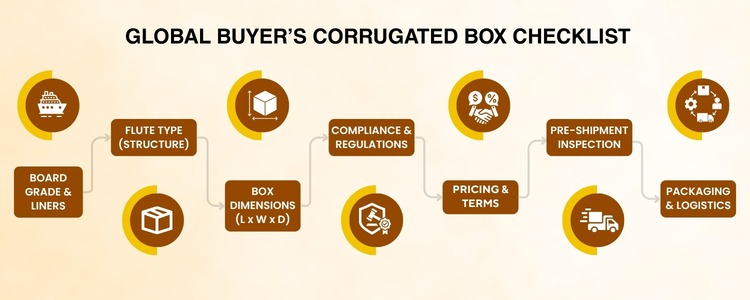
Corrugated boxes are made from linerboard and corrugated medium with fluting. Material composition, board design, and the manufacturing process affect the box’s quality and performance. Before requesting a quotation, overseas buyers need to provide the following information:
- Carton’s length, width, and height
- Corrugated board’s quality and flute profile
- Number of corrugated layers
- Edge crush test (ECT)
- Bursting strength
- Carton’s weight capacity
- Printing instructions
- Requirements for moisture resistance
- Folding and closing design
- Packaging and palletizing instructions
The specified dimensions, design, and materials depend on the weight and nature of the contained goods, transport mode, and other conditions. For instance, a paperboard box for clothing will differ from a box for industrial equipment. Following the technical specifications ensures the selected packaging will adequately protect the goods during transit.
Choosing the Export Supplier
When determining the corrugated box supplier, international buyers should consider the production capabilities, quality control processes, and pricing offered by manufacturers. Overseas buyers should look for firms using high-quality materials and advanced equipment. Producers with their own corrugating machines typically deliver superior results than subcontractors or trading companies.
Moreover, buyers need to ensure that the chosen company can fulfill the order’s specific requirements. Producers have different capabilities in regard to the corrugated sheets, box styles, and printing. For each request, buyers should ask for the following information:
- Machinery and equipment
- Raw material suppliers
- Production schedule
- Production capabilities
- Experience with international shipments
- Flexibility in the face of supply disruptions
- Payment terms
- Inspection and quality control procedures
It is essential to learn how the selected manufacturer will handle unexpected interruptions, such as delays in raw material deliveries. Fluctuating paper prices can impact the cost of carton boxes, particularly for large-scale purchases.
Before finalizing the deal, it may be necessary to request a sample for evaluation. Moreover, before placing a bulk order, it is advisable to inspect the factory to ensure that it meets the minimum production requirements, including staff qualifications, certifications, and safety standards.
Testing Production Quality
Paperboard boxes offer mechanical protection for goods in storage and during transit. The packaging’s quality should be reviewed to prevent damages to the contained items. To validate the production process, international buyers should ask for test results or review the samples. The critical indicators include:
- Edge crush test (ECT)
- Bursting strength
- Compression strength
- Box’s dimensions and tolerance
- Moisture content
The specific tests depend on the characteristics of the contained goods and the prevailing conditions during transit. For instance, a box for export may experience temperature fluctuations, heavy loads, and rough handling. In such cases, it may be required to conduct performance tests under similar conditions. The results will ensure that the chosen packaging meets the required standards and does not require modifications during the production process.
Customization and Branding Instructions
Paperboard boxes serve two critical functions: protecting the contents and delivering the desired impression in regard to visual appeal and brand image. Customized boxes provide a unique appearance, supporting product differentiation and enhancing the perceived value. Exporters offer various customization options, including unique graphics, box size, and divider inserts.
Before requesting a quotation, overseas buyers need to provide their requirements concerning printed graphics, special instructions, and box styles. If the packaging should include logos, barcodes, or follow specific design standards, it is advisable to obtain a sample for approval.
Customized options may also impact the manufacturing cost, minimum order size, and production timeline. Therefore, before finalizing the order, international buyers need to review all associated costs, including the per-carton price, delivery terms, and documentation costs.
Export Documentation and Certifications
International sales require appropriate documentation, including commercial documents and shipping papers. Depending on the transportation terms, buyers and sellers should be aware of the certificates of origin, packing list, and invoice details for the chosen shipment. For large-scale international sales, both parties need to clarify the required documents in advance.
Boxes containing specific goods often require compliance with industry-specific regulations. For instance, food packaging has more stringent requirements than regular industrial boxes and may need special certification. Similarly, wooden pallets or packaging materials may need IPPC certification to prevent the spread of pests.
Box Packing and Transportation Process
The packaging material and style can impact the shipping costs and efficiency. For instance, oversized containers can increase the transportation expenses, while insufficient protection can result in product damages. When requesting a quotation, overseas buyers should ask for the most suitable packaging options.
The ideal solution ensures that the box fits the product while providing the necessary protection. Using flat-packed boxes is a cost-effective way to minimize the storage and transportation costs before assembling the packaging at a different location. However, international buyers should keep in mind that it may be necessary to allocate space and equipment for the assembling process.
The primary purpose of the carton box is to ensure that the goods stay undamaged during transport and storage.
Comparing Quotation Offers
Before finalizing the transaction, overseas buyers should compare pricing offers from different suppliers. A favorable factory price does not always represent the best value, as the total cost should also consider the transportation costs, documentation, and other expenses.
Corrugated box manufacturers in India offer different pricing based on the specifications, printing, shipment mode, and other factors. International buyers should compare similar quotations, asking for the same production specifications, terms, and delivery conditions.
The parties also need to consider the Incoterm, payment conditions, quotation validity, and responsibility for any inspection or rework. For repeat orders, it is advisable to establish a pricing review procedure to ensure that both parties can respond to market fluctuations, such as changing paper prices, without significant delays.
Establishing a Long-Term Partnership
An initial order is an excellent way to review the quality, delivery terms, documentation, and responsibilities of an overseas supplier. Before placing the full-volume order, foreign buyers can take advantage of a sample or small-volume trial run. Once the production quality is consistent, it is possible to consider a repeat order or long-term cooperation.
It is critical to emphasize the communication role during the production process. This is particularly essential for orders with customized packaging boxes, varying volume sizes, and delivery schedule changes. Changes and updates should always be documented, preferably in writing, to avoid misunderstandings. Reliable exporters will be transparent about anticipated delays, providing valuable insight into their production capabilities and challenges.
Conclusion
India has a wide range of manufacturers and exporters of carton boxes for domestic and international sales. To reduce the risk of being deceived by aggressive pricing, overseas buyers need to consider the following points:
- Thoroughly defining the requirements
- Finding the most suitable manufacturers
- Reviewing the sample/test results
- Evaluating the total cost, including shipping and documentation
- Considering the document requirements for export
- Ensuring production timelines are followed
- Facilitating ongoing communication with the exporter
The right choice of cardboard boxes supplier will significantly impact the overseas buyer’s productivity and profitability. A small-volume purchase with a reliable exporter can be the basis for long-term sourcing relationships.
International buyers can use the tips listed above to find the best exporter for their packaging needs. The critical success factor is to choose the right manufacturing partner, minimizing production and delivery risks while reducing expenses.
1. What are the common applications of corrugated boxes?
Corrugated boxes are used for storage, shipping, and transportation of goods. The boxes’ characteristics vary depending on their intended purpose, with the materials and box construction playing a vital role. Corrugated boxes can also be used for e-commerce and retail.
2. How should overseas buyers select the corrugated box exporter in India?
Foreign buyers need to consider the manufacturing capabilities, production-related costs, and product quality. Buyers should verify the experience, business credentials, and quality control procedures. It may also be necessary to request samples, references, and conduct a factory audit.
3. What documents are required for the international shipment of corrugated boxes?
The required documents depend on the shipment terms, destination, and applicable agreements. Typically, the packing list, commercial invoice, and bill of lading are required for transporting the corrugated boxes. In some cases, additional documents are required to meet the importer’s specifications.
4. How should international buyers compare different quotation offers?
Overseas buyers should pay particular attention to the corrugated board’s specifications, dimensions, and other production details. International buyers should also consider the delivery terms, payment conditions, and responsibility for inspection. It is essential to review all aspects impacting the final cost, including the per-carton price, shipping, and inspections. The comparison should be based on the overall cost, not the factory price.
5. What factors impact the export price of corrugated boxes?
Several factors influence the export price, including the cost of materials, cardboard’s characteristics, printing, and production complexity. The order’s size, delivery terms, and destination can also play a vital role in determining the final cost. Additionally, freight rates and applicable duties should be taken into account.
6. Are samples required before the production of corrugated boxes?
Sample evaluation is an integral element of any packaging order since it defines the accuracy of the production specifications. International buyers can use this opportunity to review key characteristics, including the box dimensions and material thickness. It may also be beneficial to request a performance test to ensure that the chosen packaging will be suitable for the intended application.

Diptanshu
Leading research and marketing at Inductus Global, Diptanshu drives the company’s vision to transcend traditional trading through thought leadership in import-export. He spearheads a research-driven approach that prioritizes quality over price arbitrage, positioning Inductus as a strategic sourcing partner rather than a transactional intermediary. His work spans market intelligence, supply chain innovation, and trade dynamics, while playing a key role in sales and business development.