

Clove Export from India 2026: Quality Standards, Buyer Markets and Step-by-Step Export Process
The clove trade of India has consistently maintained a place within international commerce, and the future total number of clove exports from India in the year 2026 will depend on how well Indian farmers carry over the traditional practices of cultivating cloves with the modern influence of global demand. Increasingly, exporters have adjusted their farming methods to balance quality, traceability, and compliance with the increased scrutiny imposed by buyers located across the globe.
Through their pleasant smell as well as their use in medicine, cloves are in high demand in several industries, including Food-processing, pharmaceuticals, and personal care products. While India does not produce as many cloves as other countries, its role as a processor and re-exporter will further establish its place within the global spice trade.
Overview of India’s Position in the Global Clove Trade
The global clove trade has always been a significant player in international trade, but how many cloves India will export in 2026 is dependent on how well Indian growers continue traditional clove growing practices in conjunction with the new global demand for cloves, which will influence how much they produce. The exporters have made many changes in their growing practices to create better quality products with consistent traceability and greater compliance with increased buyer scrutiny as a result of global competition and changing buyer preferences.
In addition to their pleasant aroma, the demand for cloves is also growing due to their many uses in medicinal applications. Cloves are an important ingredient used in various industries, including food processing, pharmaceuticals, and personal care products. Although India does not produce the most cloves globally compared to other countries, it will continue to play a significant role in processing and re-exporting cloves in support of their role in the global spice market.
Quality Standards Driving Export Success
Quality is fast becoming the key factor defining the competitiveness of exporting businesses. In developed countries, buyers worldwide have become more and more demanding when it comes to their product specs. Prescriptive and Productive Parameters For cloves that qualify as being export quality, there are measurable criteria that must be adhered to, including:
- High levels of oil content are indicative of a clove’s aroma and potency.
- Uniformity of size and colour
- Low levels of moisture make the spice less susceptible to fungal growth
- No foreign matter whatsoever;
- Conformance with International Standards and Regulations
Countries such as the US and EU have stringent regulations with respect to Food Safety, requiring exporters to adhere to specific guidelines for pesticide residue, levels of heavy metals, and levels of Microbial contamination.
Exporters often receive various certifications, such as:
- ISO Standards for Quality Management;
- HACCP for Food Safety;
- Organic Certifications for specialty niche markets.
Importance of Traceability
Traceability is now an essential requirement in the supply chain. Buyers expect to receive a proof of the products’ history and where they have been shipped from; this has prompted exporters to implement digital tracking systems and be transparent about how they source their products.
A reputable wholesaler supplying organic clove must also focus on reliability, documentation and compliance with international standards.
Key Buyer Markets for Indian Cloves in 2026
Regions around the world demand cloves differently. In most cases, you will see distinct characteristics in terms of where cloves are purchased and how they are consumed.
The Middle East has been a consistent importer of Indian clove exports. Many countries in this region, including Saudi Arabia and the UAE, rely on imported cloves to meet their household consumption needs or have re-exported them internationally.
European nations offer high-value opportunities for Indian clove exporters, however; they also require compliance to meet strict standards. Many buyers in this region will accept only high-grade, residue-free cloves harvested by certified suppliers.
Increasing demand for processed and packaged spices has created export opportunities for Indian exporters to the United States. This trend is expected to continue, particularly as more processed food products are sold.
Demand for cloves is also growing in many Asia-Pacific countries, like Vietnam and Thailand, because of their expanding food processing industries. With the potential for export growth in these countries, Indian clove exporters should focus on meeting the increasing demand for their products.
Evolution of the Clove Export Business
There have been significant changes in the clove export industry in India during the last ten years. The way people have traditionally done business is changing because of the new technology and the structured ways of doing business that are now available.
Some of the major areas of concern to exporters are:
- Adding value through the development of clove products such as essential oils and extracts
- Creating brand equity within international markets so that customers know who they are
- Improving the efficiency of their supply chains to eliminate delays and maintain the integrity of their products
- Using sustainable methods of production
Digital platforms have allowed exporters to establish direct connections with international buyers, thereby reducing their reliance on intermediaries and improving their margins.
Step-by-Step Clove Export Process
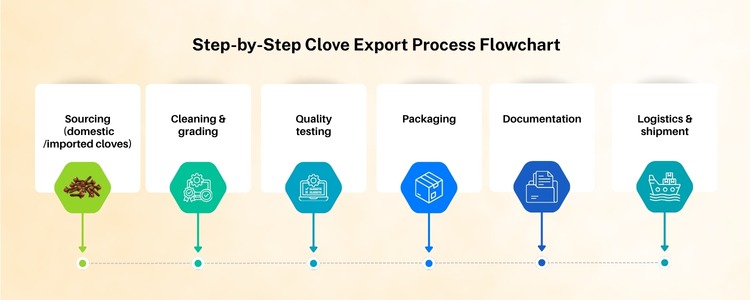
If a company is preparing to enter the export market for cloves, it is critical that they understand the entire exporting process from the point of sourcing to the final shipment. This process includes several stages; they are as follows:
Sourcing and Procurement: Cloves are procured either from a domestic source or an international source depending on whether the cloves are produced. Before export, the exporters must assure that their raw material meets at least minimum quality standards to allow for further processing.
Cleaning and Grading: Once the cloves have been procured, they undergo a cleaning process to eliminate any impurities and are subsequently divided into grade classifications depending on specific attributes such as size, colour, and oil content. This stage is important in determining the market value of the product.
Quality Testing: After cleaning and grading, the final product is tested in a laboratory for adherence to pre-established international standards. The testing covers three main parameters including but not limited to moisture content, essential oil content, and contamination.
Packaging: Once the cloves have passed quality testing, they are packed in moisture barrier and food grade packaging material to protect their quality during the transportation process. Proper packing of cloves leads to better marketability when they are moved to international markets.
Documentation: All export documentation must accompany an export shipment and includes at a minimum but not limited to the following: Invoice; Packing List; Certificate of Origin; Phytosanitary Certificate. Properly completed and accurate export documentation is needed for clearance through the customs process.
Logistics and Shipment: The exporter must make arrangements with a logistic company to ensure that the cloves are shipped in a timely manner. The exporter’s ability to manage and coordinate an effective supply chain is essential to achieve quality product delivery to the export buyer.
A professional clove exporter India must consistently handle each step of the clove exporting process with great care and attention to detail in order to ensure both legal compliance and customer satisfaction.
Challenges in Clove Export from India
Exporters face many challenges despite the potential for positive growth:
- Reliance on imports: Limited domestic production leads to instability in the supply chain.
- Prices fluctuate: Changes in the global market will have an effect on the stability of prices for exporters.
- Greater Compliance: Compliance will increase the cost of doing business.
- Increased Competition: Other countries that export are working to expand their presence in the marketplace.
To overcome these challenges, procuring and integrating better processes will be key and will require the development of a well-thought-out and planned approach.
Emerging Opportunities in 2026
The future of Indian clove exports looks bright because there are many factors driving growth in this sector. Some of the factors fueling the growth of Indian clove exports are:
Increased Demand for Natural Products
Consumers increasingly prefer to purchase natural and organic products. As cloves are a natural product with medicinal qualities and uses, they will be able to benefit from this trend of increased demand for natural products.
Expansion into Non-Traditional Markets
Opportunities for new exporters include regions in Africa and Latin America, as they are both untapped markets for clove exports.
Value-Added Products
The growing popularity of using clove oil and extracts in pharmaceuticals and cosmetics means that Indian exporters will be able to earn higher profit margins than through the sale of raw cloves.
Technological Improvements
Utilizing digital technologies to improve quality control and supply chain management will enhance both efficiency and transparency.
Conclusion
As the dynamics of global trade continue to change, Indian clove exports are evolving to adapt to these challenges and opportunities. India’s clove export sector now has an emphasis on quality and compliance, and on operating efficiently in order to maintain continued growth in international markets.
Moreover, the scope of the Indian clove export industry has expanded beyond traditional trading methods; it now includes value-added products, technological integration into the clove supply chain, and strategic expansions into new international markets. Therefore, Indian exporters can capitalize on the growth of global demand for high-quality cloves through the right approach.

Diptanshu
Leading research and marketing at Inductus Global, Diptanshu drives the company’s vision to transcend traditional trading through thought leadership in import-export. He spearheads a research-driven approach that prioritizes quality over price arbitrage, positioning Inductus as a strategic sourcing partner rather than a transactional intermediary. His work spans market intelligence, supply chain innovation, and trade dynamics, while playing a key role in sales and business development.






One Reply to “Clove Export from India 2026: Quality Standards, Buyer Markets and Step-by-Step Export Process”
Trusted Indian Spices Suppliers for USA, UK & UAE Buyers
03 Sep 2026[…] weather swings and abrupt regulatory intervention; in late 2023 the country was compelled to pause clove exports altogether while certification compliance was […]