

How to Source Premium Cardamom from India: Your Complete Guide to Exporters, Certifications, and Documentation
Trying to source cardamom could be one of the most frustrating things in the world. Exporters have different definitions of quality, goofy certification requirements, and strange ways of treating customers. Sometimes, I watch importers pay higher prices for premium cardamom only to process cardamom that would fail a quality check.
About 70% of cardamom is exported from India, according to the Spices Board of India, meaning that cardamom imports will be dominated by Indian exports. While some players may mix or stretch the meaning of quality grading and certification, and other paperwork may provide the importer with some level of protection, the Indian cardamom game involves much more.
With years of experience, I can help you understand how to source cardamom effectively and share some of my trade secrets.
Understanding India's Cardamom Varieties and Market Positioning
As a first-time buyer, before you reach out to an initial supplier, you need to learn about an important distinction. There is a segment of the market for sellers of green cardamom and then there is the segment for sellers of black cardamom. If you do not know this distinction, you will not know what you are buying when you contact a supplier.
The major exporters of green cardamom are selling Eritrean cardamom, as this is the variety that international buyers are mostly interested in. Growing in the Western Ghats of Kerala or parts of Karnataka, green cardamom is almost always justifiably prized at export prices of $25 to $45 per kilogram. Green cardamom has the ideal sweet and aromatic flavor to be used in baked goods, desserts, and high-end spice blends.
Unlike the exporters of green cardamom, the sub-Himalayan and Northeast states of India grow what is called black cardamom (Amomum subulate). It is typically one-fifth the price of green cardamom, and the two varieties serve completely different purposes in cooking. Due to its flavor profile containing a smoky camphor taste, black cardamom is used in the savory cooking of Indian and Chinese cuisine. A research article from the Journal of Essential Oil Research, it helps explain the position that black cardamom has several types of unique volatile compounds, thus elucidating the differences in its flavor and its medicinal value.
The takeaway: before contacting your suppliers, be clear about which variety you are sourcing. Nothing has killed more orders than this type of misunderstanding.
Identifying Credible Indian Spices Exporters: What to Verify
The Indian cardamom export market hosts trading companies, intermediaries, etc., from established firms to opportunistic meddlers. Here’s your verification checklist:
Registration and Legal Compliance
An Import Export Code (IEC) issued by India’s Directorate General of Foreign Trade (DGFT) is required for all exports. The 10-digit code is a must. If your supplier doesn’t have it and can’t provide it upon demand, look elsewhere. Green cardamom suppliers should be registered with the Spices Board of India. If they are, they should provide their registration number for verification.
Infrastructure and Processing Capabilities
Cardamom of export quality should satisfy certain standards. During sourcing visits, I was fortunate to see some of the best and some of the worst processing facilities in the Idukki district of Kerala. The best is invested in proper handling facilities, such as climate-controlled storage, pest-control fumigation chambers, and grading machines. Export-quality supplies should be kept pest-free in controlled dry warehouses.
The worst, such as a supplier I almost partnered with, kept cardamom in a non-air-conditioned warehouse during the monsoon, which led to a total loss of quality. This is why facility verification, whether in person or virtually, is a must.
Financial Stability and Track Record
Get bank references and check trade credit through sites like Dun & Bradstreet, which shows many established Indian exporters. Third-party financial verification is a sure sign of their operational legitimacy.
Here's a practical comparison of what to expect:
Verification Point | Established Exporter | Questionable Supplier |
Response Time | 24-48 hours with detailed specs | Instant responses, vague details |
Sample Policy | Charges a nominal fee with proper COA | Free samples without documentation |
Minimum Order Quantity | Realistic (500kg-1 ton typically) | Accepts any quantity |
Payment Terms | LC, DA, or verified escrow | Demands 100% advance payment |
Certifications | Provides certified copies proactively | Claims to “arrange” after payment |
Digital Presence | Professional website with facility photos | Social media only or generic site |
Data from India’s Agricultural and Processed Food Products Export Development Authority (APEDA) indicate that more than 60% of first-time importers say that importing suppliers are either not registered or do not have proper infrastructure. Don’t be one of them.
Essential Certifications: What You Actually Need
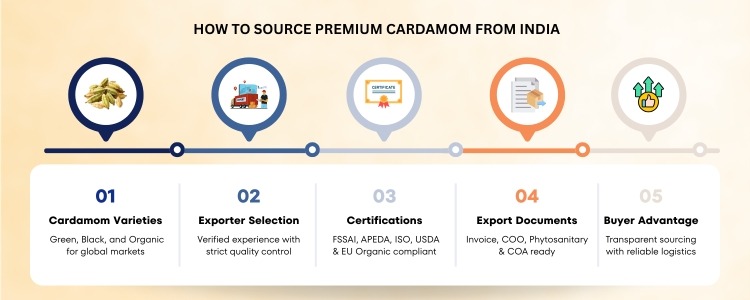
Post 2020, with the tightening of global food safety regulations, the certification process for cardamom exports from India has undergone considerable change. Here is a summary of the essentials and non-essentials.
Requirements:-
- Phytosanitary Certificate—This is issued to confirm that the shipment doesn’t harbor any sort of pest or disease. Virtually all countries require this without exception.
- Certificate of Origin—This certifies that your cardamom is of Indian origin. This can be important to achieve a lower import duty in accordance with various trade agreements. These are provided by your regional Chamber of Commerce.
- FSSAI License—This has been in effect since 2018. The Food Safety and Standards Authority of India enforces this license. It has consolidated many of the previous food safety regulations.
Advantages: –
Although optional, these certifications open new market avenues while allowing you to charge more.
– Organic Certification (USDA/EU Standards)—India has more than 5,000 organic cardamom growers, particularly in Kerala. According to APEDA, in the 2022-23 period, organic cardamom exports increased by 18% annually, indicating strong demand in the international market.
– Fair Trade Certification—This is particularly important to fulfill the needs of conscious customers and specialty retail.
– ISO 22000— (Food Safety Management) This demonstrates supply chain management with respect to quality.
Beware of suppliers who say that they “arrange” the certifications once you’ve already paid. Certifications are always done before export and not in retrospect. I have witnessed many importers pay a substantial deposit to suppliers for the promise of certifications, which never transpired.
Documentation Requirements: Your Paper Trail Protection
Even seasoned importers can take their eyes off documentation. This is what you should have and why it is important:
Core Export Documents
Every cardamom export from India shipment has to follow a specific paper trail. A commercial invoice includes the transaction value and transaction terms. The packing list details the contents of the containers, weights, and specifications of the packaging used, which are all essential for customs clearance. The bill of lading is your title and proof of shipment.
Quality Assurance Documentation
Insist on a Certificate of Analysis (COA) from an accredited laboratory. The following should be reported: Moisture content (should not exceed 12% for green cardamom), Volatile oil content (at least 4% for premium grades), Microbiological test results. The Spices Board of India has established a set of accredited laboratories, and COAs are accepted worldwide.
Ask for SGS or other third-party inspection reports on major orders. Yes, it’s an additional expense, but it’s a way of guarding against quality issues. The inspection fee is just $300, and if that inspection is rejected, it’s just $50,000 worth of cargo you’re losing.
Contractual Protections
Be specific in your purchase contract – don’t use phrases such as “export quality” or “premium grade. Establish moisture limits, volatile oil limits, size limits, and defect limits. Incorporate penalty terms for non-conforming shipments and dispute resolution provisions.
The lesson was expensive for me when I got cardamom from a supplier that met their internal export quality, which was much below industry standards. If we didn’t have certain parameters in the contract, we would have none at all.
Documentation Requirements: Your Paper Trail Protection
Initially, try ordering smaller quantities of 500 kg to one ton for your first order so you can evaluate the supplier’s ability to provide consistency, communicate effectively, and resolve issues before you make a larger order.
When you set up your payment method, use methods that afford you protection from loss. Letters of Credit are still the preferred method for first-time payment transactions, but come with bank fees. If you have an established business relationship, then payment terms of Documents Against Payment and Documents Against Acceptance can provide reasonable protection as well.
Focus on building the relationship rather than just building a transaction. The best Indian spice suppliers that I’ve worked with look at their partnerships as long-term commitments. They are continuously keeping you informed of crop conditions, price fluctuations, and supply interruptions because they care about helping you be successful so that you can help them be successful.
Conclusion
Sourcing cardamom from India offers great advantages through access to the largest supply in the world, cost-effective pricing, and high quality, with a commitment to verification at the point of finding your correct partners. It takes time and effort to vet suppliers. Take the time to review documentation without cutting corners; do not skip the vetting process just because the supplier has attractive pricing or the lowest quote. The lowest quote generally is not the best value; any time you have issues with a shipment, you lose more in reputation and dollars than you could save by taking shortcuts in your diligence.
The suppliers worth building a partnership with will be open to you asking questions, cooperating with reasonable verification requests, and providing a high degree of transparency as the relationship develops. These types of partnerships develop from being transactional partners to becoming strategic partners.
To begin with, do the basics: verify registration status, perform site inspections, and require the appropriate certification, as well as all appropriate documentation. Your future self will benefit from all the help you create for yourself today.

Diptanshu
Leading research and marketing at Inductus Global, Diptanshu drives the company’s vision to transcend traditional trading through thought leadership in import-export. He spearheads a research-driven approach that prioritizes quality over price arbitrage, positioning Inductus as a strategic sourcing partner rather than a transactional intermediary. His work spans market intelligence, supply chain innovation, and trade dynamics, while playing a key role in sales and business development.