

Premium Basmati Rice Supplier in India for Wholesale Buyers
Basmati Rice: India's Kitchen Staple With a Global Wholesale Backbone
To home cooks and restaurant chains across the world, basmati is simply the fragrant long-grain rice behind biryanis, pilafs, and everyday dinner plates. But behind that familiar kitchen image sits one of India’s most carefully engineered agricultural export systems, built over more than three decades.
The foundation was laid in 1989, when the Indian Agricultural Research Institute (IARI) released Pusa Basmati 1, the country’s first high-yielding indian basmati rice variety, followed by legal Geographical Indication (GI) protection for the crop in 2003 — a move that legally tied “basmati” to a specific belt of Indian soil and locked out imitation. That engineered foundation is now being pointed at a new audience: wholesale buyers, distributors, and food processors who want a supplier relationship built on more than a one-time bulk quote.
How Focused Suppliers Are Becoming India's New Wholesale Gateway
For years, global wholesale buyers seeking basmati defaulted to a handful of legacy Indian export houses running large-scale private-label contracts — the kind of relationships that come with major retail partners abroad and margins reported in the 25-35% range on premium basmati lines. That model works well for retail giants placing enormous, standing orders, but it leaves mid-sized wholesalers, regional distributors, and food processing companies further down the priority list, often facing higher minimum order volumes, longer lead times, and less flexibility on packaging or grain specification.
Focused, direct-mill suppliers are stepping into that gap, offering wholesale buyers a more direct relationship with the mill and harvest behind their rice, rather than an anonymous slot in a mega-exporter’s production queue. Independent research backs the scale of the opportunity: Expert Market Research’s Global Basmati Rice Market Report and Forecast 2026-2035 projects sustained growth in global basmati demand, while The Business Research Company’s own analysis expects the broader basmati rice market to reach $25.96 billion by 2030.
Inductus Global’s own sourcing and advisory work with international wholesale buyers reflects the same shift — buyers increasingly prioritizing responsiveness, order flexibility, and mill-level traceability over simply chasing the lowest quoted price. Nationally, the ambition backing this shift is explicit: India’s Ministry of Commerce has set a $100 billion agricultural export target for 2030, a goal Commerce and Industry Minister Piyush Goyal has said requires a sustained 14-15% annual growth rate across food, agriculture, and marine exports.
| Parameter | India | Pakistan | Thailand | Vietnam |
|---|---|---|---|---|
| Cost of Operations | Premium 1121 Sella near $1,200/MT, with competitive white rice FOB pricing | Comparable white rice FOB pricing, with growing basmati volumes | Jasmine rice trades well above basmati at $750–900+/MT | Lower-cost jasmine-style rice at approximately $430–440/MT |
| Grain & Aroma Quality | GI-protected, extra-long grain with superior kernel elongation | Similar genetics, but less standardized grading | Distinct floral jasmine aroma and a different product category | Jasmine-style rice with generally lower price positioning |
| Export Volume & Reliability | World’s largest basmati exporter, with 5.24M MT worth $5.83B exported in FY 2023–24 | Second-largest basmati supplier, with smaller export volumes | 2026 export target reduced 11% to 7.03M tons amid strong-baht pressures | Rice exports increased 5% YoY in early 2026, while export values declined |
| Certification & Compliance | APEDA and FSSAI compliance, GI tag since 2003, and improving traceability | Certification standards continuing to develop | Established Hom Mali GI certification, serving a different product category | VietGAP and GlobalG.A.P. adoption continuing to grow |
| Infrastructure Maturity | Kandla, Mundra, and Nhava Sheva provide diversified export gateways | Karachi-centric infrastructure with less port diversification | Bangkok-centric export network, with currency pressures affecting competitiveness | Strong Mekong Delta logistics and rice-processing network |
| Government Incentives | Government focus on expanding agricultural exports, with APEDA supporting export promotion and market development | Export-focused policies with comparatively less institutional backing | Currency headwinds are putting pressure on export price competitiveness | Regional trade agreements and export-market access support the rice sector |
Wholesale Partnerships Surrounding India as Leading Destination for Global Basmati Sourcing
A direct-mill wholesale partnership is fundamentally different from the multi-tier broker distribution that has historically defined bulk rice trade. Rather than rice changing hands across several intermediaries before reaching a wholesale buyer — each layer adding cost and diluting traceability back to the harvest — a direct partnership ties every shipment to a specific mill, aging batch, and documented compliance record, including the phytosanitary certificates, FSSAI licensing, and APEDA registration that buyers now expect as standard when importing basmati rice from India.
The competitive backdrop makes India’s position notable. Thai Rice Exporters Association President Pol Lt Charoen Laothamatas has pointed to a strong baht and elevated domestic prices as key reasons Thailand cut its 2026 export target to a five-year low, even as global rice trade hit a record 62.8 million tons for the year. India, by contrast, exported 5.24 million metric tons of basmati worth $5.83 billion in the most recent full fiscal year, with Saudi Arabia alone accounting for roughly 21% of that volume. For India’s wholesale-focused agro food products exporters, the opening is clear: as a major competitor’s supply tightens on currency pressure, buyers searching for a stable, GI-protected alternative have more reason than ever to look toward Indian basmati rice suppliers.
India's Basmati Belt as Center of Wholesale Trust & Capacity
Geographic Factors
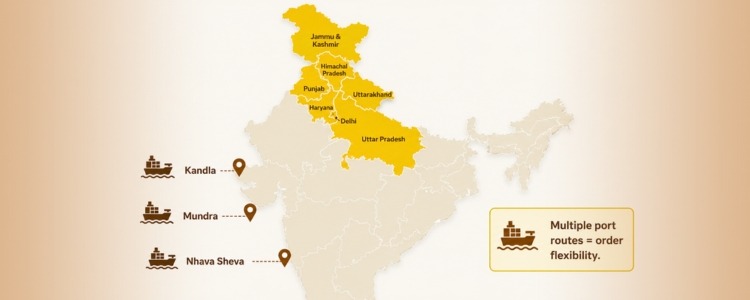
India’s wholesale supply chain begins in the Geographical Indication zone spanning seven northern states — Punjab, Haryana, Uttar Pradesh, Uttarakhand, Delhi, Himachal Pradesh, and Jammu & Kashmir — before moving through Kandla, Mundra, and Nhava Sheva, the three ports handling the bulk of India’s basmati export volume. A standard 20-foot container carries roughly 24-26 metric tons of rice, giving wholesale buyers a predictable, scalable unit for planning repeat orders regardless of destination.
Talented Youth
Basmati cultivation across Punjab and Haryana has traditionally passed down through farming families, and a newer generation is now taking it up with different tools — GI-registered seed varieties, precision irrigation, and direct digital access to mills and exporters that reduces dependence on local middlemen. Where earlier generations often left for city jobs, the crop’s premium pricing over ordinary rice varieties is giving younger farming families a tangible reason to stay in cultivation.
Qualified Professionals
Every basmati variety moving through India’s wholesale export pipeline traces back to institutional plant breeding at the Indian Agricultural Research Institute (IARI) in New Delhi. Breeders there, including Padma Shri awardee Dr. Ashok Kumar Singh, developed the Pusa Basmati lineage — 1121, 1509, and their successors — engineered specifically for the extra-long grain length and high kernel elongation that define export-quality basmati, rather than relying on generic farming know-how alone.
Innovation First Strategy
Institutional backing continues to shape the sector’s wholesale-readiness. GI protection secured in 2003 legally restricts basmati cultivation to the seven-state zone, safeguarding authenticity for buyers sourcing at scale. Layered on top, APEDA’s BHARATI initiative — supporting 100 agri-food startups with a $50 billion export target by 2030 — signals a broader institutional push to modernize traceability and market-readiness across India’s agro food products exports, basmati included.
Conclusion
India’s focused basmati suppliers aren’t trying to outbid the two or three legacy exporters holding mega-retail private-label contracts abroad — that scale of commitment isn’t the game being played here. The differentiated pitch is a wholesale relationship built on direct-mill traceability, verified compliance, and order flexibility for buyers who don’t need — or want — to negotiate through several layers of brokers. The comparison to a maturing, trust-based supply chain isn’t marketing gloss — it’s a trajectory backed by real numbers.
India already exports $5.83 billion worth of basmati annually, GI protection has safeguarded authentic sourcing since 2003, the national agricultural export target sits at $100 billion by 2030, and a major competitor’s 2026 export capacity is shrinking under currency pressure even as global rice trade hits a record high. Whether India converts these advantages into a meaningfully larger share of the world’s wholesale basmati trade remains to be seen, but for buyers weighing a direct, verified supplier relationship over another layer of brokerage, the direction of travel is no longer in question.

Diptanshu
Leading research and marketing at Inductus Global, Diptanshu drives the company’s vision to transcend traditional trading through thought leadership in import-export. He spearheads a research-driven approach that prioritizes quality over price arbitrage, positioning Inductus as a strategic sourcing partner rather than a transactional intermediary. His work spans market intelligence, supply chain innovation, and trade dynamics, while playing a key role in sales and business development.