

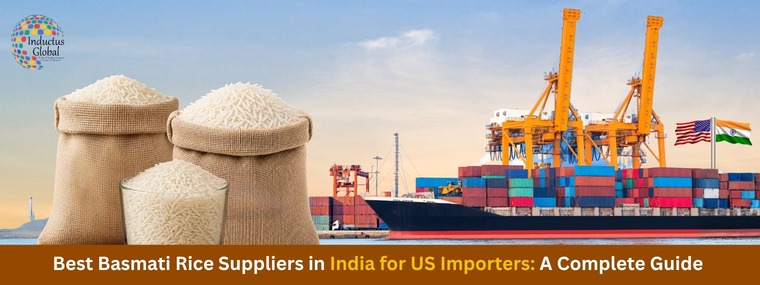
Best Basmati Rice Suppliers in India for US Importers: A Complete Guide
Basmati Rice: More Than a Kitchen Staple, A National Export Identity
To most American consumers, basmati rice is a grocery-aisle staple — the long, fragrant grain behind biryanis, pilafs, and weeknight curries. But behind that kitchen-shelf image sits a tightly engineered agricultural export system that India has spent more than three decades building. The foundation was laid in 1989, when the Indian Agricultural Research Institute (IARI) released Pusa Basmati 1509, the first semi-dwarf, high-yielding basmati variety, followed by the landmark Pusa Basmati 1121 in 2003 — the variety that holds the world record for kernel elongation on cooking and now anchors India’s premium export basket.
Basmati wasn’t left to grow wild in the market; it was bred, protected, and positioned. Today, with the United States government pursuing a $100 billion agricultural export target by 2030, and Indian trade bodies pushing to diversify basmati’s buyer base beyond the Gulf, the next phase of that strategy is aimed squarely at American importers.
Emerging Alternative to Legacy Bulk Suppliers: How Focused Exporters Are Reshaping Basmati Sourcing for the US
For years, US importers largely defaulted to broker-driven bulk purchasing — sourcing basmati through multi-origin trading houses that blended Indian, Pakistani, and Southeast Asian aromatic rice with limited visibility into mill origin or grain age. That model is under strain. A 50% US tariff on Indian basmati, against roughly 19% for Pakistani basmati, has squeezed margins, while 2025 flood damage across Punjab wiped out an estimated 10% of potential basmati output, according to the India Rice Exporters Federation (IREF). Buyers are responding by moving away from anonymous bulk lots toward exporters who can guarantee direct-mill traceability, consistent grain aging, and full compliance documentation.
Specialized exporters working the Punjab-Haryana-Uttar Pradesh basmati belt — shipping primarily through Kandla, Mundra, and Nhava Sheva ports — are stepping into that gap, offering US buyers verified sourcing relationships rather than opaque broker chains. Independent research backs the shift: Expert Market Research values the US packaged basmati rice market at $6.5 billion in 2026, projecting growth to $10.1 billion by 2033.
Inductus Global’s own work advising US-based importers on ethnic-food sourcing points to the same pattern — buyers increasingly prioritizing verified mill relationships and aging transparency over marginal price differences. On the policy side, India’s ambition is stated in hard numbers: the Ministry of Commerce has set a $100 billion agricultural export target for 2030, while APEDA’s newly launched BHARATI initiative aims to support 100 agri-food startups and lift agri-food exports to $50 billion by the same year.
| Parameter | India (Verified Exporters) | Pakistan | Thailand (Jasmine Rice) | US-Grown Aromatic Rice | Who Has the Advantage? |
|---|---|---|---|---|---|
| Tariff Exposure (US Market) | ~50% tariff, resulting in higher landed costs | ~19% tariff, offering a pricing advantage | No basmati-specific tariff overhang | No import tariff (domestic production) | Pakistan & US-Grown (Cost Advantage) |
| Grain & Aroma Quality | GI-protected authentic basmati, extra-long grains, superior elongation and aroma | Similar genetics but less consistent grading | Shorter grain with a different aroma profile | Aromatic rice, but not true basmati genetics | India (Authenticity & Premium Quality) |
| Supply Volume & Reliability | Supplies approximately 65–70% of the global basmati market with consistent availability | Lower production capacity | High production but belongs to a different rice category | Limited, niche production | India (Scale & Reliability) |
| Traceability & Compliance | APEDA registration, FSSAI compliance, improving farm-to-export documentation, direct mill sourcing | Compliance improving but less standardized | Well-established certification system for jasmine rice | Domestic compliance standards only | India (Verified Export Supply Chain) |
| Export Infrastructure | Major export gateways including Kandla, Mundra, and Nhava Sheva, with extensive logistics networks | Primarily Karachi port with fewer alternatives | Mature Southeast Asian export infrastructure | Domestic logistics focused on the US market | India (Greater Port Diversification) |
| Government Incentives & Export Policy | Strong institutional support through APEDA and India’s $100 Billion Agricultural Export Vision 2030 | Export-oriented policies with comparatively lower institutional support | Stable rice export policy but limited basmati-specific initiatives | Domestic agricultural support rather than export incentives | India (Long-Term Export Strategy) |
Role & Relevance of Verified, Direct-Mill Sourcing Surrounding India as Leading Destination for US Basmati Imports
Direct-mill sourcing is fundamentally different from traditional commodity brokering. Rather than a trading intermediary blending rice from multiple origins and mills into a single anonymous lot, a verified export partnership ties every shipment back to a specific mill, harvest, and aging batch — turning basmati from a fungible commodity into a traceable, accountable product. This distinction is exactly what institutional US buyers, from retail chains to foodservice distributors, are now demanding.
APEDA Chairman Abhishek Dev has pointed to infrastructure upgrades and expanded export facilities as central to India’s push toward the $100 billion agricultural export goal, a target Commerce and Industry Minister Piyush Goyal has said requires sustained 14-15% annual growth across food, agriculture, and marine exports.
Nationally, basmati already contributes roughly $6 billion in export earnings — nearly 12% of India’s total agricultural export forex — from the GI-protected zone’s 2.5 million hectares, according to work attributed to IARI’s Dr. Ashok Kumar Singh, the plant breeder behind many of India’s leading basmati varieties. For exporters serving the US specifically, the opportunity now is capturing a larger share of a market that still imports less than 3% of India’s total basmati output, leaving significant room to grow before any ceiling is reached.
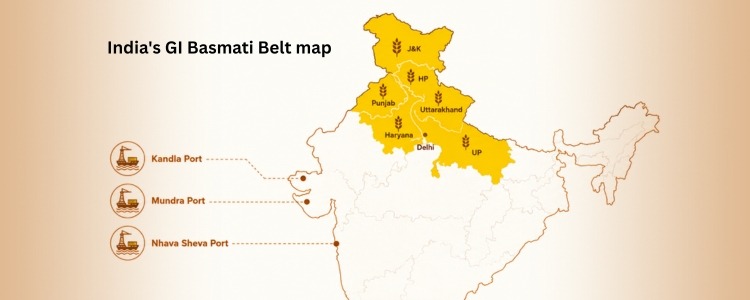
India's Basmati Belt as Center of Quality and Trust
Geographic Factors
India’s basmati advantage starts with geography. The Geographical Indication (GI) zone spans seven northern states — Punjab, Haryana, Uttar Pradesh, Uttarakhand, Delhi, Himachal Pradesh, and Jammu & Kashmir — sitting across the fertile Indo-Gangetic plains and Himalayan foothills, the only agro-climatic conditions in the world proven to produce authentic basmati. From there, the crop moves to export through Kandla and Mundra in Gujarat and Nhava Sheva near Mumbai, the three busiest gateways for basmati shipments, giving exporters multiple route options into US-bound container traffic.
Talented Youth
Basmati cultivation in Punjab and Haryana has historically been a multi-generational family trade, and a new generation of younger farmers is now taking it up with a different toolkit — GI-registered seed varieties, precision irrigation, and direct digital access to mill and export buyers through platforms that reduce dependence on local middlemen. Rather than the older pattern of agricultural households pushing the next generation toward city jobs, the GI-protected basmati economy is giving younger farming families a reason to stay in cultivation, anchored by the crop’s premium pricing over ordinary rice varieties.
Qualified Professionals
Behind every basmati variety exported to the US sits decades of institutional plant breeding. The Indian Agricultural Research Institute (IARI) in New Delhi, and breeders like Padma Shri awardee Dr. Ashok Kumar Singh, developed the Pusa Basmati lineage — including Pusa Basmati 1121, whose extra-long, slender 8.3mm+ grain and roughly 2.5x cooked kernel elongation make it the answer to which basmati variety carries the longest grain in commercial trade. That research pipeline, rather than generic farming know-how, is what allows exporters to guarantee consistent grain length and aroma shipment after shipment.
Innovation First Strategy
Government-backed institutional support underpins the sector’s push into new markets. Basmati’s GI protection, secured in 2003 and formally certified in 2016, legally restricts cultivation to the seven-state zone, insulating authentic Indian basmati from dilution. Layered on top, APEDA’s BHARATI initiative — backing 100 agri-food startups with a $50 billion export target by 2030 — reflects a broader institutional push to modernize the traceability, packaging, and market-readiness of exports like basmati specifically for demanding markets such as the US.
Conclusion
India’s basmati rice exporters aren’t trying to win the US market on tariff-driven price alone — with Pakistan holding a roughly 30-point tariff advantage, that would be a losing argument. The pitch is different: GI-protected authenticity, direct-mill traceability, and institutional backing for buyers who need consistent grain quality and clean compliance documentation, not just a lower quote. The comparison to a maturing, trust-based export economy isn’t marketing gloss — it’s a trajectory backed by real numbers.
Basmati alone earns India roughly $6 billion in export revenue against a national $100 billion agri-export target for 2030, APEDA’s BHARATI initiative is actively building startup and export capacity, the GI zone has protected authentic sourcing since 2003, and the US packaged basmati market itself is projected to nearly double by 2033. Whether India converts its structural advantages into a meaningfully larger share of the US market remains to be seen, but for importers weighing verified sourcing over anonymous bulk lots, the direction of travel is no longer in question.

Diptanshu
Leading research and marketing at Inductus Global, Diptanshu drives the company’s vision to transcend traditional trading through thought leadership in import-export. He spearheads a research-driven approach that prioritizes quality over price arbitrage, positioning Inductus as a strategic sourcing partner rather than a transactional intermediary. His work spans market intelligence, supply chain innovation, and trade dynamics, while playing a key role in sales and business development.