

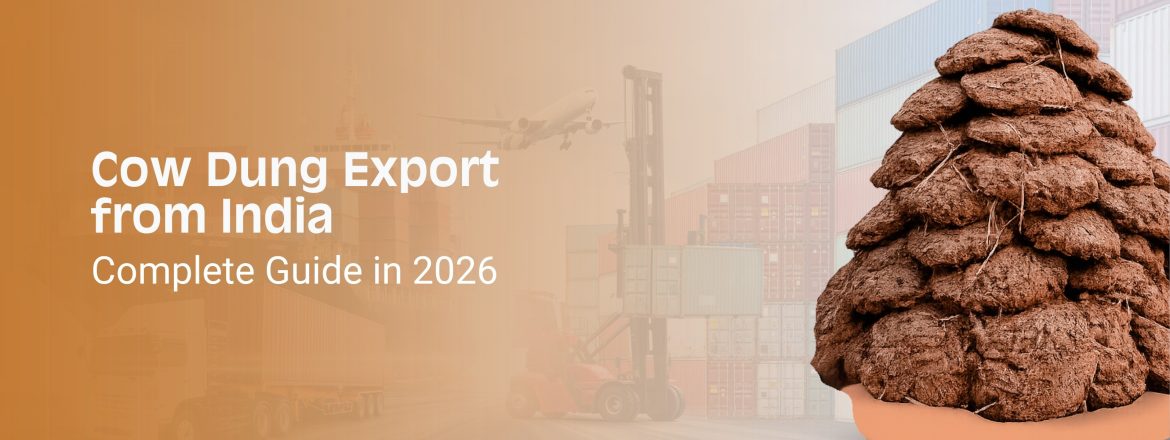
Cow Dung Export from India - Complete Guide in 2026
Recently, in India, a new trend with a lot of potential has occurred in India’s agriculture trade – the export of cow dung. What was once considered an unused by-product of the dairy industry, cow dung is now recognised internationally as a product with high value due to the increasing need for organic inputs, environmentally sustainable products, and traditional practices aimed at health and wellness for people.
With the increased demand for sustainable living globally, cow dung is being used to make organic fertilizers, biofuels, incense, and even construction materials.
Many countries throughout Europe, the Middle East, and Southeast Asia are showing increasing interest in importing cow dung, and an extensive exploration of opportunities and processes regarding the production and export of cow dung is represented in this article.
Understanding the Growing Demand for Cow Dung
With the global movement toward organic and sustainable living increasing, the amount of natural inputs being used has also grown. Cow dung is high in nutrients and beneficial microbes, and it is now commonly used as manure and soil conditioner by organic farmers.
Cow dung is also being used for the production of biogas and renewable energy sources.
Cow dung is being used as a raw material to manufacture eco-friendly products such as dung logs and incense sticks.
Cow dung has historical medicinal and cultural significance in many cultures throughout the world.
The highest demand for cow dung is from countries that are focused on reducing their usage of synthetic chemicals in agriculture. There is considerable opportunity for Indian exporters to take advantage of this new demand and enter into the international markets.
Scope of the Cow Dung Export Business
Cow dung export business is in its infancy, but can grow much more; because India has largest number of Cattle in the entire world, we have a large volume of raw material to source from.
Entrepreneurs, Farmer groups, and Cooperatives have started getting involved in this growing area, ranging from small group collection and processing to large consolidated exports.
Some driving forces behind this growth are:
- Low Cost of Raw Materials
- Growing Demand Globally for Organic Inputs
- Government Support for Rural and Agri-Related Industries
- Increasing Awareness of Eco-Friendly Alternatives
However, in order to scale the business, you will need to ensure you’re planning properly; quality control of your products; and comply with the export regulations for each country you are exporting your product to.
Key Export Markets and Opportunities
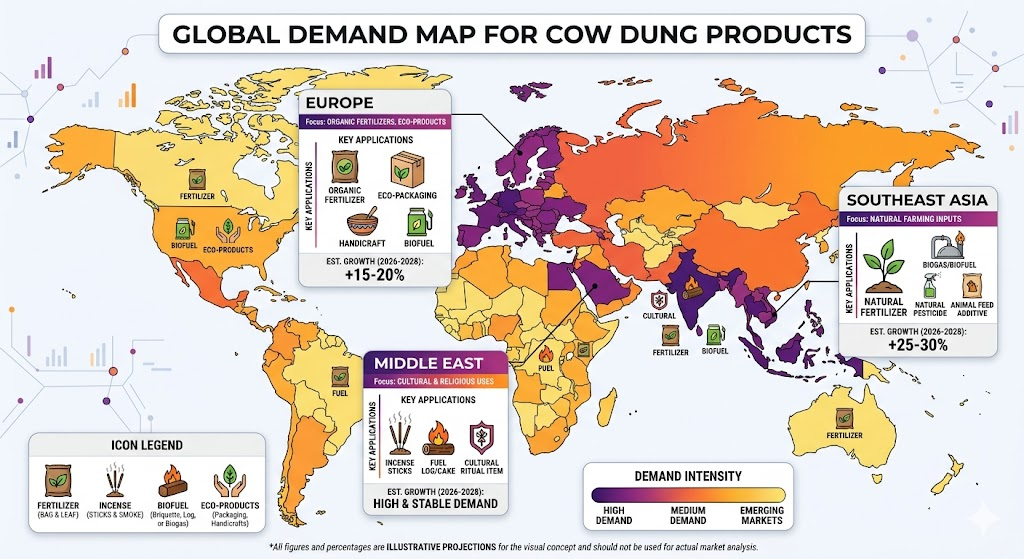
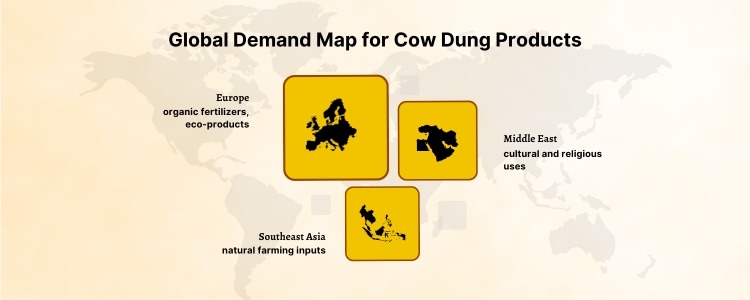
Cow dung exports from India are finding buyers within a number of areas throughout the world, such as:
– Europe: increasing demand for organic fertilizers and sustainable products
– Middle East: usage in cultural/religious practices
– Southeast Asia: growing interest in natural farming methods.
The biggest segment of cow dung export is in Europe, where demand is high, yet there are many regulations governing organic products. However, the premiums that exist in this area for certified organic products create a solid and profitable opportunity for export to this market as long as the exporter has a product that meets the requirements outlined by the European Union
Cow Dung Export from India: Process Explained
Each step in the export process must be carefully followed so that quality and compliance with regulations can be maintained throughout each stage of the export process.
– Collection and Processing: Raw cow dung is collected from the farm and processed into usable products (dried cakes, powder, or compost).
– Quality Control: Quality control is important for ensuring that there are no contaminants and that the quality of the products being shipped is consistent with the requirements set forth by the importing country and/or international standards.
– Packaging: Proper packaging is important to maintain the integrity of the product while in transit, so many exporters now use eco-friendly and moisture-resistant packaging materials.
– Documentation and Compliance: Exporters must obtain necessary certifications (import/export code (IEC), phytosanitary certificates, organic certification where necessary).
– Logistics and Shipping: Selecting an appropriate logistics partner is critical to ensuring that the product is delivered in a timely, efficient, and cost-effective manner.
Role of Product Sourcing in Export Success
Efficiently sourcing products is critical to export success for cow dung. Sourcing is the process of identifying good suppliers, ensuring that the quality of the product is consistent throughout the supply chain, and ensuring that those suppliers can consistently supply you with your product.
Many exporters partner with farmer groups and rural businesses to develop a consistent supply chain, which helps to guarantee the quality of the cow dung and improve the livelihoods of rural farmers.
Some key sourcing considerations include:
- Consistency of raw materials
- Hygiene and processing standards
- Cost-efficiency
- Traceability of origin
Challenges in Cow Dung Export
Although there are significant opportunities with exporting cow dung, there are also several challenges:
- Regulations – Import regulations vary from country to country.
- Quality – Uniform quality can frequently be difficult to maintain.
- Logistics – Transportation costs can be high due to the bulk volume.
- Market Awareness – Few markets have an awareness of cow dung.
To overcome these challenges, exporters must develop a strategy that includes investing in processing infrastructure and conducting market research.
Government Support and Policy Framework
The Indian government has actively pushed for the development of organic farming and rural entrepreneurship through several programs. The schemes assisting agri-based businesses and exports provide support to the cow-dung exporting members of the pelleted cow dung export business indirectly.
Also, there are many programs and initiatives in place to foster environmentally-friendly practices and reduce the use of chemical inputs in agricultural production, which fits well with world market demand trends.
Future Outlook for the Industry
Cow dung exports are expected to see continued growth as sustainable products become an increasing priority globally. Therefore, the demand for naturally produced and environmentally friendly products is anticipated to increase significantly.
The following are some major trends that will help shape the future of the cow dung export business:
- Increased use of organic farming methods worldwide
- Increased demand for renewable energy (e.g. biogas)
- Expansion of eco-friendly product markets
- Advancements in process technology and packaging technology
By using appropriate marketing strategies and business plans, India could easily establish itself as one of the top suppliers of cow dung products in this niche market.
Conclusion
International trade has shifted towards the exportation of cow dung from India, which traditionally was seen as a waste product, creating new economic opportunities for cow dung exporters and contributing to sustainable development. This sector provides a sustainable and profitable opportunity for entrepreneurs; however, in order to succeed, businesses must ensure their products meet regulatory requirements as well as be able to meet constantly changing market needs for the product.

Diptanshu
Leading research and marketing at Inductus Global, Diptanshu drives the company’s vision to transcend traditional trading through thought leadership in import-export. He spearheads a research-driven approach that prioritizes quality over price arbitrage, positioning Inductus as a strategic sourcing partner rather than a transactional intermediary. His work spans market intelligence, supply chain innovation, and trade dynamics, while playing a key role in sales and business development.