

Best Wholesale Shoe Suppliers for Retailers in 2026: How to Find, Verify & Order
The worldwide shoe industry continues its growth as the need of consumers for style, comfort and cost-effective options becomes more demanding. Presently, retailers are faced with two primary challenges: to continue offering their customers competitive pricing on the products that they sell and to do so while providing consistent product quality. In many instances, suppliers for retail shoe industry businesses must be relied upon as partners to provide inventory that will ultimately be used in the sale of shoes but will not affect or compromise the quality of the original product being sold to customers.
Over the last several years, sourcing of shoes has become more structured by the retail sector with consideration given to several factors when determining which of their suppliers to conduct business with. Beyond price, retailers are now using many other criteria such as manufacturing capabilities, reliability of supply chain and compliance with internationally accepted quality standards to determine which of their suppliers meet their requirements.
Whether a new entrepreneur enters the retail shoe market for the first time, or an existing retailer seeks to expand their product line to include shoes, finding a reliable supplier is an important decision. Determining how and where to locate potential suppliers, verifying supplier reliability and developing a purchase agreement with a potential supplier could all be appropriate to an entrepreneur or retailer’s long-term success in retail.
This manual will provide retailers with an understanding of the steps they need to take to identify trusted suppliers and develop strong Sourcing Relationships in 2026.
Why Do Retailers Depend on Wholesale Shoe Suppliers?
Retailers count on their suppliers to provide them with volume quantities of footwear and consistently replicate the products that they received previously in each shipment (preventing product inconsistency).
By using trustworthy wholesale shoe suppliers, retailers can ensure they have enough stock available to meet customer demands while managing their pricing margins well.
There are several reasons why wholesale sourcing is a vital component for retailers:
- Competitive pricing through the ability to buy in bulk.
- Access to a variety of different styles of footwear.
- Reliable supply of products that have seasonal demand.
- Faster cycle times for restocking.
For retailers who compete in an environment where there are many competitors, wholesale sourcing provides the retail business with a steadiness in operations, which translates into steady sales volume.
Also, many retailers work with wholesale footwear suppliers that provide them with a range of different product lines, which may include casual footwear, athletic shoes, dress shoes, and seasonal collections.
Where Can Retailers Find Reliable Footwear Suppliers?
In order to find trustworthy suppliers, you must use systematic research strategies instead of just going off of what is found in an online directory.
1. Global Trade Platforms.
Digital sourcing platforms have become a leading source for retailers who are searching for manufacturers and/or distributors. Many international suppliers utilize trade marketplaces which include product catalogues containing information regarding pricing structures, minimum order quantities and manufacturing capabilities. When retailers are looking for bulk shoe suppliers, they usually begin their sourcing on such platforms prior to conducting independent verification.
Digital directories can make things easier and quicker, however they are not sufficient by themselves to use as a basis for selecting suppliers.
2. Industry Trade Shows.
Industry trade shows provide some of the most effective means to meet with serious suppliers. Footwear trade shows allow you to meet many different types of suppliers (manufacturers, distributors, and retailers) all in the same location. Retailers who attend these events also have the opportunity to check the quality of their products and begin to build relationships with potential suppliers.
When you meet with suppliers in person, it generally gives you much better insight into their production capacity as well as how professional they are.
In addition, at trade shows, you may find emerging shoe manufacturers who do not have a strong on line presence yet.
3. Regional Manufacturing Hubs
Some parts of the globe have established themselves as a stronghold for the manufacturing of footwear and have created large-scale manufacturing operations for shoes. Many of these larger manufacturers offer lower prices than other shoe manufacturers and have a wide variety of shoe styles available to choose from. As you evaluate possible suppliers in these established manufacturing hubs, it is also important to know their production capabilities, export experience, and whether they are compliant with regulations.
How Can Retailers Verify Supplier Credibility?
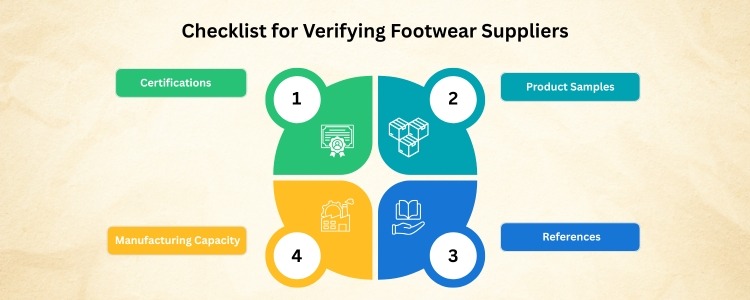
The process of identifying suppliers is only part of the process for retailers. They also need to verify that the supplier can reliably satisfy their standard for quality. Ask for Samples Before Placing Orders
Retailers should request physical product samples to be certain before committing to the first shipment of the supplier’s product.
Evaluation of product samples by retailers allows for
- Quality of material durability
- Quality of stitching
- Comfort of fit and wear
- Quality of packaging
This step will help retailers confirm that the quality of the supplier’s product meets the expectations of their brand.
Check Business Certifications
Reliable sources frequently have certification from organisations regarding labour compliance, manufacturing standards, and export regulations to support their reliability.
Retailers ought to confirm whether their potential suppliers:
- Hold manufacturing licences,
- Follow labour compliance requirements, and
- Utilise registered production facilities.
The supplier has documentation of these certifications indicating that they are operating in accordance with recognized standards from the respective industry.
Review Client References
Established suppliers can work with multiple retailers across many countries.
Clients may want to request client references or review case studies when evaluating suppliers. Retailers may also wish to evaluate customer reviews or industry feedback before making final supplier agreements.
When working with suppliers of international wholesale footwear, it is critical to have an open and transparent relationship to establish confidence and trust in the other party.
How Should Retailers Place Wholesale Footwear Orders?
After finding a dependable supplier, retailers need to develop a purchasing process that clearly outlines its various steps.
Understand Your Supplier’s Minimum Order Quantities
Suppliers normally require retailers to place minimum order quantities so that they can produce their product in the most cost-effective way.
To be able to properly place an order, retailers should first check to see if the supplier’s minimum quantity matches up with its sales capacity and storage capabilities.
Although retailers can often receive better pricing for larger orders, they could also incur additional financial risk by maintaining too much inventory.
Pricing Negotiations and Payment Structure
Pricing negotiations will often include the following:
- Discounts for bulk orders
- Costs associated with shipping
- When to make payment
Retailers will often negotiate with suppliers to come up with a payment structure that provides them with a flexible financial solution and provides the supplier with appropriate expectations for payment.
Having clear payment expectations established at the beginning will help to avoid potential misunderstandings in future transactions.
Clarifying the logistics and shipping arrangements
Retailers should research delivery timelines, available shipping methods and responsibilities regarding customs as well as what type of insurance they will need for their shipments.
If you are a retailer looking to purchase bulk footwear for retail stores, you can rely on good logistics planning to help ensure that your inventory arrives on time and without delays.
Retail Merchants Should Not Make These Mistakes
Retail footwear sourcing can have a lot of potential hazards if you are sourcing wholesale footwear for the first time.
Common mistakes include the following:
Choosing Suppliers Only By Price
A price may be below what you can find it at retail; however if that provider is selling it low, it’s probably because the product is coming from a very low-quality source or using poorer manufacturing processes, retailers have to consider price along with quality before they place an order.
Not Requesting Samples
Ordering a large amount of goods without requesting a sample first can lead to inventory issues if the quality of the product you receive does not meet your anticipations.
Poorly Planning Your Logistics
Shipping delays, customs problems and mismanagement of inventory can all have an impact on how you are able to use your retail store products.
Proper logistics planning with your suppliers and freight companies is essential to ensuring your retail stores run effectively.
What Trends Will Influence Footwear Wholesale Markets in 2026?
There are a number of shoe sourcing trends set for the next few years, which include:
1) Sustainability: The growing number of consumers who are interested in eco-friendly materials and ethical manufacturing is causing shoe brands to re-evaluate their production methods.
2) Direct Relationships With Manufacturers: Retailers are moving from using intermediaries to working directly with manufacturers, which creates better pricing and more flexible product options.
3) Quick Turnaround Times For New Styles: Retailers are looking for suppliers who can respond to new fashion trends by producing quickly.
Suppliers who are able to respond positively to these trends will be more likely to become preferred partners for retailers.
Conclusion
The footwear retail sector continues to be an exceptionally active marketplace; however, successful retailers will succeed due to their commitment to identifying reputable vendors and developing dependable product sourcing procedures.
Ultimately, each step involved in creating a reliable retail supply chain-from searching through supplier directories, to verifying manufacturing credentials and negotiating logistical contracts-is a vital part of the creation of that stable retail supply chain.
As a result, when retailers establish long-term business relationships with dependable wholesale footwear suppliers, they will have a more reliable supply of inventory available to their customers while ensuring that those suppliers produce shoes that meet the quality standards expected by customers.
Frequently Asked Questions (FAQ)
Sourcing services companies are professional firms that assist businesses with supplier relationship management, with an emphasis on efficiency and compliance, enjoying a long-term relationship and collaboration.
Agents usually manage single transactions, whereas sourcing companies create a working relationship with suppliers by employing a complete supplier relationship management process with strategic oversight.
Because trust and compliance help assure quality, minimize risk, and ensure delivery performance.
Technology provides transparency, risk monitoring, and automates and enables collaboration between buyers and suppliers across borders.
Sourcing services firms help mediate disputes, enforce contractual obligations and formalize a corrective actions plan, whilst assuring business continuity.
No. Small and medium-sized enterprises will also leverage the knowledge of sourcing services companies and access to their network to connect to global suppliers without excess overhead.