

FMCG Products Exporters from India: A Sourcing Guide for Wholesale and Retail Buyers
For over ten years, India’s fast-moving consumer goods sector has transformed into a leading force for exports. Manufacturing in India is now producing packaged foods, personal care goods, household goods and over-the-counter products that supply markets worldwide, including Africa, Middle East, South East Asia, Europe and North America. Sourcing quality FMCG providers from India is increasingly becoming a key component of global retailers/distributors long-term procurement strategies.
Developed organized manufacturing clusters, meeting global buyers’ quality standards and competitive pricing, place India as one of the most attractive sourcing options globally. Simultaneously, global buyers require compliance, scalability and supply chain transparency elements that will set the stage for global trade relationships in 2026.
Why Are FMCG Products Exporters from India Gaining Global Attention?
Exporting Indian FMCG products are driven by three key competitive advantages: cost-effectiveness, a diverse product range, and compliance with regulations. The large population of India provides a significant domestic consumption market for manufacturers operating at scale. This scale allows for cost-effective pricing for export buyers while maintaining high-quality standards.
Additionally, there is diversity in the product offerings from India, including:
- Packaged food and beverage products
- Spices and seasonings
- Personal care and hygiene products
- Cleaning products for the home
- Candy and snack food products
A large number of manufacturers are ISO, HACCP, and GMP certified. Many of these companies do business with customers in regulated markets, where these certifications are not just a matter of procedure but also a requirement for doing business.
The import/export ecosystem of Indian FMCG export companies has also developed significantly, with many companies establishing their own warehouses and distribution operations outside India to achieve shorter delivery times.
How Do FMCG Products Suppliers from India Support Wholesale Buyers?
Many wholesale/distributors place a high value on consistency in volume and flexibility with private label products. Many of India’s well-known suppliers of FMCG products are large/established already. For example:
Labelling in different languages
Follow the food safety standards imposed by the country the product is being shipped to
Shipping of the products in one container
Retail Chain Grocers and Cash & Carry wholesalers can purchase directly from the manufacturers, eliminating market intermediary margins. This is valuable for certain categories of products, including biscuits, ready-made meals, herbal personal care products, and cleaning products.
Numerous exporters focus on exporting large FMCG products from India, allowing wholesale buyers to enter into long-term contracts with fixed pricing arrangements.
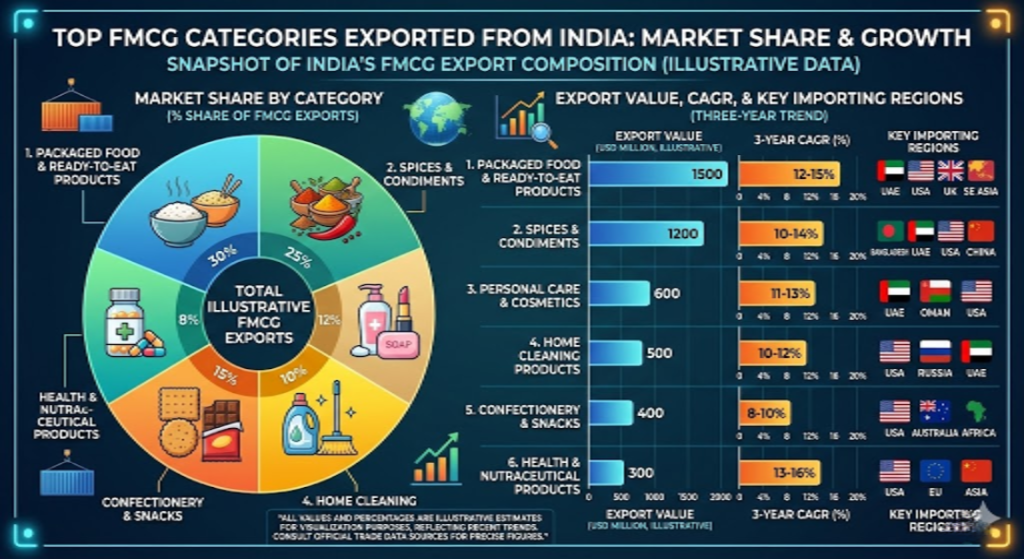
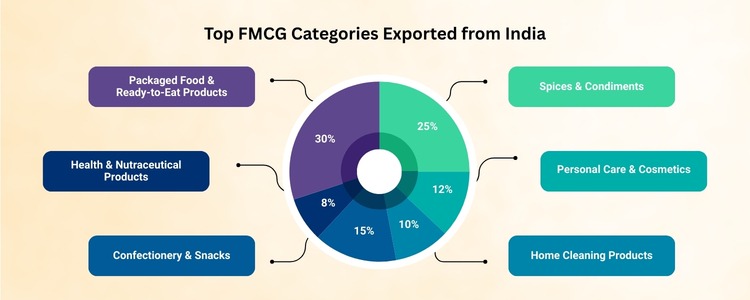
What Categories Dominate India’s FMCG Export Portfolio?
India’s export basket is a combination of its strengths as a nation and its emerging consumer demands.
Packaged Food Products
Today’s packaged food products are responding well to traditional diaspora markets in products such as ready cooked curries, instant noodles, snacks, and spice mixes.
Personal Care Products
Herbal shampoos, Ayurvedic skin care products, and oral care products are increasing in popularity.
Household Cleaning Products
Detergents, dishwashing liquid and disinfectant remain staples of the bulk supply chains.
Health/Nutritional Products
Vitamin/health supplements and immunity-boosting products continue to grow in the aftermath of the pandemic.
The range of products available makes India an attractive import destination for sourcing FMCG products to all corners of the globe.
How Does Compliance Influence Export Partnerships?
When it comes to cross-border trade of Fast-Moving Consumer Goods (FMCG), adherence to compliance regulations is important. Exporters will be required to comply with the following:
- Food Safety Standards Authority of India (FSSAI) regulations for exports from India to other countries
- Food safety and cosmetic standards for the destination country
- Food labeling and packaging requirements for the destination country
- Customs documentation norms and procedures of the country you are exporting to
For example: Shipment to the EU requires that all ingredients used in the product are disclosed and must include allergen information. In addition, most Middle Eastern markets require halal certification to sell any product. In addition, many products sold to the USA require that the exporter registered with the FDA.
Most FMCG wholesale exporters in India employ teams of compliance professionals dedicated to managing documentation and quality audits. Vendors are encouraged to conduct due diligence on suppliers by visiting the manufacturing facility and/or obtaining third-party verification of compliance with their regulations.
What Logistics and Supply Chain Factors Should Buyers Consider?
As logistics play a large role in whether an export relationship is successful, exporters need to understand how shipping FMCG products may involve different shelf lives. For example, products that require refrigeration during transportation must be shipped using temperature-controlled containers, while other dry goods may be shipped using standard modes of transportation.
When determining the best way to ship FMCGs, exporters need to consider the following logistical issues:
The level of port connectivity available to ship their products (ie: Nhava Sheva, Mundra, Chennai)
Freight cost volatility
Lead-time associated with inventory
Whether or not the products are insured
Many exporters in the FMCG exporting business today are using digital tracking systems to provide buyers with up-to-date information on their shipments.
Exporters delivering to wholesale buyers may benefit from using consolidated shipments as a way to lower freight cost per unit. Conversely, retail chain customers may prefer shipping goods to mixed SKU containers based upon the forecasting of demand at each store level.
How Are Private Labels Shaping the Market?
Because of the rapid rise of the number of retailers (supermarkets) interested in how they can have their own products custom made by Indian suppliers, private label sourcing has rapidly emerged as the primary growth factor for the private label business within the supermarket channel.
The benefits for retailers that use private label sourcing include:
– Higher margins for retailers
– More control over the pricing of their products
– The ability to construct a product brand with local customer preferences
Indian suppliers have the manufacturing technology, capacity to produce products in large volumes, and capabilities in research and development to assist them in meeting these specifications.
What Risks Should Buyers Be Aware Of?
While opportunities are abundant, buyers must remain diligent about potential issues with:
Regulatory Delays: If there is an issue with your documentation (missing, incomplete, or showing inconsistencies), customs can prevent the product from entering the country.
Quality Variability: If a supplier is sourcing its raw material from multiple locations, it may be unable to create a consistent product.
Currency Fluctuations: Global currency exchange rates fluctuate, impacting the landed cost of your product.
What Makes Long-Term Partnerships Successful?
The foundation of sustainable export relationships is built on transparency and the establishment of consistent communications and shared compliance standards. Retailers who communicate regularly with their suppliers of FMCG products from India often receive better pricing terms, earlier availability of new products, and more predictable inventory management.
In today’s competitive global marketplace, the supplier’s reliability often outweighs the margin price difference between suppliers. Procurements heads who are evaluating suppliers will look for indicators such as the supplier’s financial stability, operational scale, and compliance to regulatory requirements when selecting a supplier
Conclusion
The FMCG sector in India is at a critical juncture. An increase in manufacturing capacity, digital integration and changes in export-friendly policy are expanding the global reach of the FMCG sector. Retail buyers and wholesale distributors can benefit from collaborating with credible exporters of FMCG products from India, giving both scale and strategic advantages.
As international demand for goods grows increasingly diverse, careful selection of suppliers will determine success in sourcing. When buyers establish relationships with the right partners, they can obtain quality, compliance and cost benefits—these elements are key to remaining competitive in retail and wholesale operations on a worldwide basis.
1. What types of FMCG products are most exported from India?
Packaged foods, spices, personal care items, and cleaning products form the bulk of exports.
2.How can buyers verify exporter credibility?
Verification can be done through export registration certificates, trade references, and factory audits.
3. What is the typical minimum order quantity?
Minimum order quantities vary by product category, but container-load shipments are common for wholesale trade.
4. Are private label options available?
Yes, many exporters offer customized packaging and branding services for international retailers.
5. How long does shipment usually take?
Transit times range from 7–10 days to the Middle East and 20–30 days to Europe and North America.
6. Do Indian exporters comply with international standards?
Most established exporters operate under ISO, HACCP, GMP, and other globally recognized certifications.

Diptanshu
Leading research and marketing at Inductus Global, Diptanshu drives the company’s vision to transcend traditional trading through thought leadership in import-export. He spearheads a research-driven approach that prioritizes quality over price arbitrage, positioning Inductus as a strategic sourcing partner rather than a transactional intermediary. His work spans market intelligence, supply chain innovation, and trade dynamics, while playing a key role in sales and business development.