

Global Supply Chain Crisis: How the Iran–Israel–USA War is Changing Procurement Forever
The tensions between Iran and Israel and the U.S. since 2026 have changed the way the global trade system works. What began as a geopolitical standoff has become a crisis with serious implications for the economy of the world. The disruptions have occurred primarily in the supply chain management area of global commerce.
Businesses around the world are experiencing uncertainty due to increased freight costs, delays in receiving shipments, and inconsistent supply availability, as this situation reveals vulnerabilities and accelerates the evolution of procurement and logistics practices across the world.
Geopolitical Tensions and the Fragility of Global Trade
The Middle East has played an important role in global trade over time, primarily as an energy producer and a critical link in the transportation of goods via shipping routes around the globe. For instance, the Strait of Hormuz is one of the major choke points in the transportation of oil from the Persian Gulf to the rest of the world.
Due to increased military activities in the region, shipping lanes have become unsafe. There is more scrutiny on cargo vessels, higher shipping insurance rates, and delays in getting goods shipped. As a result, shipping lines are increasingly using longer routes that keep them out of the conflict areas, which results in longer transit times for shipments.
The supply chain crisis is indicative of the fact that while the world’s trade system is highly efficient, it is also very vulnerable to geopolitical disruption.
Rising Costs and Economic Pressure
The supply chain is experiencing significant price changes due to the conflict as a consequence of rising costs affecting energy prices, transportation, and manufacturing costs.
There is multiple cost pressure on businesses today:
- High shipping and freight costs
- High fuel costs having an impact on logistics
- High insurance premiums for goods travelling in-transit.
- Currency fluctuation adding to import cost.
Many businesses are seeing their profit margins reduced because of increased costs and are being forced to revisit their pricing strategies. In some cases, businesses are passing the increased costs to customers, which are adding to inflationary trends.
Delays and Operational Disruptions
Delays of all kinds have characterised this global crisis, particularly in relation to shipping from ports in or on the outskirts of the conflict zone due to heightened security measures, which have resulted in congestion and slower processing times. Delivery schedules that were once set in stone are now subject to uncertainty; this impacts particularly heavily on industries reliant on highly coordinated supply chains.
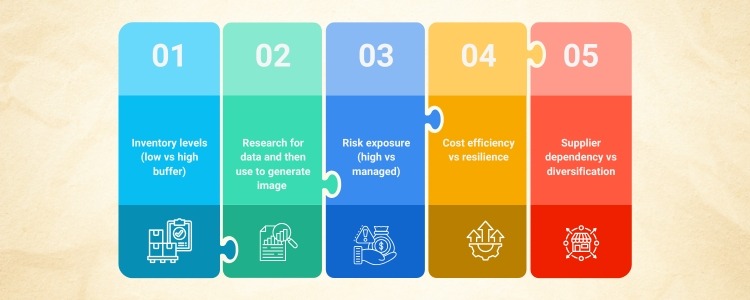
The traditional “just-in-time” model of supply chain management is increasingly being called into question, with many businesses moving toward higher levels of inventory to minimise risk, even if this means incurring greater holding costs. This represents a marked shift in the evolution of supply chain management as organisations are now valuing resiliency as highly as they have previously valued efficiency.
Shortages and Supply Constraints
The result of rising costs and delays is that there are large-scale shortages across almost all the major industries. The availability of raw materials, components and finished goods has been adversely affected.
Some industries experiencing extreme shortages include:
- Automotive – A lack of electronic components
- Electronics – Disruption of the semiconductor supply chain
- Pharmaceuticals – Halting of suppliers procurement of critical ingredients
- Retail – Low levels of inventory and stock inconsistency
These industry-wide shortages not only affect production but also influence consumer purchasing, resulting in higher prices and decreased goods availability.
Transformation of the Procurement Process
The current crisis is fundamentally changing the way procurement happens at businesses today. Companies are no longer able to depend on single-source suppliers or on a predictable logistics network.
Procurement teams are focusing more on the direction of being diverse and looking for multiple suppliers in different regions so that there is less of a dependency on any single area, but with this comes new complexities such as needing to perform compliance checks, conducting quality assurance checks and managing logistics.
Flexibility has become a top priority as well. Short-term contracts, dynamic pricing models, and real-time decision-making processes are replacing traditional long-term contracts.
The Evolving Role of Procurement Services
Given the current environment, procurement services are more important than ever. Procurement services assist organizations with the complexity involved in procurement by providing organizations with access to expert knowledge regarding supplier selection, risk assessment and logistics management.
However, the role of procurement services is also changing. In addition to being able to assist with optimizing cost, procurement services are expected to provide other opportunities such as delivering resiliency, transparency, and agility to their clients. Companies want partners who can provide them with real-time insights and adapt to rapidly changing conditions.
Impact on Business Procurement Strategies
The pandemic has changed the way businesses procure goods. Many companies have shifted away from traditional methods of procurement, that are centered around cost alone, towards risk aware frameworks that help manage potential disruptions.
Some significant changes occurring in business procurement strategies are:
- Suppliers – Companies are seeking to diversify their supplier base to assist in reducing their risk of dependency.
- Regional Sourcing – To mitigate supplier/risk dependencies, more and more businesses are now sourcing products from closer to their facilities.
- Buffer Stock – In an effort to provide a cushion for potential supply chain disruptions, more companies are investing in additional stock of safety stock.
- Using Digital Tools – Businesses are utilizing digital tools to assist in providing better visibility into their supply chains.
These shifts provide a stronger foundation for more robust and flexible procurement systems.
Challenges in Product Sourcing
The current level of uncertainty has also created challenges for many businesses when it comes to identifying reliable suppliers. As a result, a sourcing agent has become an indispensable resource for businesses looking to source products from new areas and/or develop alternative supply channels. However, these new areas can present challenges such as regulatory differences, infrastructure issues, and cultural differences. Therefore, when businesses are considering these factors for sourcing decisions, they need to ensure that they adequately evaluate them before moving ahead.
Technology and the Future of Supply Chains
There are several technological advances emerging to help businesses manage disruptions. Companies are using many digital tools to provide better visibility into their supply chains, improve forecast accuracy, and streamline their operations.
Some of the most notable technological trends are as follows:
- Tracking Shipments in Real Time
- Predictive Analytics for Demand Planning
- Automation of the Procurement Process
- Platforms Used to Monitor Risks
While each of these technologies helps businesses tremendously, they require an investment in both time and resources prior to implementation and businesses have to prepare before adopting any of these tools.
Long-Term Implications for Global Trade
It’s likely that the current Iran-Israel-USA conflict will significantly change the way global trade operates by changing how businesses think about resilience versus cost efficiency in terms of their operational costs.
With this change in thinking, businesses are likely to develop a more regionalized trade model which reduces their dependence on long-distance suppliers and uses local/regional supply chain networks. Governments will also promote domestic manufacturing to lessen their dependency on imported goods.
Conclusion
The ongoing conflict has unveiled weaknesses in the current supply chain systems and pushed for faster change. While rising costs, delays, and shortages may appear to be short-term issues; they are the beginning of a much larger transformation.
To move forward, businesses must be prepared to become adaptive, develop long-term strategic plans, and invest in creating more resilient systems. The future of procurement will no longer be defined solely in terms of efficiency; it must also include the capacity for resilience against future uncertainty.
Frequently Asked Questions (FAQ)
Sourcing services companies are professional firms that assist businesses with supplier relationship management, with an emphasis on efficiency and compliance, enjoying a long-term relationship and collaboration.
Agents usually manage single transactions, whereas sourcing companies create a working relationship with suppliers by employing a complete supplier relationship management process with strategic oversight.
Because trust and compliance help assure quality, minimize risk, and ensure delivery performance.
Technology provides transparency, risk monitoring, and automates and enables collaboration between buyers and suppliers across borders.
Sourcing services firms help mediate disputes, enforce contractual obligations and formalize a corrective actions plan, whilst assuring business continuity.
No. Small and medium-sized enterprises will also leverage the knowledge of sourcing services companies and access to their network to connect to global suppliers without excess overhead.