

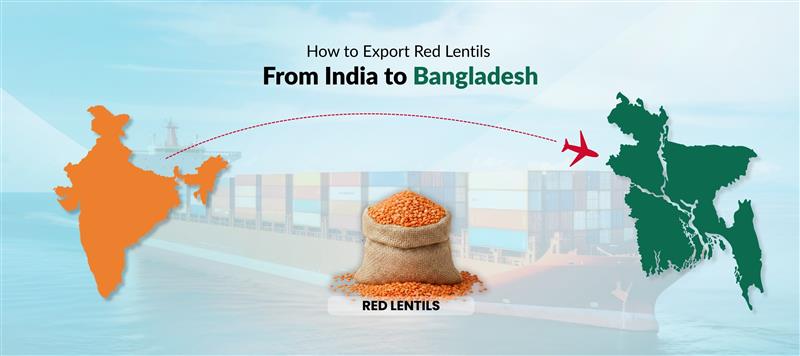
How to Export Red Lentils (Masoor Dal) from India to Bangladesh
Trade in pulses has long been a stabilising factor in South Asia’s food economy. Among these commodities, red lentils commonly known as masoor dal occupy a central place in household diets and public distribution systems. For Indian exporters, Bangladesh represents one of the most consistent and strategically important markets for lentils, driven by steady demand and geographic proximity.
This article explains the commercial, regulatory, and operational aspects involved in exporting red lentils from India to Bangladesh, with a focus on compliance, logistics, and risk management. It is written as a practical reference for traders, agri-exporters, and first-time exporters seeking clarity rather than speculation.
Why is Bangladesh a Key Market for Indian Red Lentils?
The Bangladesh market largely relies on importing lentil products from other countries to fulfill their demand for lentil products. Domestic production of lentils is still limited and as the population increases and the trend towards the consumption of plant protein grows, demand for lentil products continues to rise in Bangladesh. Therefore, red lentils are a staple food that is commonly included in the daily diet of many Bangladeshi citizens; thus, they are both volume driven and price sensitive.
Due to India’s proximity to Bangladesh, the fact that the majority of the population has similar culinary preferences for lentils, and the established trade routes for lentils between both countries, Indian exporters are at a competitive advantage. The short transit time for shipments also reduces the logistics risk associated with exporting products and the ongoing familiarity with trading histories simplifies negotiation procedures and documentation involved with the exporting process.
What are the Basic Eligibility Requirements for Exporters?
Prior to commencing shipments, all Exporter Companies are required to conform to all of the relevant laws and regulations of the Indian Export Industry. These usually include: becoming a registered business, obtaining an Import Export Code (IEC) from the Directorate General of Foreign Trade and gaining registrations with relevant Agricultural Export Authorities (as necessary).
Exporters ought also to pay attention to one another’s notices concerning the exportation of Pulses. Because of Lentil’s role in maintaining domestic food security, policies concerning the exportation of Lentils can be subject to frequent changes as a function of Climatic and Price Trends. Therefore, it is critical to remain informed regarding pulse export notifications from the Government of India.
How does the Export Red Lentils from India Process Work in Practice?
The Exportation Process of any commodity will always follow a fixed sequence of activities commencing with Procurement and ending with Delivery of the goods into Bangladesh. Once the exporter has obtained a supply of lentils that meet the Quality Standards as determined by the importer, the next step for the exporter will be to negotiate the terms of the contract with the Bangladeshi buyer regarding price, quantities, conditions of delivery.
Upon finalising the contract, the products will be cleaned, graded, and packed in accordance with the parameters specified in the Contract by the Buyers. Following this, the invoices (Commercial), Packing Lists, Certificates of Origin and Phytosanitary Certificates will be prepared before the Exporter can ship the Goods. This description provides an overview of the structure of Masoor Dal Export from India, however individual operations may vary based upon the mode of transport and size of shipments.
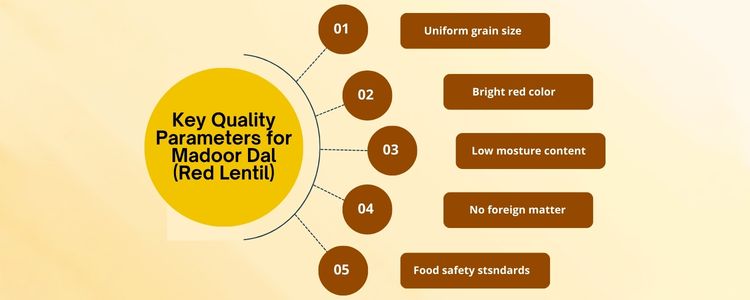
What Quality Standards Apply to Red Lentil Exports?
There are specific standards related to quality in the Bangladeshi lentil market, including consistency of grain size, moisture content, and foreign material content. Additionally, buyers are influenced by the consistency of colour, affecting their perceptions of the product and how well it cooks.
To maintain compliance with these quality standards, export companies should implement pre-shipment inspections and laboratory testing. Moreover, when providing repeat orders of lentils, continued quality consistency will provide exporters with a competitive advantage and help establish a long-term business relationship, as price alone typically does not drive continued trading in an agricultural commodity.
Which documents are required for exporting to Bangladesh?
Documentation accuracy is critical to avoiding clearance delays. Core documents typically include:
- Commercial invoice and packing list
- Certificate of origin
- Phytosanitary certificate
- Bill of lading or transport document
Bangladesh customs authorities scrutinize agricultural imports closely, making document alignment essential. Errors, even minor ones, can result in demurrage costs or shipment holds.
How are logistics typically managed for this trade route?
Logistically, the movement of lentils from India to Bangladesh is fairly easy due to the two countries having a shared border and established transportation corridors. A shipment from India to Bangladesh can be made using any of these transportation methods: truck, rail, or coastal shipping, depending on the size and urgency of the shipment.
For shipments of smaller quantities of Red lentils being exported from India, truck transport is popular because of its flexibility and quick delivery time. In contrast, rail and ocean shipping are preferred for larger volumes of Red lentils. Exporters wanting to do bulk shipments of Red lentils from India often use a combination of transport modes to provide a balance between cost and reliability.
What role do Pricing and Contracts Play in Export Success?
Pricing of Red lentils is determined by several factors: cyclical harvests, domestic availability of Red lentils, and movements in foreign currency exchange rates. Short-term contracts often reflect current price volatility in the market and Buyer caution.
Exporters need to consider procurement and logistics costs, along with policy risk and the credibility of the Importer in providing a secure payment method. Letters of credit provide a safer payment method, especially for new business relationships, by reducing the risk to the Exporter of non-payment by the Importer.
How do Indian Exporters manage competition in Bangladesh?
There is competition in the lentil export market in Bangladesh from a wide variety of sources including Canada and Australia. As a result of being located closer to Bangladesh, Indian exporters have an edge over other countries due to their ability to respond more quickly to buyer needs and requirements and because of their familiarity with how to meet those demands.
Most of the established Indian exporters of red lentils separate themselves from others in the market by having established relationships with buyers through their consistency of supply schedules, packaging flexibility, and clear communication. These operational advantages are often enough to overcome slight pricing discrepancies when making a purchasing decision for buyers.
What Risks Should Exporters be Aware of?
Risks to the exporters include changing government policies, potential disputes over lentil quality, and a potential delay in payment. Export restrictions during times of domestic inflation create factors which can disrupt contracts. Discrepancies with lentil quality can cause buyers to lose confidence in the exporter.
Indian exporters must take a conservative approach to contract risk, develop a diversified portfolio of buyers and closely monitor any regulatory changes affecting the exportation of red lentils. Risk management should be viewed as an integral part of pricing rather than as a response to an unforeseen circumstance.
What is the long-term outlook for this trade corridor?
The fundamentals of demand in Bangladesh are expected to continue a dependency upon imported lentils. Most exports from India into Bangladesh will be stable, bulk shipments of lentils. Success will be driven by the exporter having an understanding of the relevant government policies, following disciplined operational processes, and delivering consistent quality lentils throughout the exporter’s trade cycle.
Conclusion: What Determines Success in Exporting Red Lentils?
The process of exporting red lentils to Bangladesh is not a speculative venture but is based on a process-driven sales approach. Exporters to Bangladesh face favorable fundamentals that include strong demand, geographic proximity, and established trade relationships with Bangladesh. The success (profitability) of these exporters will depend on how well they execute their export plans. Proper execution includes compliance, quality control, logistics planning, and risk management.
Exporters to Bangladesh who employ a disciplined approach as opposed to a more opportunistic approach are likely to build sustainable trading relationships with Bangladesh for these essential food commodities.

1. Is Bangladesh a reliable market for Indian red lentils?
Yes, due to consistent demand and structural import dependence.
2. Are export policies for lentils stable in India?
Policies can change based on domestic supply conditions, so regular monitoring is essential.
3. Which transport mode is most cost-effective?
Rail and coastal shipping are economical for bulk volumes; road transport suits smaller consignments.
4. What payment methods are commonly used?
Letters of credit are widely preferred, especially for new buyers.
5. How important is quality certification?
Extremely important, as it directly affects customs clearance and buyer confidence.
6. Can small exporters enter this market?
Yes, provided they manage compliance, quality, and risk effectively.

Diptanshu
Leading research and marketing at Inductus Global, Diptanshu drives the company’s vision to transcend traditional trading through thought leadership in import-export. He spearheads a research-driven approach that prioritizes quality over price arbitrage, positioning Inductus as a strategic sourcing partner rather than a transactional intermediary. His work spans market intelligence, supply chain innovation, and trade dynamics, while playing a key role in sales and business development.