


Bahrain Ramadan 2026: Indian Basmati Rice Bulk Import Guide
Bahrain’s food economy is significantly impacted by the annual observance of Ramadan. Indeed, the entire economic cycle of food purchasing for households occurs within just one month prior to Ramadan. As a result, both hotels and caterers as well as community kitchens begin making preparations during the months leading up to Ramadan for higher than normal daily demand for both iftar (morning meal) and suhoor (evening meal). Therefore, this perfect storm of food purchasing behaviour creates a predictable peak in imports of staple foods such as rice.
As a country that does not produce enough food to feed its population (Bahrain is classified as a net food-importing nation), then 2026 will present an opportunity for those involved in the importation of food into the country to test their commitment to cost-effective sourcing, maintaining adequate levels of inventory and ensuring that products purchased will meet consumer needs.
How Does Indian Basmati Rice Fit into Bahrain’s Ramadan Demand Pattern?
Of the many different varieties of rice imported into Bahrain, Indian basmati rice has traditionally represented one of the most significant sources of demand because of both its established reputation with consumers and institutions as well as its unique properties which make it a popular choice for both individual household consumption and the large-scale preparation of food during Ramadan.
Over the past few years, as the number of communal meals being provided has increased, so has the number of importers relying on the varieties of Indian basmati rice. As a result of the increasing use of this particular type of rice, and especially with the increasing demand for large quantities of rice just prior to Ramadan, India’s position as a preferred supplier has been further solidified.
How Does Indian Basmati Rice Fit into Bahrain’s Ramadan Demand Pattern?
Of the many different varieties of rice imported into Bahrain, Indian basmati rice has traditionally represented one of the most significant sources of demand because of both its established reputation with consumers and institutions as well as its unique properties which make it a popular choice for both individual household consumption and the large-scale preparation of food during Ramadan.
Over the past few years, as the number of communal meals being provided has increased, so has the number of importers relying on the varieties of Indian basmati rice. As a result of the increasing use of this particular type of rice, and especially with the increasing demand for large quantities of rice just prior to Ramadan, India’s position as a preferred supplier has been further solidified.
Why Is Bulk Indian Basmati Rice Central to Large-Volume Buyers?
For hotels, distributors, and institutional buyers Bulk Indian Basmati Rice provides operational efficiency, as bulk shipments mean lower per-unit logistics costs, which permits distributors to service multiple retail and food service clients through centralized inventories.
The bulk procurement model is well suited to Ramadan and other high sustained demand periods, as it offers importers an opportunity to manage inventories more effectively, avoiding the need to place multiple orders during peak weeks when increased competition for freight space could result in an inability to get product to customers in a timely manner.
How is Bahrain’s Rice Import Market Expected to Evolve Ahead of Ramadan 2026?
Market signals indicate the expectation of continued, steady growth rather than dramatic growth phases. Population trends combined with the resiliency of the hospitality industry will result in continued incremental increases in rice consumption over the course of Ramadan; therefore importers have made a concerted effort to secure volume early as opposed to relying on spot market purchases closer to the season.
The focus will continue to be on predictability, as importers work to ensure that their supply chains do not experience interruptions due to challenges such as delays in transportation or obstacles at the point of origin. This approach is reflective of the realities from previous cycles of peak demand for rice.
What Role Do Wholesale Channels Play in Ramadan Supply Stability?
The backbone of Bahrain’s Ramadan food supplies, wholesale distribution helps retailers, restaurants and institutional kitchens access staple foods reliably all month long. A reliable wholesale food supplier will ensure that all retailers, restaurants and institutional kitchens throughout Bahrain can access their staple food products consistently throughout the month.
With bulk rice imports flowing through wholesale distribution, they can be redistributed rapidly as demand fluctuates. Importers who have close relationships with wholesalers will be in a position to address last-mile pressure better, and are less likely to be forced to source food through emergency measures.
How Do Product Sourcing Companies Support Bulk Imports?
The role of product sourcing companies is to serve as the intermediary between overseas suppliers and domestic buyers, especially for bulk shipments. In addition to negotiating prices, product sourcing companies handle quality control, and maintain documentation and coordinate shipment.
During the month of Ramadan, VMI sales have compressed timelines, necessitating procurement streamline and reduce administrative friction. Additionally, their familiarity with regulatory compliance and logistics workflow will be critical in ensuring all products arrive in a timely fashion.
What Quality and Compliance Considerations Matter Most?
Bahrain has established clear standards for imported food products, including rice. All bulk shipments must undergo testing for moisture content, grain integrity and accurate labelling; during Ramadan, enforcement is usually more stringent due to increased consumption levels.
Therefore, for importers who source bulk Basmati rice, it is important to establish relationships with suppliers who maintain established quality control standards; as any deviation will have a ripple effect through the distribution chain, impacting retailers and end consumers alike.
How Do Consumer Preferences Influence Bulk Import Decisions?
While institutional demand drives the majority of bulk imports, consumer preferences also have a large impact on the overall sourcing strategy. Household brands and origins are highly valued in Bahrain, especially during Ramadan when food choices are closely associated with cultural values.
The consistent demand for Basmati rice in Bahrain reflects the trust that consumers have in Basmati rice as an aromatic long grain variety. Importers take the consumer preferences of Basmati rice into account in their varietal selection even when their bulk procurement levels are high to ensure alignment between bulk procurement and retail expectations.
What Should Importers Prioritise for Ramadan 2026?
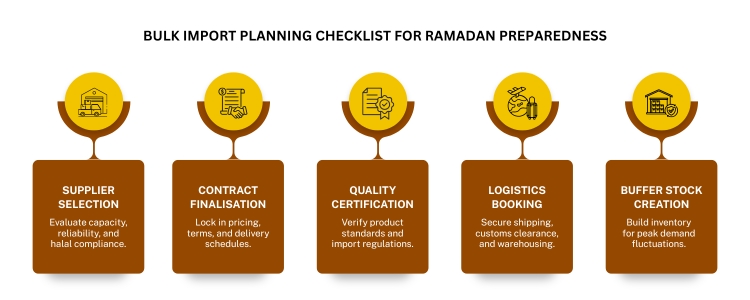
As Ramadan approaches for the year 2026, the need for structured decision-making and disciplined sourcing becomes more evident. To make bulk rice imports possible, importers rely upon collaboration between their own suppliers, logistics providers, and domestic distributors. Importers who take a proactive, structured approach to bulk rice imports (e.g., securing stating volumes early, diversifying shipment schedules across the season, maintaining oversight of product quality) are in a better position to address the unique challenges presented by Ramadan.
In addition, because the market size in Bahrain magnifies the impact of even small disruptions, disciplined rice procurement practices during Ramadan are critical for maintaining consumer confidence.

1. Why does rice demand rise sharply in Bahrain during Ramadan?
Daily communal meals, hospitality events, and charitable distributions increase consumption of staple foods.
2. When should bulk rice imports for Ramadan 2026 be planned?
Most professional importers begin planning six to eight months in advance.
3. Are bulk imports more cost-effective than phased purchases?
It is relatively resilient, especially during Ramadan when quality takes precedence.
4. How important is quality control for bulk consignments?
Extremely important, as any compliance issue can delay large volumes during peak demand.
5. Do wholesalers influence import volumes?
Yes. Their inventory strategies directly affect how much rice is imported ahead of Ramadan.
6. Can smaller distributors participate in bulk procurement?
Yes, often through partnerships or shared sourcing arrangements.