


6 Secrets Indian Sourcing Agent Use to Cut Your Product Costs by 40%
Why Do Experienced Sourcing Agents Deliver Lower Costs Than Direct Buying?
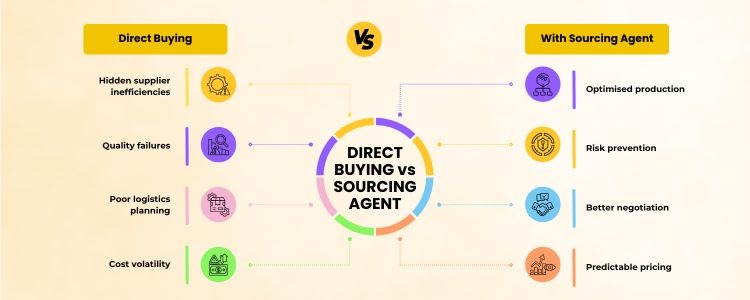
For many global buyers, especially those new to overseas manufacturing, the assumption is simple: eliminating intermediaries should reduce costs. In reality, this approach often produces the opposite result. A professional Sourcing Agent operating on the ground in India understands cost structures, supplier behavior, and operational inefficiencies that remain invisible to overseas buyers.
Cost reduction in sourcing is rarely about squeezing factory margins. Instead, it involves process optimization, intelligent negotiation, risk prevention, and timing. Indian sourcing agents draw on deep local networks and operational insight to reduce hidden costs that accumulate quietly across the supply chain. The result is not just cheaper production, but predictable and sustainable pricing.
Secret 1: How Do Sourcing Agents Identify the Right Factory Not Just the Cheapest One?
When considering overseas manufacturing, many global purchasers believe that by having no intermediaries, they will be able to reduce their costs. However, this will often have the opposite effect of what was anticipated. A sourcing agent located on the ground in India will have greater understanding than overseas purchasers about cost structures and supplier behavior as well as operational inefficiencies that may be unknown to overseas buyers.
In almost all cases, cost reduction in sourcing will not be due to the squeezing of factory margins; rather, the process of optimising a company’s processes, negotiating intelligently, preventing risks and timing their developments are more important considerations. Additionally, networking with other companies will allow Indian sourcing agents to draw upon their connections for operational insight, resulting in a significant reduction of the total costs within the supply chain. Thus, the effect of using an Indian sourcing agent will usually not only be lower production prices but also predictable and sustainable prices.
Secret 2: Why Do Sourcing Agents Negotiate Beyond Unit Price?
While buyers tend to focus on the unit price of a product, sourcing agents negotiate the complete cost architecture. In other words, they consider aspects such as mould amortisation, packaging specifications, acceptables for wastage, payment milestones and also penalty clauses for delays.
Sourcing from India also know where factories will have flexibility, and where they will not. For example, changing the way order batches are scheduled or the timing of delivery can reduce the overtime labour incurred by the manufacturer, thereby allowing price concessions to be given without compromising on quality. Buyers that conduct negotiations in this holistic manner are typically not able to do so when they are communicating with factories solely through emails.
Negotiating in this fashion often reduces the total landed cost of goods by percentages to an extent that may not be apparent when reviewing invoices.
Secret 3: How Does Production Planning Reduce Hidden Manufacturing Costs?
Poor production planning is a passive cost driver. When a purchasing department rushes an order, makes changes to a design at the last minute, or has unrealistic timelines, it forces the factory into an inefficient environment resulting in: overtime labour, expedited procurement of raw materials, and possibly would be compromised quality checks.
The functions of a sourcing agent include coordinating production schedules to ensure that they are aligned with the factory’s work flow as well as its seasonal capacity cycles. This is accomplished by working with the factory to avoid periods of peak congestion and to ensure that materials are available when production is scheduled to begin, thus allowing the factory the opportunity to operate more efficiently. These efficiencies can often be rewarded with better pricing and fewer downstream corrective actions. This level of discipline in planning is a key cost savings tool that goes underappreciated.
Secret 4: How Do Sourcing Agents Control Raw Material Cost Volatility?
Manufacturing costs are subject to considerable fluctuation due to the price of raw materials fluctuating regularly. This is especially true in textiles, metals, and plastics. As a result, experienced agents track local markets for materials to aid the buyer’s ordering process.
As agents work to lock in prices via forward planning or through guidance on alternative materials with the same performance characteristics for buyers, they minimise pricing volatility. When working with an agent that has access to multiple supply bases and commodity streams, the ability to plan and monitor materials allows for greater cost predictability.
Through proactive management of raw materials, these agents can help prevent unexpected increases in cost that would otherwise go unnoticed by the buyer.
Secret 5: Why Does On-Ground Quality Control Save More Than It Costs?
Quality control failures are one of the most expensive risks associated with sourcing. Waste due to rejections, rework, reshipments or returns from customers will quickly outweigh any initial cost benefits achieved. Sourcing agents perform in-line and pre-shipment inspections to detect quality issues while they are still economically correctable.
Additionally, agents also ensure all aspects of the manufacturing process are compliant with procedural discipline, utilising only approved materials, assuring skilled labour is used consistently, and not allowing for any procedural shortcuts due to time pressures. These interventions should ensure that both the quality and the cost of a product remain intact.
In many cases, the savings associated with eliminating unexpected quality control failures are enough to cover the total fee structure of a sourcing agent.
Secret 6: How Do Logistics and Packaging Decisions Impact Final Costs?
The optimisation of costs does not stop at the factory gate. Packaging inefficiency, bad container use, and incorrect labels can lead to increased freight charges or customs delays. The approach of a sourcing agent in India will be to evaluate packaging material and design, carton capacity, and loading plans in order to achieve maximum space and safety during shipment.
Sourcing agents also co-ordinate the consolidation of shipments across suppliers whenever possible to further reduce the logistics costs per unit. When purchasing from multiple Product Sourcing Companies, this consolidation may yield significant economies of scale.
Why Local Knowledge in India Matters for Cost Control
The effective logistics planning transforms operational accuracy into quantifiable savings. The manufacturing environment in India is highly variable in decentralisation, with significant differences in local work practices and processes based have been observed by sourcing agent from year to year.
Understanding local labour practices, infrastructure limitations, and supplier behaviour patterns greatly affects the price offered by a supplier and thus how much an external buyer will pay for a product. A Sourcing Agent in India will utilize this context-specific local knowledge to identify and preemptively mitigate risk, negotiate rationally with suppliers, and help external buyers to avoid the common pitfalls of doing business with suppliers in this country.
The long-term advantage of this advantage will increase significantly the more frequently an external buyer sources products from suppliers in India.
Can Cost Reduction Coexist With Ethical and Sustainable Sourcing?
The idea that ethical sourcing and cost-effectiveness are opposites is incorrect. Consistent pricing stability and minimal disruptions can often be achieved through stable processes, fair labour standards, and reliable supplier partnerships.
Buyers can reduce their potential liabilities by utilising sourcing agents committed to sustainable practices. The costs associated with poor quality sourcing practices are typically much greater than any marginal increase in price associated with ethical sourcing projects. The professional management of ethical sourcing can also provide a buyer with an effective strategy to control costs.

1. Can a sourcing agent really reduce costs by 40%?
In many cases, yes—when savings include avoided quality failures, logistics inefficiencies, and production delays, not just unit price reductions.
2. Are sourcing agents only useful for large buyers?
No. Small and mid-sized buyers often benefit the most, as they lack local leverage and operational visibility.
3. Do sourcing agents increase dependency on intermediaries?
When structured correctly, they reduce dependency by improving transparency and supplier accountability.
4. How are sourcing agents typically compensated?
Fees vary, but many work on a percentage of order value or fixed service agreements.
5. Can agents work across multiple product categories?
Experienced agents usually specialise but may manage multiple categories through verified networks.
6. What is the biggest cost risk without a sourcing agent?
Hidden costs from quality failures, delays, and miscommunication often outweigh apparent savings.

Diptanshu
Leading research and marketing at Inductus Global, Diptanshu drives the company’s vision to transcend traditional trading through thought leadership in import-export. He spearheads a research-driven approach that prioritizes quality over price arbitrage, positioning Inductus as a strategic sourcing partner rather than a transactional intermediary. His work spans market intelligence, supply chain innovation, and trade dynamics, while playing a key role in sales and business development.