

Why Global Buyers Are Choosing India for Sunflower Seeds Sourcing
Introduction
A sunflower does something almost no other major crop does: it turns, hour by hour, to track the sun, until it settles facing east by nightfall. Curious discipline for a plant. Stranger still: what does that daily pilgrimage have to do with a global oilseed trade worth tens of billions of dollars?
Everything, if you’re a procurement lead, re-evaluating source countries after the Black Sea’s supply lines started wobbling. Buyers sourcing sunflower seeds from India today aren’t chasing a pretty crop story; they’re chasing a supply line built with resilience in mind, and the reasons run deeper than the fields themselves. This is a market that rewards buyers who look past the obvious origins.
From Sunflower Seeds to Sunflower Oil: India, Land of Sunflower Fields
India’s sunflower story runs on a curious irony. The country isn’t the world’s largest grower but a leading one. Karnataka alone accounts for nearly half of India’s sunflower output, with Haryana, Andhra Pradesh, Odisha, and Maharashtra rounding out what could be called the country’s sunflower corridor.
What makes this belt worth watching isn’t scale; it’s specialization. Karnataka’s Raichur, Koppal, and Yadgir districts have built a reputation for hybrid varieties suited to both confectionery and oil-crushing use, a flexibility few single-origin markets offer easily. India has historically leaned on imports to satisfy its own edible oil appetite, yet within that same economy, a smaller, quality-focused seed-export segment has quietly taken root, proof that a country can be a heavy importer and a credible, emerging supplier in the same breath.
Global Demand of Hour, Premium Indian Sunflower Seeds
Timing has a way of rewriting trade maps. Since 2022, disruptions along the Black Sea, the corridor that once carried the lion’s share of the world’s sunflower supply, have pushed buyers across Europe, the Middle East, and Southeast Asia to actively diversify where they source from, rather than lean on two or three dominant origins. That shift hasn’t crowned India a dominant exporter overnight, but it has earned Indian seed a place on more shortlists than before, from confectionery-grade seed for snacking and bakery use to oil-type seed bound for crushing plants.
The real question buyers are asking these days isn’t “who’s the biggest supplier,” it’s “who else is reliable when the biggest suppliers stumble.” India’s answer, still modest in volume, is a seat at that table, and for buyers who value optionality over dependence on a single region, that seat is worth taking seriously.
Key Characteristics: Why Buyers Choose Indian Sunflower Seeds
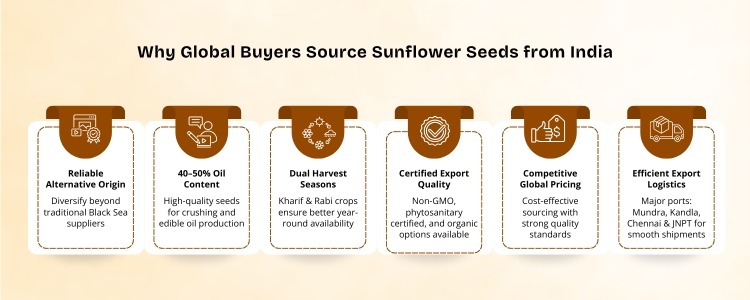
Numbers make better arguments than adjectives. Here’s what the spec sheet says when Indian sunflower seed lands on a buyer’s desk, and why each line matters more than it first appears.
|
Characteristic |
What It Means for Buyers |
|
Oil Content |
40–50% oil content across major varieties — competitive for crushing-grade demand |
|
Seed Type & Grade |
Confectionery (bold, striped) and oil-type (black) seed, sourced separately by end use |
|
Moisture & Purity |
Sub-8% moisture standards support longer shelf life and lower port-side rejection risk |
|
Price Positioning |
Competitive landed cost versus traditional Black Sea and South American origins |
|
Harvest Window |
Dual-season harvest (Kharif and Rabi) supports more consistent year-round availability |
|
Certifications |
Non-GMO status, phytosanitary certification, and organic-grade options on request |
Read individually, each row is a spec. Read together, they build a case for treating India as more than a fallback line, and the next question is simply how to act on it.
Guide for Sourcing Sunflower Seeds from India
1. Identify Key-Sourcing Region
Not all seed, or soil, is sown equally. Buyers chasing oil-type seed for crushing should look toward Karnataka’s established belt, while confectionery-grade sourcing often benefits from regions with stronger hybrid-variety cultivation and closer proximity to processing infrastructure.
- Match the region to the end use; oil-type and confectionery-grade sourcing don’t follow the same map.
- Weigh proximity to processing and crushing infrastructure, not just raw growing volume.
- A shorter harvest-to-processing gap is where seed quality is won or lost.
2. Contact Stable Suppliers
Here, trust becomes the product. Look past the lowest quote and toward export track record, volume history, FIEO or APEDA-registered status, and trade references that hold up under a phone call.
Ask for shipment history, not just a sample.
- Verify FIEO / APEDA registration and export credentials directly.
- A “stable” supplier is the one whose third shipment still matches the first.
3. Verify Quality Standards
Quality verification isn’t a bureaucratic checkbox; it’s the buyer’s insurance policy. Third-party lab testing for moisture and purity, aflatoxin screening for oil-type seed, and phytosanitary certification should be non-negotiable steps before a shipment is confirmed, not after it lands.
- Third-party lab testing for moisture, purity, and aflatoxin levels.
- Phytosanitary certification aligned to the buyer’s country of import.
- Cross-check compliance against destination-country import regulations before, not after, shipment.
4. Smooth Logistics
A great seed that arrives late, damp, or damaged isn’t a sourcing win; it’s a claim waiting to happen.
- Packaging standards: PP bags versus jute, and container-load consistency.
- Export routing through key ports — Mundra, Kandla, Chennai, and JNPT.
- Incoterms clarity: FOB versus CIF, agreed before shipment, not during a dispute.
- Realistic, upfront shipping timelines to protect both sides.
Conclusion
The sunflower still turns toward the sun, one field at a time, but the buyers watching it have moved on to a different question. Not “where does the flower grow best,” but “where does the supply chain hold up best.” India’s answer isn’t the loudest in the room, but it’s a deliberate one, a market building itself seed by seed, shipment by shipment.
For buyers looking to diversify beyond the usual origins, that deliberateness might be worth a conversation, and possibly, a first shipment.

Pratibha Soni
I write where strategy meets storytelling. As a passionate writer and literary enthusiast, I craft business-focused content that transforms trading insights into compelling narratives. Drawn to global business ecosystems, I enjoy turning research, innovation, and ideas into content that informs, connects, and inspires. With an analytical mind and a creative soul, I bring curiosity, collaboration, and a sharp eye for detail to every project. Adaptable and growth-driven, I believe the right words do more than communicate; they leave an impression.