

How UK Sourcing Companies Help Apparel Businesses Manage Supplier Risks
Introduction
How much profit are you losing to supplier uncertainty right now? Most UK apparel importers never quantify it. Supply chain disruption costs the UK retail sector £billions annually, yet the real damage isn’t always visible until it’s too late. A delayed shipment. A quality failure. A factory closure.
These aren’t anomalies; they’re symptoms of unmanaged supplier risk. UK sourcing companies exist for a reason: they architect risk-proof procurement ecosystems between Indian production excellence and Western operational safety. They’re not order placers. They’re risk architects.
India’s Vast Apparel Market-2026
India dominates global apparel production. Despite producing only 5% of the world’s apparel, India captures a disproportionate share of UK import volume, a paradox that reveals deeper truths about capability and complexity. India’s apparel sector is no longer synonymous with cost arbitrage. The narrative has shifted.
- Market Scale & Capacity: Export-oriented clusters like Tiruppur, Ludhiana, and Kolkata form a production spine that rivals any global competitor. According to NASSCOM and SBI data, these clusters operate at scale that accommodates everything from bulk commodity runs to bespoke small-batch orders. Tiruppur alone processes over 40% of India’s apparel exports; Ludhiana dominates denim and heavy wear; Kolkata specializes in luxury and specialty fabrics.
- Quality Renaissance: Modern Indian mills are technology-enabled, equipped with digital printing capabilities, sustainable production frameworks, and certifications that match (or exceed) European standards. Oeko-Tex, GOTS, and SEDEX compliance is now table-stakes, not a differentiator.
- Volatility Underbelly: But here’s the catch. Seasonal capacity swings are brutal. Geopolitical tariffs reshape margins overnight. Currency fluctuations turn a 15% margin into a 5% loss. FICCI and EY India reports document these “opportunity windows with execution risk.” Sourcing from India isn’t about finding cheap production. It’s about finding managed production.
UK Leading Choice: Sourcing Indian Apparel
The obvious answer: cost. But that’s the wrong answer.
If price were the only variable, Bangladesh would own the UK import market. It doesn’t. Vietnam would dominate technical wear. It doesn’t.
The Real Answer: The Cost-Quality Sweet Spot
India undercuts Bangladesh and Vietnam on advanced fabrics, technical wear, luxury blends, and specialty finishes, while maintaining competitive pricing on basics. This dual capability doesn’t exist everywhere. UK sourcing agents leverage this asymmetry: they know which Indian suppliers excel at performance fabrics versus commodity cotton basics, and they don’t confuse the two.
Scale Flexibility Matters
A UK retailer needs 50,000 units of seasonal basics AND 5,000 units of a limited-edition DTC collection. A single Indian supplier can handle both without the quality compromise that comes from forcing a commodity specialist into bespoke work. That flexibility is gold.
Regulatory Alignment is Real
Indian factories increasingly hold UK-recognized certifications. This isn’t compliance theatre, it’s operational alignment. WRAP, SEDEX, Oeko-Tex audits provide the documentation framework that UK brands need to satisfy Modern Slavery Act requirements, ESG reporting mandates, and retailer risk thresholds.
Personal Relationships Are Infrastructure
This is the unfashionable truth: Indian procurement culture runs on relationships. A factory manager’s word, a handshake, a decade of trust. UK sourcing agents are the cultural brokers. They speak both languages, Western compliance rigor and Indian relationship currency.
Ways UK Sourcing Companies Mitigate Apparel Business Supplier Risks
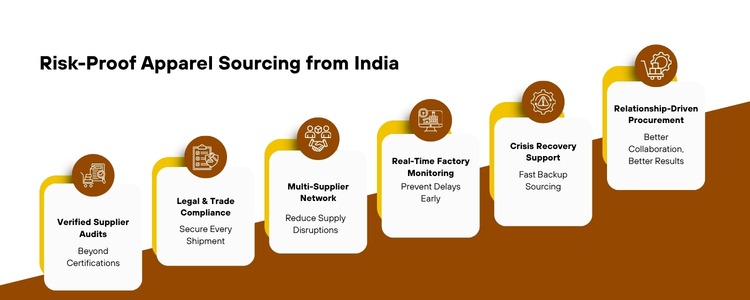
- Certifications & Verifications: One certificate means nothing. Twelve certifications with no audit trail means less than nothing, it means you’re not looking closely enough. UK sourcing agents don’t just verify that a supplier has SEDEX certification. They verify the audit date, the scope, the audit findings, and the corrective action history. They cross-reference SMETA reports. They map factory subcontracting networks, because here’s what happens: a factory holds three major certifications, publishes a pristine labor practice dashboard, and then subcontracts 30% of production to unlicensed workshops. One certificate. Twelve hidden subcontractors. ESG-conscious UK brands increasingly face pressure to prove sustainable sourcing.
- Legal Compliance & Documentation: Purchase orders. Quality agreements. IP clauses. Liability frameworks. This isn’t glamorous. It’s invaluable. UK sourcing agents embed arbitration clauses, jurisdiction clarity, and dispute resolution pathways before problems arise. Post-Brexit Rules of Origin documentation, GSP+ compliance, and duty optimization conversations happen upfront, not when Customs delays a shipment. For premium brands, design confidentiality agreements and mold ownership clauses are non-negotiable, and agents make sure they’re negotiated correctly.
- Supply Chain Diversification: “Don’t put all eggs in one basket” is cliché, but the execution is sophisticated. It’s 2-3 primary suppliers across different geographies, with 2 vetted secondary suppliers for surge capacity. Tiruppur handles basics and cotton-dominant runs. Ludhiana owns denim and heavy wear. Kolkata specializes in luxury finishes. This geographic spread ensures that when one cluster faces capacity constraints (seasonal or geopolitical), others absorb the load. Category diversification matters too. Your basic supplier shouldn’t be your technical wear supplier. When your primary cotton supplier hit capacity in February 2024, your backup was already production-ready. Your competitor? Stockout. Revenue missed. Customers turned away.
- Real-Time Monitoring: Static annual audits are rearview mirrors. Modern UK sourcing agents operate continuous oversight frameworks. Digital dashboards connected to factory MES (Manufacturing Execution Systems) data surface real-time production status, quality metrics, and capacity utilization. Algorithm-driven alerts flag capacity strain, quality variance, and labor-related issues before they cascade. On-ground presence matters, factory visits, manager-to-manager calls, informal intelligence networks, because numbers don’t tell you about factory morale, management instability, or emerging bottlenecks.
- Post-Catastrophe Support: What happens when your primary supplier’s factory burns down? When geopolitical tensions close borders? When a supplier suddenly closes? UK sourcing agents maintain crisis playbooks. They activate backup suppliers within days. They possess speed-sourcing capabilities from their backup network—even at premium cost, because brand revenue loss is worse. They manage the supplier-brand conversation during crises, preventing panic and miscommunication. Catastrophe planning isn’t pessimism. It’s margin protection.
- Supplier-Client Relationship Management: UK agents translate UK brand demands into actionable Indian factory language. “Reduce thread tension by 12% to prevent pilling on performance fabrics” means something different depending on who’s listening. Agents ensure both parties understand. When quality variance happens, agents mediate root-cause analysis and corrective action, not blame cycling. Long-term suppliers offer innovation partnerships, custom development capabilities, and preferential capacity allocation.
Why is Risk Management a Competitive Advantage for India-UK Trading?
Currency volatility. INR fluctuations swing margins 15-20% annually. Risk management includes hedging strategy conversations upfront.
Post-Brexit tariff complexity reshapes the duty landscape constantly. Sourcing agents stay ahead of regulatory change so clients don’t face surprises at customs.
Emerging markets, African suppliers, Southeast Asian mills, are rising. Proactive India sourcing requires risk management discipline; without it, you’re chasing price into mediocrity.
UK retailers face Modern Slavery Act scrutiny and ESG reporting mandates. Supplier vetting isn’t a compliance checkbox. It’s brand protection.

Conclusion
UK sourcing companies are risk architects, not order placers. They’re vital for transparency, infrastructure, relationship capital and operational agility. In a market where margins are thin and disruption is constant, managed sourcing isn’t a cost. It’s insurance and unlike traditional insurance it generates positive ROI via operational excellence. The brands that will win the India-UK apparel trade in 2026 are not chasing the lowest price. They want the safest supply chain.

Pratibha Soni
I write where strategy meets storytelling. As a passionate writer and literary enthusiast, I craft business-focused content that transforms trading insights into compelling narratives. Drawn to global business ecosystems, I enjoy turning research, innovation, and ideas into content that informs, connects, and inspires. With an analytical mind and a creative soul, I bring curiosity, collaboration, and a sharp eye for detail to every project. Adaptable and growth-driven, I believe the right words do more than communicate; they leave an impression.