

Why UK Buyers Import Leather Shoes & Footwear Raw Materials from India in 2026
India’s Diverse Leather Market Overview
How does a single nation supply more than 50 leather grades, finishes, and footwear raw materials to global markets simultaneously? The answer lies in India’s deeply integrated leather ecosystem. Rather than functioning as a low-cost sourcing destination, India operates as a multifaceted supply fortress built on specialisation, scale, and technical expertise.
Different regions cater to different buyer needs. Kanpur continues to be the leader in industrial and technical leather production, while Chennai has established itself as a centre for fashion-led finishes, premium footwear components and product innovation. Buyers can choose the right material for durability, softness, grain structure and performance specifications from the Indian buffalo, goat, sheep and cow hides.
Suppliers cover the entire footwear value chain from wet-blue processing and crust leather manufacturing to the production of fully finished leather. The top Indian tanneries are also increasingly getting certified by the Leather Working Group (LWG), boosting their appeal to sustainability-conscious UK buyers.
Position of Leather & Footwear Raw-Material Industry
By 2026, India’s leather and footwear raw-material industry will not only be a part of global trade, it will also define it. The country remains one of the world’s largest suppliers of leather, footwear components, soles, uppers, linings and finished leather products. Vietnam and Indonesia are taking away market share in manufacturing, but India is still ahead when it comes to the variety of materials and the ability to customize. This distinction is important to UK importers. Footwear brands require consistent access to multiple grades, finishes, and technical specifications without the need to source from fragmented networks.
India’s advantage is reinforced by an experienced workforce. Many tannery technicians, finishers, and leather craftsmen possess decades of practical expertise passed through generations. While competitors offer speed, India offers predictability, an increasingly valuable commodity in a volatile global supply chain environment.
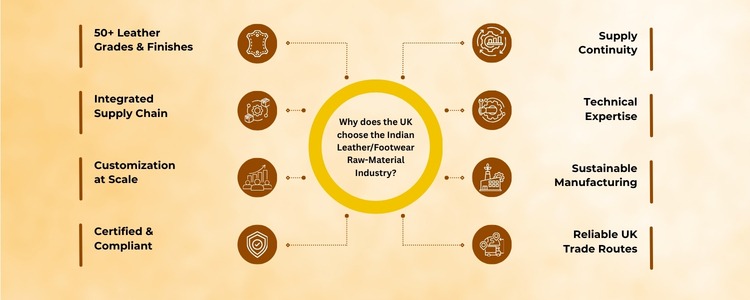
Why Should You Choose India’s Raw-Material Market
Many UK buyers face recurring challenges: inconsistent quality, rising costs, excessive minimum order quantities, and limited customization options. What if your sourcing partner could deliver innovation and reliability simultaneously?
UK buyers are embracing the efficiency of India’s integrated leather ecosystem rather than chasing perfection from multiple suppliers. Indian raw materials often offer a good cost-to-quality ratio and at the same time meet international compliance standards. Buyers can access commercially scalable premium leather, chrome-free alternatives, recycled leather products and new sustainable materials.
Most reputable vendors follow globally recognized standards like ISO 9001, ISO 14001, REACH and ZDHC frameworks. Plus, vertically integrated operations minimize procurement friction by controlling everything from sourcing hides to chemical treatment and finishing. This means faster decision-making, better quality consistency and long-term partnerships, which frequently lead to preferential pricing, opportunities for product innovation and dedicated production capacity.
What does the UK Look for in the Competitive Footwear Industry?
The more important question is not what India has to offer, but what the UK market needs. The UK buyer of today isn’t just buying the leather, they’re buying provenance, compliance and consumer confidence.
- Sustainability requirements increasingly play a role in procurement decisions. Retailers are increasingly requiring traceability, reduction in use of chemicals, water recycling initiatives and documented environmental performance. Durability is equally important as consumers want footwear that lasts longer and justifies premium pricing.
- Speed and agility are also essential. Brands need fast sample changes, scalable production runs and reliable replenishment schedules. Design compatibility is also important, particularly in fashion-led collections where grain consistency, quality of finish and colour accuracy have a direct impact on retail success.
Indian suppliers are increasingly responding to these expectations, offering a mix of technical know-how, sustainability investments and production flexibility that supports both premium and mass-market footwear brands.
Why UK Buyers Import Quality Footwear Raw-Material from India?
The strategic appeal of India extends beyond cost savings. It is rooted in supply continuity, technical capability, and long-term commercial value. After periods of global supply disruption, several UK footwear importers diversified sourcing, with many looking to Indian suppliers due to their broad manufacturing base and resilience of production. This reduced dependence on single-source markets and increased procurement flexibility.
- Innovation also features heavily. Clusters such as Kanpur and Chennai have leading tanneries that continue to invest in chrome-free finishes, low-impact tanning methods and advanced treatment technologies that are demanded by premium UK brands.
- In addition to raw material supply, many Indian partners also offer design consultation, prototype development, batch customization and technical troubleshooting. Buyers also have greater certainty on costs and delivery times with relatively stable production economics and proven shipping lanes to key UK ports.
- Smooth logistics, it involves end-to-end shipping. But the structural benefits are hard to argue against as buyers are getting more than materials, they are securing expertise, adaptability, and long-term sourcing stability.
Warning Signs to Avoid Rush
‘Sometimes the best deals are hiding the worst surprises.’
- Insist on seeing certifications, audit reports and proof of ownership before choosing a supplier. Have you verified that compliance credentials are up to date? Does the supplier have independent laboratory test results?
- A common mistake is expecting production quality to be exactly like the first samples. Smart buyers ask for pilot runs before going to full volume orders.
- Hidden costs can also eat up margins. When planning for procurement, take into account currency fluctuations, inspections, packaging requirements and logistics adjustments. Similarly, low MOQ promises can be expensive when pricing negotiations start.
- Lastly, assess relationship risk. Avoidable disruptions can happen when demand picks up due to dependence on a single point of contact, a lack of backup production capacity, or lack of clarity around account management structures.

Conclusion
For UK footwear brands trying to compete for quality-conscious and sustainability-driven consumers, sourcing decisions are becoming strategic, not transactional. India’s leather ecosystem is a robust confluence of quality, cost efficiency, customisation and supply reliability.
Green tanning innovations, stronger compliance frameworks and expanding manufacturing capabilities continue to make India one of the most influential sourcing destinations in 2026. The question is not about whether we should source from India. It’s whether you are sourcing from the right partners.

Pratibha Soni
I write where strategy meets storytelling. As a passionate writer and literary enthusiast, I craft business-focused content that transforms trading insights into compelling narratives. Drawn to global business ecosystems, I enjoy turning research, innovation, and ideas into content that informs, connects, and inspires. With an analytical mind and a creative soul, I bring curiosity, collaboration, and a sharp eye for detail to every project. Adaptable and growth-driven, I believe the right words do more than communicate; they leave an impression.