

How to Import Canola Oil into Bangladesh: Step-by-Step Guide
The trend of rising consumption of edible oil in Bangladesh has been observed due to increasing household need, growth of food processing sector, and shifts in customers’ tastes. Among the many varieties of edible oils present in the market, canola oil has been acknowledged for its lighter texture and versatility in use, as well as for possible domestic and commercial purposes. With the growing demand for canola oil, many companies are in search of global sourcing alternatives to secure their supplies.
Importing as a new business activity can seem complicated for the newcomer as the process of importing includes choosing suppliers, ensuring compliance with laws and regulations, gathering documents, dealing with logistics, and clearing customs. However, if planned wisely, importing canola oil could become an effective business operation. The present guide will explain important steps that a newcomer has to know about while sourcing and importing canola oil.
Understanding Bangladesh's Canola Oil Market
Bangladesh imports a large quantity of edible oils to meet domestic demand. The rapid increase in population, urbanization, and development of catering establishments, hotels, and food producing companies has led to an increase in consumption.
Canola oil is well known for its taste and versatility, making it suitable for household cooking, food service, packaged food products, and food processing. Importers are trying to find reliable foreign partners who are able to deliver quality products and competitive prices as consumers learn more about cooking oils.
A good knowledge of demand in the market allows companies to assess the volumes of imports, select potential customers, and create sustainable supply schemes.
Step 1: Identify Reliable Canola Oil Suppliers
A unique supplier is a key to a successful business in imports since a reliable supplier guarantees consistent qualities of supplied goods, punctuality of shipments, transparency of talking, and adherence to international standards regarding products.
Before entering into a contract, companies should assess the supplier based on a few criteria:
1) experience in exporting products and reputation in the market
2) certifications and guarantee of product quality
3) production and refining facilities
4) packaging options suitable for the Bangladeshi market
5) production capacity and delivery terms
6) responsiveness of the supplier.
Step 2: Verify Product Specifications
It is of vital importance for a prospective buyer to establish proper product specifications to avoid any confusion while receiving the consignment and ensure that the goods delivered comply with market needs.
Some of the key specifications are as follows:
- Product quality.
- Quality of processing.
- Dimensions of the packaging.
- Length of usage.
- Type of labeling.
- Storage conditions.
- Country of origin.
In case an importer demands inspection of laboratory tests and product specifications in anticipation of delivery, he/she will have a chance to check the quality of the goods.
Step 3: Understand Bangladesh's Import Regulations
Consistent with different rules and regulations, food products imported by foreign companies must meet certain requirements for the purposes of food security and consumer protection. Therefore, all importers must be aware of the particular customs regime and licensing rules, national food security laws, and what labeling requirements must be followed.
It is much wiser to engage professional customs brokers and trading companies in order to facilitate the customs regulations process.
Still, documentation is highly important as any errors may lead to other checks and waiting periods.
Step 4: Finalise Commercial Terms
Once a supplier is chosen, and the product specifications are confirmed, both parties should settle the commercial terms of their deal.
The discussions between them usually cover:
- Product pricing
- Minimum quantities needed
- Terms of payment
- Requirements regarding packaging
- Delivery schedules
- Who is responsible for shipping.
- Insurance arrangements.
A well-documented purchase agreement ensures that commercial disputes are reduced while the interests of buyer and seller are safeguarded.
Step 5: Arrange International Shipping
Good logistics practices are essential for effective international edible oil trade. Importers have to identify the best mode of transport depending on the shipment quantity and volume, time of delivery and budget.
Sea freight is a common way to meet the bulk transport needs of big commercial shipments. Proper packaging and container handling are necessary to ensure that the quality of goods is preserved during shipping.
In the process of launching their Canola Oil Export business in India, many companies take advantage of the already existing shipping routes and efficient connections between Indian ports and Bangladesh.
Step 6: Prepare Import Documentation
Correct document preparation aids customs clearance and decreases delays in administration. While specific document conditions may differ based on the laws and conditions of delivery, the importer requires the documentation for shipment and commerce purposes in order to provide proof about the cargo.
With accurate document checking before the gateway, the goods ensure compatibility between invoices, packaging information, transport documents, and declarations.
Having good book-keeping will be helpful later in the course of audit and for repeating the import procedure.
Step 7: Complete Customs Clearance
After the arrival of cargo in Bangladesh, the customs will check the documentation and ensure that all the rules are followed.
Depending on customs specifics, the imported cargo can be subject to the verification and appraisal. Quick submission of documents leads to the swift customs clearance.
It is known that cooperation with professional customs clarifiers makes this stage easier.
Step 8: Conduct Quality Inspection After Arrival
Receiving the freight is not the last phase of the delivery process. Upon arrival, the cargo has to be assessed for possible damages, conformity to the specifications, and the correctness.
Quality control ensures that the compliance of the packages is assessed and no issues occur before the distribution.
Step 9: Build Long-Term Supplier Relationships
Successful international trade is not limited to transactions between importers and exporters. Importers have a vested interest in establishing long-term relationships with reliable suppliers who have a good understanding of their business needs.
Experienced Canola Oil Exporters go the extra mile and provide a wide range of services, such as advice, packaging options among others and hence help to strengthen this commercial relationship.
Stable supplier relationships help improve inventory planning and reduce uncertainty in procurement in times of fluctuating markets.
Common Challenges Faced by Importers
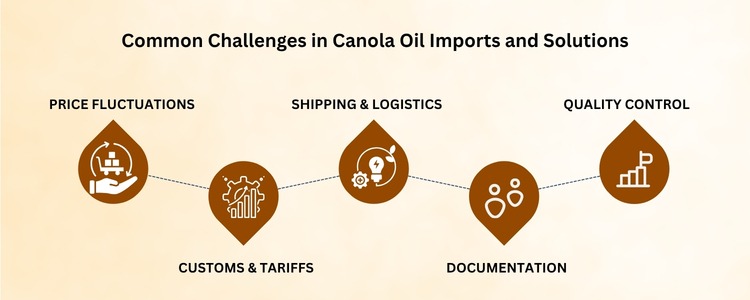
Although importing canola oil has several commercial prospects, the business has to deal with multiple operational challenges, such as the following:
International price fluctuations.
Shipping troubles.
Regulatory updates.
Currency fluctuations.
Chain breakdowns, and others.
All of these challenges can be overcome with meticulous planning, proper communication, and collaboration with knowledgeable suppliers.

Conclusion
When businesses take a systematic approach to importing canola oil into Bangladesh, they find the process to be much more straight forward. It is necessary to choose trustworthy suppliers, to know the regulation framework and to think through logistics properly and make sure to follow quality standards.
The growing market for food oils in Bangladesh means that companies which comply with the norms, act operationally efficient and cooperate with reliable suppliers will manage to supply their customers with what they want.

Diptanshu
Leading research and marketing at Inductus Global, Diptanshu drives the company’s vision to transcend traditional trading through thought leadership in import-export. He spearheads a research-driven approach that prioritizes quality over price arbitrage, positioning Inductus as a strategic sourcing partner rather than a transactional intermediary. His work spans market intelligence, supply chain innovation, and trade dynamics, while playing a key role in sales and business development.