

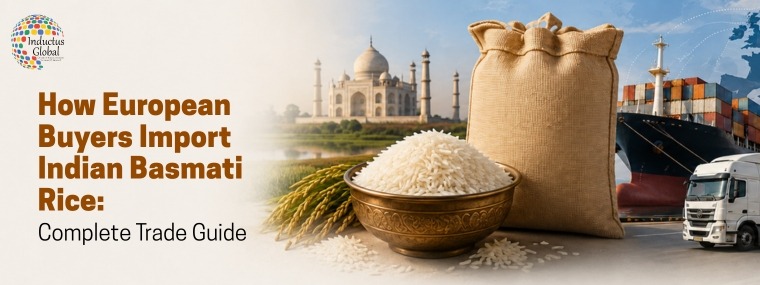
How European Buyers Import Indian Basmati Rice: Complete Trade Guide
What makes a grain of rice worthy of crossing oceans and landing on dinner tables in Berlin, Amsterdam, or Paris? Indian Basmati Rice doesn’t just travel, it earns trust, one shipment at a time. As European demand climbs through 2026, buyers are navigating a landscape thick with certifications and compliance checkpoints, where not every supplier claim holds up under scrutiny. This guide decodes exactly how serious importers source Indian Basmati Rice the right way, starting with the grain’s own story.
The Overhaul of Indian Basmati Rice: Origins, Varieties, Market 2026
Basmati isn’t a commodity; it’s provenance. Grown exclusively across the Indo-Gangetic plains and protected under India’s Geographical Indication (GI) tag, authentic Basmati carries a terroir no other rice can replicate. For European buyers, the real negotiation begins with variety: Pusa Basmati for aroma-forward blends, 1121 for its signature grain elongation after cooking, and Traditional Basmati for buyers chasing heritage and longer aging.
Heading into 2026, the market is tilting toward premiumization; aged, long-grain varieties are commanding higher prices across EU retail and HoReCa channels, as consumers pay for authenticity over volume.
Why are Europe Buyers the Top Leading Importers of Basmati Rice?
Why does Europe keep circling back to Indian Basmati, even as regional alternatives multiply? The answer lies in three converging forces. Europe’s ethnic-food retail sector is expanding at a pace few categories can match, and Basmati rides that wave.
EU food-safety consciousness, stricter than most global norms, rewards Indian exporters willing to certify rigorously rather than cut corners. And strategically, Germany and the Netherlands function as re-export gateways into the wider EU, meaning basmati rice importers in Europe and basmati rice importers in Netherlands aren’t sourcing just for domestic shelves, they’re sourcing for an entire continent.
Complete Trade Guide: Sourcing Indian Basmati Rice to European Markets
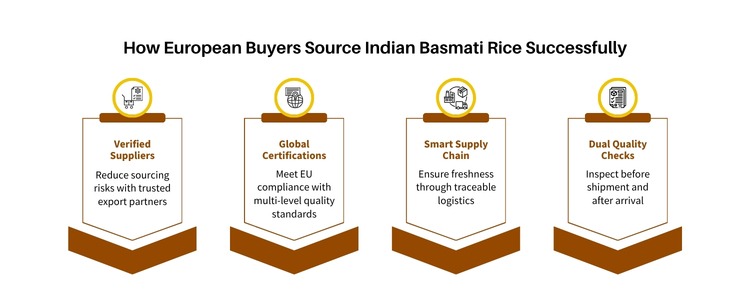
Understanding why Europe buys is only half the equation. The real work, the operational core every serious buyer must master, lies in how sourcing actually happens. Here is the complete trade guide, broken into the pillars that separate resilient importers from reactive ones.
Stable Sourcing Partners
Stability in sourcing isn’t luck, it’s the outcome of deliberate due diligence. The buyers who avoid mid-season supply shocks are the ones who invest early in long-term supplier relationships, verify milling capacity firsthand, and demand harvest-to-shipment traceability rather than taking claims at face value. Indian exporters with active APEDA registration and a documented export track record substantially reduce counterparty risk, particularly for European buyers entering the Basmati trade for the first time. In agri-trade, reliability is rarely accidental.
Diversified Certification
Certification is a passport, not paperwork to file away. ISO and HACCP signal process discipline; FSSAI confirms domestic food-safety compliance; phytosanitary certificates and pesticide-residue documentation unlock the door to EU entry specifically. Each certification opens a different layer of buyer trust, which is why diversified certification, not a single stamp of approval, future-proofs a sourcing relationship. As EU regulation tightens, suppliers who certify broadly today are the ones buyers will still be calling in 2030.
Supply Chain Management
There’s a meaningful difference between a shipment and a partnership, and supply chain visibility is what separates the two. Aged Basmati demands cold-chain-adjacent storage to preserve aroma and grain integrity; container-load consolidation determines cost-efficiency at scale; and increasingly, digitized inventory tracking between Indian mills and European ports is what prevents spoilage, mistimed arrivals, and the kind of delay that quietly erodes buyer confidence. Visibility isn’t a luxury feature anymore; it’s the baseline expectation.
Market Trends & APEDA
APEDA, the Agricultural and Processed Food Products Export Development Authority, functions as both watchdog and enabler for Indian rice exports, overseeing quota tracking, quality benchmarking, and broader trade facilitation. What’s shifting in 2026 is who’s actually reading APEDA data: it’s no longer just regulators and exporters. European buyers themselves are increasingly using APEDA’s public trade data to vet supplier credibility before contracts are ever signed, turning a regulatory body into an unofficial due-diligence tool.
Contract & Legal Compliance
It isn’t glamorous, but it is non-negotiable. INCOTERMS clarity, whether a deal is structured FOB or CIF, determines who bears risk and cost at each stage of transit. EU import duty structures shift by classification and origin, and dispute-resolution clauses decide what happens when something goes wrong. The truth of B2B trade is this: trust between buyer and exporter is only ever as strong as the contract behind it.
Smooth Logistics
Every shipment has a physical journey, and its smoothness determines whether trust survives contact with reality. Rotterdam and Hamburg remain the key entry points for Indian Basmati into the EU, and shipping line reliability directly shapes delivery predictability. Bottlenecks at Indian ports, congestion, documentation delays, container shortages, don’t stay contained to origin; they ripple straight through to European shelf timelines. Logistics, in this trade, is the last mile of trust, not merely the transportation in between.
Pre-Post Quality Check
Great sourcing operates on a two-checkpoint philosophy: pre-shipment inspection at origin, and post-arrival verification at the European port. Skip either, and buyers expose themselves to grain breakage, moisture variance, or contamination risks that surface only after the rice has already reached the shelf. This is precisely where supplier reputations are made, or quietly lost. The buyers who insist on both checkpoints, without exception, are the ones who rarely have to explain a recall.
Precaution & Risk Management
Global supply chain risk is no longer theoretical. Supplier defaults, counterfeit products, port congestion, regulatory shifts, and payment fraud are daily realities for import-dependent businesses. Inductus treats risk management not as a reactive function but as a proactive discipline embedded in every engagement.
Supplier onboarding at Inductus is preceded by rigorous vetting, financial health, manufacturing capacity, compliance certifications, and quality track record are all assessed before any supplier enters the network. Backup supplier tiers exist across product categories, so a single-source failure never becomes a buyer’s crisis.
Payment structures are milestone-based, protecting buyers from capital exposure on undelivered or substandard goods. And with a team that actively monitors India’s evolving Foreign Trade Policy, including the 2023 FTP’s $2 trillion export target roadmap, Inductus clients are never blindsided by regulatory changes that affect import timelines or documentation requirements.
Perhaps most critically, Inductus operates as a single point of accountability. When something goes wrong in global sourcing, and at some point, something always does, the question every buyer asks is: who owns this problem? At Inductus, the answer is unambiguous. That single point of ownership is not just operationally useful. It is what trust is made of.
Future of Safe-Sourcing: AI-Driven Tech Process From Indian Farms to European Shelves
What happens when blockchain-based traceability, satellite crop monitoring, and AI-driven grain quality grading converge on a single supply chain? The early answer is already visible: predictive analytics are beginning to flag compliance risks before a shipment ever leaves Indian soil, catching issues that once surfaced only after arrival, and after damage was done.
This isn’t a distant vision; it’s a quiet redefinition of what “trust” means in agri-export trade, replacing after-the-fact inspection with before-the-fact certainty. For European buyers, the promise is genuine farm-to-shelf transparency, beginning the moment a seed is sown, not the moment a container docks.
Conclusion
Indian Basmati Rice has always been something of a quiet diplomat, earning its place on European tables not through aggressive marketing, but through consistency, provenance, and shipment after shipment of delivered trust.
For European buyers, the real lesson of this guide is simple: successful sourcing was never about finding the cheapest grain. It’s about finding the most reliable partner. The next step is yours: explore verified, compliance-ready Indian sourcing partnerships built for the long term.

Pratibha Soni
I write where strategy meets storytelling. As a passionate writer and literary enthusiast, I craft business-focused content that transforms trading insights into compelling narratives. Drawn to global business ecosystems, I enjoy turning research, innovation, and ideas into content that informs, connects, and inspires. With an analytical mind and a creative soul, I bring curiosity, collaboration, and a sharp eye for detail to every project. Adaptable and growth-driven, I believe the right words do more than communicate; they leave an impression.