

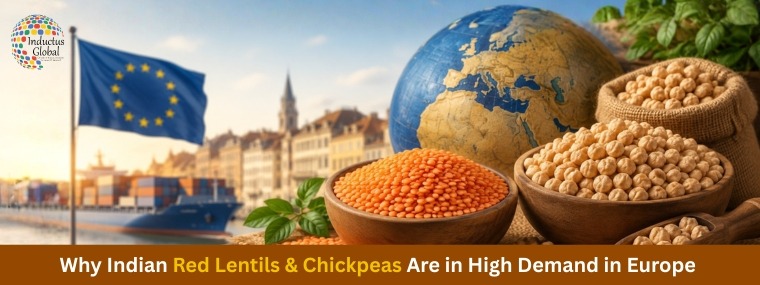
Why Are Indian Red Lentils & Chickpeas in High Demand in Europe?
What is it that turns a modest bowl of dal into a strategic European import? Across supermarket aisles in Berlin, Amsterdam, and Milan, Indian Red Lentils are quietly rewriting the rules of protein sourcing.
As Europe’s food industry pivots toward plant-based diets, India has emerged as a leading Indian chickpeas exporter, feeding a continent hungry for sustainable, affordable protein. For B2B importers and agri-trade companies, this is not a passing trend, it is a supply chain opportunity worth understanding closely.
Indian Pulses Market 2026: From Red Lentils to Chickpeas
India remains the world’s largest producer and consumer of pulses, and its export ambitions are catching up fast. According to APEDA and Ministry of Commerce data, pulses exports have climbed steadily as global buyers seek reliable, high-volume suppliers outside traditional Western agricultural hubs. Red lentils and chickpeas, once staples reserved for domestic kitchens, have become premium commodities on European trade desks.
What gives India its edge as a leading Indian pulses exporter? Diverse agro-climatic zones mean near-continuous harvest cycles, filling gaps precisely when European domestic production slows. Add competitive scale and cost efficiency, and the appeal sharpens further.
2026 marks an inflection point, traceability and certification now weigh as heavily as price in buyer decisions. So what exactly is pulling Europe toward Indian shores? The answer lies in a convergence of regulation, consumer demand, and nutrition science.
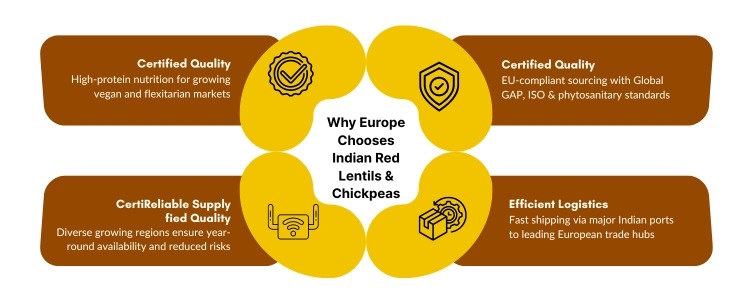
Why Europe has a High Demand for Indian Lentils & Chickpeas?
What happens when sustainability regulation collides with consumer appetite for clean-label protein? The answer is a surge in demand that has made Red Lentils importers in Europe some of the most active buyers in the global pulses trade. The EU’s Green Deal and Farm to Fork strategy have pushed food companies toward lower-carbon, plant-forward supply chains, while a growing vegan and flexitarian population reshapes retail shelves.
Indian lentils and chickpeas answer both demands at once, nutritionally dense, minimally processed, and grown largely under rain-fed, low-input farming systems.
| Category | Why It Matters |
|---|---|
| Plant-Based Protein | Red lentils provide approximately 24g of protein per 100g, while chickpeas offer around 19g per 100g, making them excellent alternatives to animal-based protein. |
| Vegan | Naturally dairy-free, gluten-free, and cruelty-free, making them ideal for Europe’s rapidly expanding vegan and plant-based consumer market. |
| Sustainable Farming | Grown using rain-fed agriculture, nitrogen-fixing crop rotation, and requiring significantly less water and lower carbon emissions than livestock-based protein production. |
| Clean-Label & Healthy | Free from preservatives, minimally processed, and produced to meet EU import regulations, food safety, and pesticide residue compliance standards. |
Every column tells the same story: India isn’t just meeting European demand, it’s engineering supply to match Europe’s evolving values.
Steps to Source Lentils & Chickpeas from India to Europe
For European buyers ready to move from interest to action, sourcing Indian pulses follows a field-tested, four-step roadmap.
Step 1: Finding Diverse Suppliers
Sourcing begins with finding reliable exporters in India’s prime growing belts, chickpeas from Madhya Pradesh, Rajasthan, Maharashtra & Karnataka; red lentils from Uttar Pradesh & Madhya Pradesh. The risk is spread across many harvest zones and supply networks by working with established Indian agricultural export companies rather than individual regional traders.
Why is diversity so important? Single-origin dependencies expose buyers to climate volatility, local crop failures or changes in trade policy. Diversified sourcing is not about being careful, it is a strategy to protect European importers from disruptions that no contract clause can fully prevent.
Step 2: Certified Procurements
In the global pulse trade, trust is measured by certifications. Global GAP, ISO, FSSAI, organic certification, phytosanitary clearance, and compliance with EU Maximum Residue Limits (MRLs) are not bureaucratic checkboxes. They are the credentials that separate a dependable Indian chickpeas exporter from a risky one.
For European buyers, being ready for certification is a sign that a supplier is in it for the long haul. This readiness has gone from being a competitive advantage to being a baseline requirement, the entry ticket to sustained, contract-worthy partnerships, as EU import scrutiny tightens in 2026.
Step 3: Establishing Routes & Logistics
Efficient logistics turn intention into delivery. Major Indian ports, Mundra, Kandla, and JNPT, anchor shipping lanes toward European hubs like Rotterdam, Hamburg, and Antwerp, with transit times and storage conditions critical to preserving pulse quality en route.
Digitized trade documentation and freight consolidation have shortened the India-Europe corridor considerably, reducing both cost and delay. What separates a dependable exporter from an occasional one? Often, it isn’t the product at all, it’s the precision of the journey it takes to reach the port.
Step 4: Quality Checks & Control
The last trust checkpoint before Indian pulses make it to a European plate is quality control. Moisture content limits, thresholds for foreign matter, size grading and third-party lab testing prior to shipment ensure consistency, shipment after shipment.
To buyers, grain uniformity and protein content are not cosmetic details, they are what gets repeat orders. In this market, quality control isn’t optional when one bad batch can kill a partnership. It’s the quiet confidence that makes one order into a long-term supply relationship.
The Future of India-Europe Trade Relations: From Pulses, Rice to Apparel & Handicrafts
Pulses are proving to be more than a commodity, they’re a gateway. As red lentils and chickpeas export from India build steady trade volume with Europe, they’re also building something less tangible: commercial trust. That trust is increasingly spilling into adjacent categories, from Basmati rice to apparel and handicrafts, as ongoing India-EU Free Trade Agreement discussions aim to deepen and diversify bilateral commerce.
What does India’s next export frontier look like once trade matures? If current momentum holds, agri-commodities may well become the opening chapter of a much larger India-Europe trade relationship, one where consistent, certified, quality-driven pulses supply becomes the reference point for evaluating India as a sourcing partner across categories altogether.
Conclusion
India’s rise as Europe’s preferred pulses partner isn’t accidental; it’s the result of scale, certification, and consistency working in tandem. For European importers and agri-trade companies exploring reliable Indian Red Lentils and Indian chickpeas exporter partnerships, the opportunity is open and the supply chain is ready. The question now is: who moves first?

Pratibha Soni
I write where strategy meets storytelling. As a passionate writer and literary enthusiast, I craft business-focused content that transforms trading insights into compelling narratives. Drawn to global business ecosystems, I enjoy turning research, innovation, and ideas into content that informs, connects, and inspires. With an analytical mind and a creative soul, I bring curiosity, collaboration, and a sharp eye for detail to every project. Adaptable and growth-driven, I believe the right words do more than communicate; they leave an impression.