

How to Import Rice Bran Oil from India to the UK: Complete Buyer's Guide
Introduction
What if the healthiest oil on a UK shelf isn’t olive, sunflower, or rapeseed, but one most buyers have barely noticed? Rice bran oil, long dismissed as rice milling’s quiet by-product, has quietly turned into one of India’s most sought-after edible oil exports.
Post-Brexit, UK retailers and manufacturers are hunting for sourcing that’s stable, health-forward, and cost-efficient, and India has stepped up to answer that demand. This guide isn’t theory. It’s the actual roadmap UK importers follow, from first supplier contact to a fully cleared warehouse delivery.
Everything You Should Know About Indian Rice Bran Oil
Rice bran oil isn’t pressed from the rice grain itself. It comes from the bran, the thin outer layer milled away during processing, which is exactly why it’s earned the nickname “a by-product with premium potential.” A high smoke point makes it a natural fit for frying and industrial food processing, while naturally occurring oryzanol and tocotrienols give it a nutritional edge tied to healthy cholesterol support. Its neutral flavor lets it blend into recipes without overpowering them.
Its uses span three lanes: culinary, industrial, and cosmetic-grade, each with its own specification. Food manufacturers lean on it for frying oils and packaged snacks, industrial buyers use it in surfactants and lubricants, and cosmetic formulators prize it for skin-conditioning properties. As UK consumers push brands toward clean-label ingredients, rice bran oil is emerging as a credible alternative to palm and sunflower oil, drawn from a crop already central to Indian agriculture rather than a new plantation footprint carved out to meet demand.
Rice Bran Oil Varieties & Specifications: A Quick Reference
Not all rice bran oil leaving Indian ports is the same, and buyers who treat it as a single commodity end up paying for the wrong grade. Specification, not marketing language, is what should drive a sourcing decision. Here’s how the main varieties stack up:
| Variety / Grade | FFA Level | Oryzanol Content | Best Suited For |
|---|---|---|---|
| Crude Rice Bran Oil (CRBO) | Up to 10–15% | 1.5–2% | Further refining, biodiesel production, industrial applications |
| RBD Rice Bran Oil (Refined, Bleached & Deodorized) | Below 0.15% | 1–1.5% | Retail cooking oil, food processing, food manufacturing |
| Physically Refined Rice Bran Oil | Below 0.1% | 1–1.5% | Premium food-grade products, health-focused retail brands |
| Winterized / Dewaxed Rice Bran Oil | Below 0.15%, low wax | 1–1.5% | Cold-climate markets (e.g., UK & Europe), salad dressings, mayonnaise, sauces |
| Cosmetic-Grade Rice Bran Oil | Below 0.1% | 1.5%+ | Skincare, haircare, cosmetics, personal care formulations |
Meeting Global Demands: India, Leading Supplier of Premium Rice Bran Oil
India’s dominance in rice bran oil isn’t a given; it’s earned. As the world’s largest rice producer, India sits on a raw material advantage few exporters can replicate at scale. Production hubs across Punjab, Haryana, Andhra Pradesh, and Telangana feed a steadily rising export volume, backed by refining infrastructure that increasingly ships RBD (refined, bleached, deodorized) oil rather than crude. That shift matters.
It means India isn’t just supplying oil, it’s supplying scale and consistency, the two things global buyers actually pay for. So what happens to global edible oil supply chains when one country controls this much of the raw material and the refining capacity behind it? For UK buyers, the answer is leverage worth understanding before it becomes leverage worth negotiating around.
Why the UK Imports Rice Bran Oil from India: Key Factors
Price is only where the case for India starts. Cost competitiveness against European and other Asian sourcing gets buyers to the table, but several other factors keep them there:
- Post-Brexit flexibility: an evolving UK-India trade relationship is opening sourcing lanes that didn’t exist a few years ago.
- Compliance readiness: a growing base of FSSAI, ISO, and HACCP-certified Indian exporters shortens the runway to UK Food Standards Agency approval.
- Consistency at volume: large-scale Indian suppliers offer a reliability that fragmented, smaller-origin markets often can’t match.
- Clean-label demand: UK packaged food and cosmetics brands increasingly want non-GMO, allergen-friendly oils, and rice bran oil checks that box.
Point by point, the case builds itself: India isn’t simply an option for UK sourcing. It’s becoming the default, and buyers who treat it as one option among many risk losing ground to competitors who lock in supply first.
Your Go-To Guide: Import Indian Rice Bran Oil to the UK
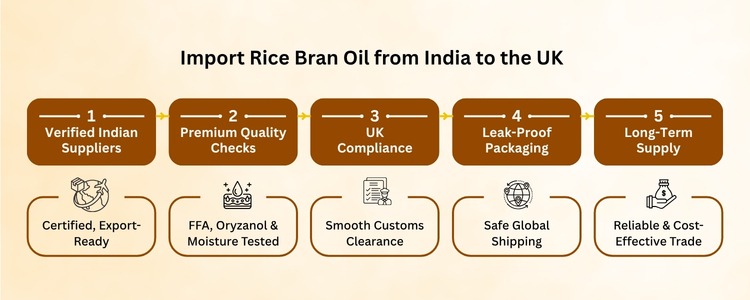
- Locate Standard Suppliers: start by vetting exporters on verified trade licenses, documented export history, and FSSAI or ISO certification, then cross-check UK trade references directly. An uncertified, first-time exporter offering the lowest price is rarely the cheapest option once quality risk enters the equation.
- End-to-End Quality Verifications: “Quality” needs numbers, not adjectives. Confirm free fatty acid (FFA) levels, moisture content, oryzanol percentage, and color grading against agreed specifications before any shipment moves. This is the buyer’s first real line of defense against a substandard consignment.
- Third-Party Testing: independent inspection agencies validate what suppliers claim, before payment or shipment is finalized. Skipping this step to save time or cost isn’t due diligence deferred; it’s due diligence abandoned.
- Oil Refining & Leak-proof Packaging: refining runs through degumming, neutralization, bleaching, and deodorization to reach export-grade standard. From there, packaging carries equal weight; flexitanks, food-grade drums, and tamper-proof seals are what keep oil intact through a multi-week sea voyage.
- Following Legal Regulations & Contracts: correct HS codes, certificates of origin, and phytosanitary certificates, keep shipments moving through customs. Contracts should lock in Incoterms (FOB or CIF), penalty clauses, and a clear dispute resolution path before goods ever leave Indian shores.
- Pre/Post Shipping: pre-shipment inspection and complete documentation handoff set up a clean arrival. On the UK side, that means customs clearance, warehousing, and a final quality re-verification before the oil enters the domestic supply chain.
Developing a Stable Supply Chain for Long-Term Trading: India & UK
A one-off import is a gamble dressed up as a transaction. Real margin and real reliability live in structured, long-term supplier relationships built on multi-year contracts, dual-sourcing as a hedge against disruption, and logistics partnerships that mature over time. Every clean transaction between an Indian exporter and a UK importer compounds into something more valuable than the shipment itself: trust.
That trust is what shortens negotiation cycles, softens price volatility, and turns a supplier into a partner willing to prioritize your order when global demand tightens. As India’s refining capacity grows and the UK’s appetite for clean-label oils sharpens, this corridor is positioned to move from opportunistic sourcing to a genuine strategic pipeline.
Conclusion
So, is rice bran oil still an overlooked player in the India-UK edible oil trade, or is it quietly becoming the smart default? Importing it from India isn’t just a sourcing decision; it’s a strategic one, where cost, compliance, and quality align in a way few other markets currently offer. For UK buyers ready to move beyond guesswork, the next step is simple: connect with verified suppliers and see where the numbers actually land.

Pratibha Soni
I write where strategy meets storytelling. As a passionate writer and literary enthusiast, I craft business-focused content that transforms trading insights into compelling narratives. Drawn to global business ecosystems, I enjoy turning research, innovation, and ideas into content that informs, connects, and inspires. With an analytical mind and a creative soul, I bring curiosity, collaboration, and a sharp eye for detail to every project. Adaptable and growth-driven, I believe the right words do more than communicate; they leave an impression.