

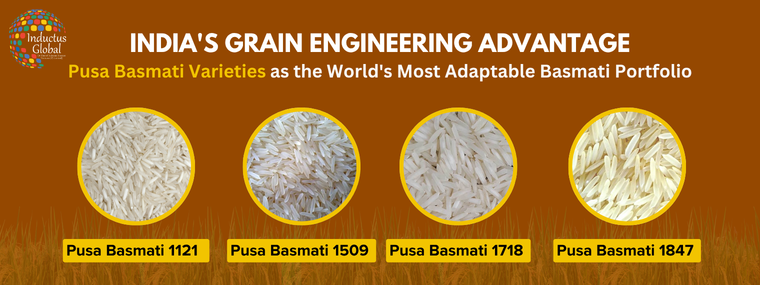
Pusa Basmati Rice Buying Guide: Compare 1121, 1509, 1718 & 1847
Basmati Rice: One Famous Name Hiding a Family of Engineered Varieties
To most international buyers, “basmati” reads as a single product on a shelf label — one grain, one grade, one story. But behind that generic name sits a deliberately diversified breeding program that the Indian Agricultural Research Institute (IARI) has spent more than two decades building out.
The foundation was laid in 2003, when IARI released Pusa 1121 — later notified as Pusa Basmati rice 1121 in 2008 — the variety that went on to be marketed globally as the world’s longest basmati grain and became the benchmark against which every subsequent release is measured. Two decades on, IARI’s newer generation of varieties is pushing buyers past a single default choice, toward selecting the specific grain profile, yield, and disease-resistance package that actually matches their order.
How Newer Pusa Varieties Are Becoming Exporters' Next Default Choice
For most of the past two decades, global buyers seeking premium, extra-long-grain basmati defaulted almost automatically to Pusa Basmati 1121, sold raw or as 1121 Sella, its parboiled form. That default came with real trade-offs: 1121 carries a long seed-to-seed maturity of around 145 days and no built-in disease resistance, while its widely planted early-duration successor, Pusa Basmati 1509, turned out to be highly susceptible to both bacterial blight and blast disease, each scoring a susceptibility index of 7.0 on IARI’s own resistance testing.
IARI’s molecular breeding program addressed that gap directly. Pusa Basmati 1718, notified for commercial cultivation across Punjab, Haryana, and Delhi in a government gazette notification dated August 25, 2017, is a near-isogenic line of 1121 carrying two bacterial blight resistance genes, xa13 and Xa21, while retaining 1121’s grain quality.
Pusa Basmati 1847 followed in 2021 as an improved version of 1509, cutting its blast susceptibility index from 7.0 down to 2.5 and its bacterial blight susceptibility from 7.0 down to 3.0. APEDA’s own documentation on newly released basmati varieties confirms the pattern: each new release is engineered to solve a specific agronomic weakness in an existing commercial variety, not to replace the category from scratch.
Inductus Global’s own conversations with international buyers increasingly reflect this shift too, with more importers now specifying a named variety — 1509 or 1718, for instance — rather than placing a generic “basmati” order. The scale of what’s at stake nationally is substantial: IARI-bred, high-yielding basmati varieties account for roughly 90% of India’s projected $5.5 billion basmati rice export value in FY 2023-24, according to government data on the sector.
| Parameter | Pusa Basmati 1121 | Pusa Basmati 1509 | Pusa Basmati 1718 | Pusa Basmati 1847 |
|---|---|---|---|---|
| Grain Length / Cooking Quality | World’s longest basmati grain; premium elongation benchmark | 8.40 mm grain; 18.2 mm cooked kernel length | Near-isogenic to 1121; similar grain quality with disease resistance | Similar grain profile to 1509, with added disease resistance |
| Maturity Duration | ~145 days seed-to-seed | Early maturity; ~120 days | 136–138 days | ~125 days |
| Disease Resistance | No built-in disease resistance | Highly susceptible to bacterial blight & blast | Built-in bacterial blight resistance (xa13, Xa21) | High resistance to blast and bacterial blight |
| Average Yield | ~4.5 t/ha (45 q/ha) | Higher than 1121; non-lodging variety | ~4.64 t/ha average; up to 6.04 t/ha potential | ~5.7 t/ha average |
| Water / Input Requirement | Highest due to longer maturity duration | Lower than 1121 | Moderate | Lowest due to shorter maturity duration |
| Market Positioning | Premium benchmark; highest price tier | Mid-tier; suitable for fast-turnaround volume | Lower-risk alternative for 1121 buyers | Lower-risk successor to 1509 for volume buyers |
Pusa Basmati as Leading Destination for Disease-Resistant Basmati Sourcing
Marker-assisted backcross breeding is fundamentally different from developing an entirely new variety from scratch. Rather than accepting the yield and quality uncertainty of an unproven new cross, the technique produces a near-isogenic line — a variety with the exact grain quality, aroma, and agronomic profile of a proven parent, but with specific disease-resistance genes inserted through molecular marker selection. That’s precisely how 1718 and 1847 were built from 1121 and 1509 respectively, giving exporters a lower-risk upgrade path rather than an unfamiliar new product to sell buyers on.
The scale and coordination behind that program is well documented. Following direction from the Union Minister of Agriculture and Farmers Welfare to address bacterial blight and blast outbreaks, IARI released three improved varieties simultaneously in 2021 — Pusa Basmati 1847, 1885, and 1886 — as disease-resistant successors to 1509, 1121, and 1401/PB-6 respectively, according to a press release from India’s Press Information Bureau.
IARI Director Dr. Ashok Kumar Singh subsequently described 1847 to Krishak Jagat as retaining all of 1509’s core features while adding resistance, with a maturity of just 125 days. Nationally, IARI’s high-yielding basmati varieties underpin roughly 90% of India’s projected $5.5 billion FY 2023-24 basmati export value. For exporters specifically, the opportunity is matching each buyer’s actual grain-quality and supply-risk tolerance to the right named variety, rather than selling basmati as one undifferentiated product.
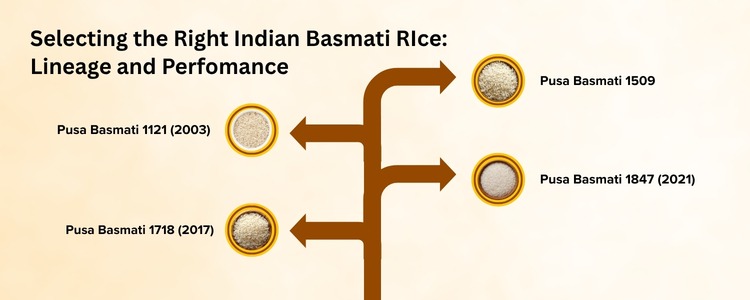
Pusa Basmati's Breeding Program as Center of Precision & Reliability
Geographic Factors
Pusa Basmati varieties are grown across the Geographical Indication zone’s core states — Punjab, Haryana, Delhi, and western Uttar Pradesh. Pusa Basmati 1718 was specifically notified for commercial cultivation in Punjab, Haryana, and Delhi under a 2017 government gazette notification, and from there, shipments move through Kandla and Mundra toward international buyers.
Talented Youth
Younger farming families across Punjab and Haryana are increasingly adopting the newer disease-resistant lines — 1718 and 1847 in particular — to cut fungicide and pesticide costs while stabilizing yields season to season. That combination of lower input cost and more predictable output is giving the next generation of basmati farmers a stronger economic case to stay in cultivation rather than shift to other crops.
Qualified Professionals
The breeding work behind every Pusa Basmati release traces back to IARI’s molecular breeding team, led by Director Dr. Ashok Kumar Singh, using marker-assisted backcross breeding to build near-isogenic lines with inserted disease-resistance genes. That specialized institutional capability, not generic seed selection, is what lets exporters guarantee a specific grain profile paired with a specific resistance package.
Innovation First Strategy
IARI’s 2021 release of Pusa Basmati 1847, 1885, and 1886 stands as a concrete, government-directed innovation program: three disease-resistant successor varieties released together, each engineered to replace a specific existing commercial line while preserving its grain characteristics. Paired with 1718’s 2017 release, the program represents a systematic, ongoing upgrade cycle for India’s core commercial basmati varieties rather than a one-off breeding success.

Conclusion
Newer Pusa Basmati rice varieties aren’t trying to dethrone 1121 as the premium, longest-grain benchmark — that positioning remains intact and commercially valuable. The differentiated pitch is choice: buyers can now select the specific variety that matches their risk tolerance, turnaround needs, and price point, instead of defaulting to a single generic basmati order. The comparison to a maturing, precision-bred product line isn’t marketing gloss — it’s a trajectory backed by real releases.
Pusa Basmati 1718 was notified in 2017 with built-in bacterial blight resistance, 1847 followed in 2021 cutting blast susceptibility from an index of 7.0 down to 2.5, IARI-bred varieties collectively anchor roughly 90% of India’s $5.5 billion FY 2023-24 basmati export value, and Pakistan’s own adoption of these same IARI-bred lines — rebranded locally as “Kissan Basmati” and “1121 Kainat” — is itself a back-handed proof of their competitiveness.
Whether the newer disease-resistant lines fully displace 1121 and 1509 as exporters’ default choice remains to be seen, but for buyers weighing grain quality against supply reliability, the direction of travel toward variety-specific sourcing is no longer in question.

Diptanshu
Leading research and marketing at Inductus Global, Diptanshu drives the company’s vision to transcend traditional trading through thought leadership in import-export. He spearheads a research-driven approach that prioritizes quality over price arbitrage, positioning Inductus as a strategic sourcing partner rather than a transactional intermediary. His work spans market intelligence, supply chain innovation, and trade dynamics, while playing a key role in sales and business development.