

Leather Goods Export Trends: Market Analysis for Indian Manufacturers
Introduction
India’s quest to increase its production capacity for leather and leather goods began with craftsmen who made products in their homes. Today, however, many of India’s great cities boast superbly designed and produced bags, shoes, belts, wallets, handbags, etc., all created using both traditional methods and techniques of mass production. Additionally, many leather product manufacturers use ethically sourced materials from around the world in order to produce their goods; thus, creating large quantities of high-quality products at low cost.
In the last ten years, the demand for ethically-sourced leather products has led to dramatic changes in trade routes around the world. Because of significant investment in workforce development, along with strong supply chains, India has positioned itself as a trustworthy supplier of leather products to Europe, North America, & the Middle East.
Unfortunately, the current state of global trade is quickly changing. Increasing sustainability policies are affecting many product categories; consumer behavior is changing; and geopolitical tensions are creating uncertainty regarding trade treaties between countries. So, in order for manufacturers in India or any other country to stay competitive, they must monitor changes in export markets closely and quickly respond to any emerging opportunities that may arise from these market changes.
How is the Global Demand for Leather goods Evolving?
A continuing increase in consumption of high quality, affordable leather goods has led to a rise in demand for premium leather goods worldwide. As a result, customers living in developed economies place greater emphasis on durability and craftsmanship than they do on fast-changing fashion trends.
Although there has been significant growth in the number of synthetic alternatives, real leather has remained a preferred material for use in luxury and mid-priced items. For instance, leather footwear represents a large proportion of total leather product exports, with leather footwear making up a large proportion of exports from India.
The availability of e-commerce platforms has provided international customers with access to suppliers who previously used third-party distributors. As a result, from a financial perspective, suppliers are enjoying larger profit margins as a result of the loss of profits to these traditional third-party distributors. From a customer satisfaction standpoint, however, consumers are now expecting more consistent product quality and accurate and complete compliance documentation with their purchases.
Growth in demand for leather products is not uniform across all regions. While developed European markets are experiencing modest levels of growth, developing African and Southeast Asian markets present greater growth opportunities. Therefore, exporters will need to develop targeted strategies based upon the specific demand characteristics within the various geographic regions in which they are engaged.
What Role Does the Indian Leather Export Market Play Globally?
India continues to be a major player in the global leather supply chain through its robust contribution to the exports of leather products around the world. The country has a strong base of raw materials and a labor market with competitive wages. In addition, it has an established ecosystem for tanning.
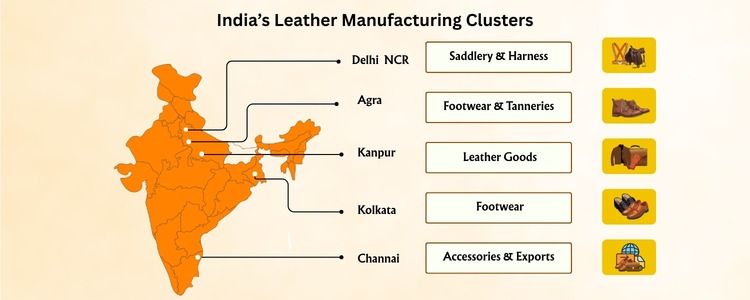
The Indian business clusters at Chennai, Kanpur, Agra, and Kolkata have developed specialization across various types of leather products due to government support through export incentives and skill development programs to improve on their level of competitiveness.
Recent data from various trade statistics shows that Indian leather exports have shifted away from just being sold to traditional European buyers and that the United States, UAE, and some countries in Africa are becoming increasingly important for leather manufacturers.
The level of competition is still intense across all regions of the globe; for example, new capacities have opened up by countries such as Vietnam and Bangladesh, which means Indian manufacturers will need to provide greater value-added products instead of just relying on their cost advantage.
Are Sustainability Norms Reshaping Export Strategies?
Compliance with environmental and ethical standards is a critical factor in the global marketplace. There is an increasing demand from buyers for any product to demonstrate chain-of-custody from the raw materials to the end product, which includes verifying that tanning methods are environmentally sustainable and that carbon emissions are reduced.
Indian exporters have responded by either modifying their effluent treatment systems or using chrome-free tannage methods. Obtaining certification for either environmental management or social responsibility is now a condition of selling internationally.
Compliance as a wholesale leather supplier is no longer limited to the standards set at their factory but also applies to all areas of their supply chain. Auditors in the global market evaluate all segments of the leather supply chain, including how raw hides are sourced, how waste is handled, and how employees are treated.
If companies do not meet sustainability standards, they will likely experience cancelled orders and damages to their reputations. However, companies that adopt sustainability standards early on will benefit from improved credibility and stronger long-term relationships.
How Are Trade Policies and Tariffs Influencing Exports?
Trade agreements and tariffs directly affect the price competitiveness of exports. Preferential trade agreements that India has with certain countries allow for duty exemptions, making exported products more price-competitive.
However, due to customs clearance delays resulting from errors in documentation or compliance issues, exporting products is subject to potential pricing instability from tariff uncertainty and non-tariff barriers. As a result, manufacturing companies need to closely monitor trade agreement developments, particularly in the European Union and the United States. Aligning strategies with changes in trade regulations will enable longer-term stability and predictability in manufacturing costs.
What Technological Shifts Are Impacting Leather Manufacturing?
As production processes evolve over time due to technological advancements, automating processes such as cutting and using CAD/CAM systems eliminate waste while improving efficiency. This also increases the ability to track how a product was manufactured, and the data can be passed on to foreign clients by exporters.
Small and medium enterprises represent a large portion of the industry and have made more investments in technology to remain competitive. The availability of digital catalogues and online marketplace platforms has facilitated an increase in global reach.
For an industry that has always based itself on craftsmanship, the incorporation of technology is a way for manufacturers to strike a balance between an artisan quality product and an efficient industrial product.
What Challenges Do Indian Manufacturers Face in 2026?
However, there are many challenges facing the industry today despite being such a strong industry in creating jobs and producing revenue for the economy:
- Fluctuating price of raw materials
- Increasing cost of compliance
- Currency Fluctuations
- Rising competition from other materials
- Skilled labour shortages across geographic areas
In addition, global slowdowns can have a negative impact on consumer discretionary spending, which has an effect on demand for non-essential items (luxury goods).
To remain competitive in the future, manufacturers must innovate, diversify markets and continue to uphold strict quality standards.
How Can Exporters Strengthen Global Positioning?
Strategic positioning involves moving beyond commodity production. Manufacturers can:
- Focus on design innovation
- Develop private-label partnerships
- Expand into niche markets
- Invest in brand building
- Strengthen direct buyer relationships
Diversification across product categories reduces dependence on single segments. Emphasis on quality, compliance, and delivery reliability enhances trust among international buyers.
In a competitive landscape, sustained credibility is a powerful differentiator.
1. What are the main export destinations for Indian leather products?
The European Union, United States, UAE, and select African markets are key destinations.
2. How important is sustainability in leather exports
It is critical. Buyers demand environmental compliance and traceability across the supply chain.
3. Is leather footwear the largest export category?
Yes, footwear accounts for a significant share of total export value.
4. How does technology benefit leather manufacturers?
It improves efficiency, precision, and supply chain transparency.
5. What challenges affect export competitiveness?
Rising compliance costs, currency fluctuations, and international competition.
6. Can small manufacturers compete globally?
Yes, with proper quality control, niche focus, and adherence to global standards.

Diptanshu
Leading research and marketing at Inductus Global, Diptanshu drives the company’s vision to transcend traditional trading through thought leadership in import-export. He spearheads a research-driven approach that prioritizes quality over price arbitrage, positioning Inductus as a strategic sourcing partner rather than a transactional intermediary. His work spans market intelligence, supply chain innovation, and trade dynamics, while playing a key role in sales and business development.