

How to Source Electronic Components: A Step-by-Step Guide for Buyers
The future of global manufacturing relies heavily on an uninterrupted flow of semiconductors, connectors, resistors, capacitors and integrated systems across international borders. Any disruption in the supply chain could stop production lines, impede export schedules, and reduce margins. For both procurement directors and business owners alike, sourcing electronic components is no longer simply counting pieces of a product to fulfill orders; rather, it has become a formalized discipline.
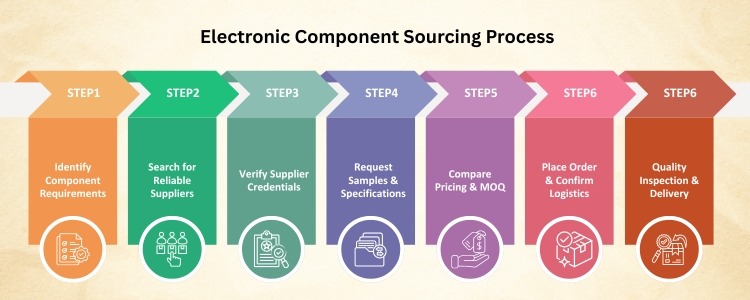
The purpose of this guide is to give you an understanding of your approach to sourcing electronic components as it relates to diligence versus speed; data versus assumption; step-by-step.
What Does Electronic Components Sourcing Really Involve?
Sourcing at its highest level consists of finding, evaluating and qualifying trustworthy suppliers who can provide specified electronic components that meet agreed upon commercial and technical requirements; it’s more than just negotiating best price.
A structured source approach includes:
- Technical validation of component parts
- Verification of supplier credibility/background
- Risk and compliance checks/verification
- Clarity of contract agreements and terms
- Inventory and logistics alignment
A complete source process protects against:
- Quality failure
- Counterfeit parts
- Volatile pricing due to market conditions
Once an organisation uses a methodical approach to sourcing Electronic Components, the organization will have created an effective source to protect against risks associated with quality, counterfeit products, and volatility in the marketplace.
Why is Requirement Definition the First Critical Step?
Procurement errors often originate at the requirement stage. Buyers must translate engineering specifications into precise purchasing criteria.
Key details to clarify:
- Exact part number and manufacturer reference
- Acceptable alternatives or second-source approvals
- Quantity projections and forecast cycles
- Tolerance levels and certifications required
- Environmental compliance such as RoHS or REACH
Without a clear Bill of Materials (BOM) validation, the rest of the component procurement process becomes vulnerable to misinterpretation.
How Should Buyers Identify Reliable Suppliers?
Procurement errors frequently begin at the requirement stage. Buyers must convert engineering specifications into exact purchasing criteria.
The essential information that buyers need to determine includes:
- The precise part number and reference are made by the manufacturer.
- Possible second-source approvals and acceptable alternatives.
- Forecast cycles and quantity requirements.
- Requirements for both tolerances and certification.
- Environmental compliance (i.e., RoHS and REACH).
If the Bill of Materials (BOM) has not been confirmed accurately, then the entire component procurement process will be vulnerable to misinterpretation.
How Can Buyers Evaluate Pricing Without Compromising Quality?
Within the global electronics industry, there are many distributors, brokers and direct manufacturers. Not all of them will have the same reliability or traceability.
Buyers will generally select from among:
- Authorized distributors (lower risk and more price stability) or
- Original equipment manufacturers (OEMs) (typically only for large orders) or
- Independent brokers (more flexibility but may be exposed to more counterfeit products).
When evaluating electronic component suppliers, buyers should pay particular attention to:
- Number of years that the business has been in operation.
- The financial stability of the supplier.
- ISO certification that the supplier maintains.
- Client references from the supplier.
- Protocols that the supplier has in place to prevent counterfeit products from entering the supply chain.
- Site audits (including virtual site audits) continue to be a viable screening tool.
What Documentation Should Be Verified Before Finalizing Orders?
Documented records create an endpoint business model (assured quality or assurance type). Buyers should demand documentation that has been verified for traceability and authenticity, particularly on high dollar value semiconductors. Documents typically included are:
- Certificates of conformance
- Manufacturers tests and certifications
- Batch traceability records
- Import/export compliance documents
The inability to properly verify documentation could lead to recalls and compliance fines across multiple industries.
How Important is Risk Management in Electronic Components Sourcing?
The semiconductor shortage industries across the globe have increased because of the pandemic, trade restrictions, and disruption of raw material supplies. A way to address this is to implement a mitigation plan.
- Utilizing a dual sourcing strategy
- Placing safety stock
- Establishing long-term price agreements
- Conducting regular supplier performance evaluations.
Risk management is a proactive process and is initiated at the point of supplier screening in the electronic components sourcing process.
Should Buyers Consider Electronic Component Sourcing from India?
The electronics manufacturing sector in India has grown due to legislative incentives and an increase in assembly location. For global buyers that want to diversify their supplier base outside of east Asia, sourcing electronic components from India has recently become an evolving alternative.
The competitive advantage of sourcing electronic components from India are:
- Low cost of labor
- Government-supported programs for manufacturing
- Increased capacity for semiconductor packaging and printed circuit board assembly
- Geographically closer to the Middle Eastern and European markets
Regardless, buyers still need to perform independent verifications and quality audits of suppliers.
What Role Do Structured Procurement Systems Play?
When purchasing goods manually, there is often a larger opportunity for error. Conversely, a digital ERP can help provide better transparency and tracking.
Electronic component purchasing should be done through a coordinated framework that includes items such as:
- Vendor evaluation systems;
- Alerts for automated reorders;
- Tracking of contracts;
- Reconciliation of inventory;
Clearly written documentation and digital records will help to mitigate disputes and promote accountability.
How Does Logistics Planning Affect Procurement Outcomes?
Due to the susceptibility of electronic components to moisture, temperature and electrostatic discharge, the logistics decisions, at every step of your supply chain, greatly influence the product integrity of your finished goods.
Some considerations when making logistics decisions would include:
- Standards for anti-static packaging;
- Timelines of air freight versus ocean freight;
- Customs clearance documents;
- Insurance for goods of high dollar value;
Logistical scheduling aligned with production schedules to eliminate idle capacity wasted costs.
What Quality Control Measures Should Be Implemented?
Quality assurance cannot be completely outsourced to your supplier. Therefore, buyers must implement their own incoming inspection procedures for electronic components. Incoming inspections may include:
- Visual inspections;
- Random sampling;
- X-ray scans to detect counterfeits;
- Functional tests on integrated circuits;
Using a structured process to electronically source electronic components will help manufacturers create an acceptable quality benchmark prior to releasing parts into production.
When Should Buyers Engage External Expertise?
Small to mid-sized manufacturers that do not have an internal procurement department will most likely utilize sourcing services as a way to identify suppliers or negotiate contracts directly. Sourcing services can reduce the amount of time it takes to onboard suppliers and will provide regional market knowledge.
However, your organization is still responsible for all outsourcing activities. Therefore, you will still want to maintain final approval of the procurement process as well as compliance checks.
How Can Long-Term Relationships Improve Stability?
Buying through a transaction reduces the short-term cost of purchasing yet reduces the short-term resilience to manufacturer supply shocks.
Supplier partnerships yield benefits in the long term, including:
- Priority to secure the product during a shortage,
- Stable pricing provisions,
- Enhanced credit terms,
- Joint development of products.
Furthermore, building up consistent ordering patterns creates trust and gives the buyer greater leverage in negotiations.
Conclusion
When sourcing of electronic components, it is a systematic exercise in precision, validation, and risk management. It requires clarity with respect to specification, discipline for evaluating suppliers, and consistency in documentation. Therefore, in an environment where any downtime of manufactured products results in large realized losses for a company, the procurement function does not solely provide support functions; rather, procurement represents a strategic pillar of a company’s operational capabilities.
A methodical approach to sourcing electronic components supports operational continuity, discipline with respect to cost, and product integrity. As such, buyers utilizing a structured, methodical approach to sourcing are better equipped to navigate supply chain volatility as well as scrutiny from regulatory bodies.

1. What is the biggest risk in sourcing electronic components?
Counterfeit parts and unreliable supply chains remain the primary risks. Verification and supplier audits reduce exposure.
2. How can small buyers compete with larger companies?
Pooling orders, working with authorized distributors, and negotiating annual contracts can improve purchasing power.
3. Is it better to source directly from manufacturers?
Direct sourcing works best for high-volume buyers. Smaller quantities are often more efficiently handled by distributors.
4. How often should suppliers be evaluated?
Performance reviews should be conducted at least annually, with quarterly reviews for critical components.
5. What documents are mandatory for international sourcing?
Certificates of conformity, compliance documentation, commercial invoices, and shipping documents are essential.
6. How can component shortages be managed proactively?
Maintaining a safety stock for critical components, monitoring market lead times, and identifying approved alternative parts in advance are the most effective strategies. Building relationships with multiple qualified suppliers also provides flexibility when primary sources face supply disruptions.

Diptanshu
Leading research and marketing at Inductus Global, Diptanshu drives the company’s vision to transcend traditional trading through thought leadership in import-export. He spearheads a research-driven approach that prioritizes quality over price arbitrage, positioning Inductus as a strategic sourcing partner rather than a transactional intermediary. His work spans market intelligence, supply chain innovation, and trade dynamics, while playing a key role in sales and business development.