


End-to-End Sourcing Services and Process: A Complete Guide for Global Importers
Why Are End-to-End Sourcing Services Becoming Essential Today?
The world of international trade has changed. It has passed into a different phase where various aspects such as fragmentation, regulation and risk are now co-existing with multiple opportunities. The companies who now source internationally have changed their model as well; they are no longer unpacking individual purchase orders; but instead, they are managing “interconnected” systems that cover everything from shipping documents at manufacturing facilities to warehouses until they reach U.S. Customs. End-to-end sourcing is considered to be a more structured response to the new complexities of the new procurement ecosystem, than a standalone piece of support provided by a purchasing organization.
The reason modern day sourcing is defined or differentiated has changed. It is no longer simply based on price savings; it is now based on control – and accountability – for product quality, product lead-times, and accountability to comply with trade laws (including trade regulations).
Businesses that use fragmented vendor models (and rely on ad-hoc/ non-pre-planned coordination) will find that inefficiencies will become apparent long after orders have been shipped or rejected. End-to-end sourcing provides a consolidated level of responsibility across each step of the entire process from preparation through delivery reducing “blind-spots” that otherwise normally “drive down the cost” of international procurement.
What Does “End-to-End” Really Mean in Sourcing?
A procurement solution is used to address a complex set of supply chain challenges at multiple levels, from supplier sourcing and evaluating suppliers based on a variety of criteria, through the processing and providing materials to a company or business establishment. This approach also integrates suppliers into the whole supply chain and gives companies the ability to enhance their competitiveness. Compliance with regulations is key to creating and maintaining positive supplier relationships.
The entire end-to-end process is designed to provide a seamless flow of information and goods between the buyer and supplier. The entire flow of goods from a supplier to a buyer is treated as one supply chain (supplier, manufacturer, transport company, and distributor), and the locations of each of these entities must be in accordance with the buyer’s requirements and accepted by the shipping and transport companies that handle the movement of the goods.
How is Supplier Selection Conducted in an End-to-End Model?
To ensure that a potential supplier is a good choice, an end-to-end procurement solution requires an exhaustive evaluation of the supplier, including their certifications, financial stability, production capacity, and overall operational flexibility. The level of operational flexibility is typically determined based on an audit of the manufacturer’s and supplier’s production facilities and processes. An effective audit will identify any risks associated with the potential supplier’s ability to fulfil their obligations.
By auditing potential suppliers before the business relationship is established, a company will have significantly reduced the chance of being exposed to any operational risks. This will reduce the number of new supplier-related issues that may arise during the course of the business relationship. By employing the end-to-end procurement model, a company will build long-term partnerships with both existing and potential suppliers.
Why is Cost Negotiation Only One Part of the Equation?
When you’re looking to source items for a long-term project, price is not always the most important factor when considering how you will be successful. In order to successfully source goods globally and through an end-to-end sourcing process, the cost of your good must be looked at in the whole scheme of things that could potentially affect sourcing costs. For example, payment terms, production flexibility, lead-time consistency and risk allocation are all factors you will want to consider when developing an overall picture of global sourcing.
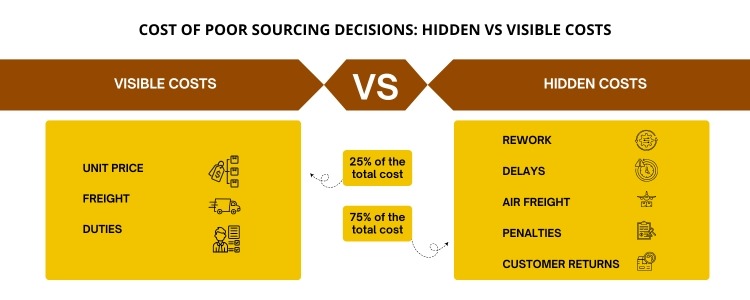
In a transactional sourcing model, the issue of tooling ownership, material price fluctuations, packaging requirements and penalties for late performance often get overlooked but are critical factors that can have a tremendous impact on the overall landed price of goods. Therefore, it makes sense to look at sourcing from the perspective of sourcing’s holistic approach, so the idea of cost savings doesn’t come back to haunt you as hidden costs.
How Does Production Monitoring Reduce Sourcing Risk?
Once production of goods begins, risk level dramatically increases. Risk factors such as using non-approved materials, taking thin customer process shortcuts or using unqualified labour may result in compromised quality or on-time delivery. By utilising an end-to-end sourcing service, in-process inspection can identify those issues before they become costly to resolve.
When you conduct frequent on-site visits and check progress versus established specifications or schedules, you will identify issues before they develop into significant problems. This proactive approach allows you to efficiently implement corrective action while still allowing for adjustments to be made which will help prevent delays or rejection of shipments that result from last minute surprises.
What Role Does Quality Control Play Across the Sourcing Cycle?
In an end-to-end model, quality control is done on a continuous basis instead of being completed on an episode by episode basis. It covers the three stages of pre-production, in-line and pre-shipment and has different purposes at each of the different stages which are to avoid error, maintain continuity and validate output.
The layered approach is particularly critical for markets that are highly regulated, as the quality control failure can result in regulatory non-compliance or recalls. Embedding the quality controls in the operating process results in reduced operational and reputational risk to the company.
How Are Logistics Coordinated Within End-to-End Sourcing Services?
Logistics is generally considered a transfer point from sourcing to delivery, but it is considered a function of the end-to-end business. Requirements for packaging, container optimisation and shipment scheduling are planned in conjunction with production planning, rather than planned on a reactive basis.
Coordination of these three aspects of production and logistics ensures that goods are packaged to withstand transit and that they comply with destination country’s labelling requirements. Coordination also reduces the likelihood of demurrage, re-handling or missed sailing windows, all of which will decrease margins in a more inconspicuous way.
Why is Import Compliance a Critical Component?
When sourcing goes wrong, import compliance is where the problems show up to the authorities. If there is incorrect or not enough information on the documents (like valves) used to identify the shipment of goods, the result could be shipment holds, fines or the product being forced out of the country. By using full-service, end-to-end sourcing services, importers have built-in compliance checks at the early phase of sourcing versus only having a compliance check at the very end to see if they are compliant or not.
For example, importers can verify tariff classifications, country of origin, and support documentation long before the goods are shipped. By ensuring proper paperwork and classification before shipping, the import process is smooth through customs and reduces the chance of an importer being subject to regulatory scrutiny.
How Do Sourcing Services Companies Differ in Their Approach?
There is a disparity among providers in these types of compliance processes. Some companies that provide sourcing services provide some level of supplier identification; however, other companies that provide modem-day sourcing services provide a true lifecycle approach to sourcing. The difference is in accountability.
Companies that provide a true end-to-end solution, hold themselves accountable to the results of their sourcing, as well as the activities. They are able to identify issues throughout all phases of the project, and resolve the issues through a single point of contact, rather than pointing fingers at other vendors. In other words, the level of accountability is what separates end-to-end sourcing from bundled sourcing services.
What is the Strategic Advantage of Using End-to-End Sourcing?
In addition to enhancing operational efficiencies, end-to-end sourcing enhances strategic initiatives as well-allowing companies to expand their sourcing programs without increasing internal oversight disproportionately. They can also increase the continuity of their data, resulting in improved decision-making regarding how to use past cycle information for future purchase and sourcing decisions. In volatile trading conditions, the adaptability provided by end-to-end sourcing becomes a key competitive advantage, enabling companies to react rapidly to disruptions, make supplier mix modifications, and continue to remain compliant without needing to start over at the beginning of their sourcing process.
Are End-to-End Sourcing Services Suitable for Smaller Businesses?
Contrary to what many believe, smaller companies typically benefit more from using end-to-end sourcing. Due to their limited internal resources, fragmented sourcing increases the risk associated with their supply chain and does not necessarily save them any money. By providing an established framework and processes that small teams/Limited groups may lack, end-to-end sourcing reduces the risk of costly errors.
There will always be fees associated with using sourcing services; however, these fees are typically outweighed by the potential costs associated with having to redo work, experience delays, or failure to comply with applicable regulations because the alternative is to implement internal sourcing solutions. For growing companies, end-to-end sourcing provides a solid, scalable foundation rather than an interim solution.
What Should Businesses Look for When Choosing a Provider?
When selecting sourcing services for use by the organisation, companies should look for candidates that provide transparency, proven experienced sourcing processes, and experience in similar products/industries. Characteristics that exhibit transparency and documented processes are accurate reporting, clear and documented workflow, independence from suppliers, and consistent service levels across the sourcing lifecycle are additional signs of reliability. Pilot orders or test engagements are additional tools that can assist with evaluating responsiveness and judgment.
When working with sourcing services firms, sourcing services vendors, or sourcing services providers, the focus must be on accountability throughout the entire end-to-end sourcing lifecycle rather than in isolation from the other capabilities provided within the source chain.
1. What are end-to-end sourcing services?
They manage the full sourcing lifecycle, from supplier selection to import compliance.
2. Do these services replace internal procurement teams?
No. They complement internal teams by handling execution and local oversight.
3. Are end-to-end services more expensive?
They involve fees, but often reduce total cost by preventing errors and delays.
4. Can they support compliance for multiple markets?
Yes, many providers align sourcing processes with destination-market requirements.
5. Are these services industry-specific?
Most providers specialise by sector to manage category-specific risks.
6. When should a business adopt end-to-end sourcing?
Ideally when sourcing internationally at scale or entering unfamiliar markets.

Diptanshu
Leading research and marketing at Inductus Global, Diptanshu drives the company’s vision to transcend traditional trading through thought leadership in import-export. He spearheads a research-driven approach that prioritizes quality over price arbitrage, positioning Inductus as a strategic sourcing partner rather than a transactional intermediary. His work spans market intelligence, supply chain innovation, and trade dynamics, while playing a key role in sales and business development.