

How to Choose a Sourcing Company: Guide for UK and EU Importers
Why Has Global Sourcing Become More Complex for European Buyers?
In the last ten years, global trade has become increasingly connected and at the same time fragile. European buyers are now working under an environment of increased regulatory scrutiny, increased geopolitical uncertainty, supply chain disruptions and increased consumer expectations for sustainable and transparent sourcing. Buyers used to focus only on price when making purchasing decisions, however, now there could be legal implications, reputational impact or operational impact associated with these purchasing decisions.
For European buyers, this shift in purchasing has made procuring goods from across the world a much more strategic decision and requires more than just being able to buy things with an understanding of transactional purchasing skills as they also must be able to navigate unknown ecosystems of suppliers, language barriers and compliance frameworks. This is the context within which professional intermediaries have been able to increase their relevance as a risk manager and process custodian rather than a middleman.
What is a Sourcing Company in Practical Terms?
The role of a sourcing company is to be an independent service provider that represents buyers’ interests in offshore markets by identifying potential suppliers, verifying their abilities to provide product(s), monitoring production, and reducing the various risks associated with cross-border procurement.
Unlike traders (who buy products and resell them), a sourcing company does not have its own stock of goods. Instead, it manages the sourcing process for buyers as an extension of the buyer’s purchasing organization on the ground.
A sourcing company is responsible for ensuring that suppliers are able to meet the standards established by their buyer (e.g., quality, production capacity, compliance, and delivery). To buyers located in Europe, sourcing from vendors that are located geographically distant from their manufacturing base can often materially affect whether sourcing activities are successful or unsuccessful.
How is a Sourcing Company Different From an Agent or Trader?
Understanding the distinction between sourcing companies, agents and traders is critical, but often misunderstood by many buyers. Traders purchase goods, mark them up and then sell the marked-up goods to their buyer. The cost associated with the added “mark-up” will therefore be included in the price of the goods sent to their buyer. Agents refer customers to suppliers and receive commissions from the suppliers. Because of the commissions received from suppliers, agents are not independent from suppliers and therefore may potentially have their independence compromised.
Sourcing companies operate exclusively on a fee-based model, provide services to both sellers and buyers on a non-exclusive basis, and therefore have no vested interest in the factories in which they source. As a result, sourcing companies can focus their efforts towards specific outcomes for their buyers (quality and consistency, continued compliance and longevity under continuous production) without the potential of any conflict of interest or loyalty from the buyer’s standpoint. For European buyers to maintain their ability to continue sourcing from suppliers due to audits and governance standards, they must source through an independent source, such as a sourcing company.
What Services Does a Sourcing Company Typically Provide?
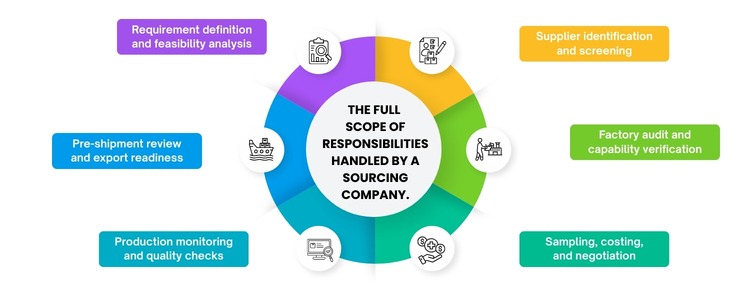
The Sourcing Services are a comprehensive service that supports all areas of the Sourcing Lifecycle from identifying and shortlisting Suppliers through Factory Audits and Sample Evaluation; once Suppliers are approved, the Sourcing Partner then leads the Supplier in negotiating contracts and production planning.
While Products are being manufactured, the Sourcing Partner conducts Quality Assurance checks and monitors the timing of each stage of production. Subsequently when Products are ready for shipment, the Sourcing Partner verifies the Packaging, Documentation, and Readiness of Products for Export. Many Buyers utilize Sourcing Partners to coordinate transportation with Logistics Providers, however, the Buyer always retains ownership of the Freight Decisions.
Sourcing has evolved from a series of Transactions into a Process through the use of structured deliveries.
How Do European Buyers Use Sourcing Companies to Reduce Risk?
Risk in Global Sourcing typically does NOT occur suddenly, it is built up through small holes; i.e., unclear use of Subcontractors, inconsistent use of Quality Control Processes and unrealistic production schedules. Sourcing Companies are focusing their efforts on identifying holes earlier in the process.
There are on-the-ground verification processes used to verify that factories control their own production process, that workers are treated appropriately, and that Quality Control Systems are being followed. Identifying these risks early in the process reduces the potential impact of downstream costs such as reworking an order, delays or rejected shipments to the buyer.
In the minds of many European companies, the preventive controls of Sourcing represent a justification for the Sourcing Investment.
Why Is Local Market Knowledge So Important?
Manufacturing ecosystems can vary widely within and between regions. The labour market, infrastructure reliability, levels of regulatory enforcement, and types of business culture will differ at both the national and cluster level. Sourcing companies will have insight into these local contextual clues, which would be very difficult for someone not on the ground to gather remotely.
As an example, a product sourcing agent who has worked in a particular industry can advise a client as to whether a lead time offered in a quotation is something that can realistically be met or if a reduction in offered price indicates a probable reduction in product quality. This judgement is typically based on experience not just data and therefore is a valuable asset when sourcing within an unfamiliar country.
How Do Sourcing Companies Support Quality Assurance?
Quality assurance is not simply a one-time inspection at the end of the production process. Quality assurance is built into the manufacturing process by a competent sourcing company by providing oversight of product quality from the start of the manufacturing process through the entire manufacturing cycle. This includes raw materials inspection prior to manufacturing, in-process inspection and finished product inspection.
For buyers based in Europe who supply regulated markets, consistent quality and compliance with regulations are fundamental to establishing brand trust among customers. Early detection of defects in product, through the use of effective sourcing practices, provides an opportunity to correct issues before they become too costly. This shift in focussing on quality inspection from a reactive approach to a proactive approach to implementing quality inspections will provide better long-term results.
What Role Do Sourcing Companies Play in Supplier Relationships?
Intermediaries, often referred to as purchasing agents or sourcing companies, act as professional intermediaries between suppliers and buyers by assisting buyers and suppliers in understanding each other’s expectations (example translating or explaining what the supplier is expecting from the buyer), settling disputes, aligning motivation, and not causing disruptions in their relationship with one another. This level of balance is particularly significant in cultures where direct confrontation would be unproductive.
Sourcing partners have contributed, over time, to the transformation of buyers from transactional purchasing methods to structured collaborative purchasing methods. Suppliers benefit from being able to provide clear expectations of requirements and order quantity/quality, while buyers benefit from a more stable and accountable supply chain.
How Do European Buyers Choose the Right Sourcing Partner?
Selection criteria that buyers use to judge sourcing partners extend beyond years of operation and geographical reach. In Europe, buyers judge sourcing partners based on their independence, size and scope of industry experience, depth of reporting and professional communication standards. Transparent and written fee structures as well as established written processes are indicators of professionalism.
Typically, many buyers will begin using a new sourcing partner (or purchasing agent) on a trial basis through a pilot order to test responsiveness and judgement prior to placing larger orders. Cultural alignment and effective time-zone communication can also be important considerations for buying firms that need to coordinate with suppliers located in different countries. Depending on the level of internal purchasing capability and appetite for risk, some buyers will compare various sourcing options (e.g., using a sourcing agent located in the U.K. vs. using a sourcing agent located in another country).
Can Sourcing Companies Support UK and EU Market Alignment?
Certainly. A large number of sourcing partners understand UK and EU regulatory expectations as far as documentation standards and compliance standards for their products, which lessens the amount of friction during customs clearance and post market audits.
The regulatory knowledge of sourcing companies in the UK can be important to Buyers that are sourcing through product sourcing companies in the UK, particularly when these buyers are looking to expand their supplier base outside of Europe. The sourcing company’s role is to help ensure that suppliers meet clearly defined specifications and to provide suppliers with the tools needed for compliance with regulatory requirements.
What Are the Limitations of Working With a Sourcing Company?
Sourcing companies do not take the place of the internal decision-making process. Product design, commercial strategy, and supplier selection are the buyer’s responsibility. Overusing sourcing companies without internal oversight can lead to a lack of accountability. However, effective use of sourcing companies can enhance the effectiveness of an internal team rather than replacing them. The value of sourcing companies is in execution, verification, and local expertise rather than in taking control of the strategy.

1. Is a sourcing company necessary for European buyers?
Not always, but it significantly reduces risk when sourcing from unfamiliar markets.
2. Does working with a sourcing company increase costs?
It adds service fees, but often lowers total cost by preventing errors and delays.
3. Are sourcing companies suitable for small buyers?
Yes. Smaller buyers often benefit most from local oversight and expertise.
4. How are sourcing companies usually paid?
Typically through transparent service fees rather than supplier commissions.
5. Can sourcing companies manage multiple suppliers?
Yes. Managing supplier networks is a core part of their role.
6. How long does it take to see value from a sourcing company?
Value often appears within the first production cycle, and increases over time.

Diptanshu
Leading research and marketing at Inductus Global, Diptanshu drives the company’s vision to transcend traditional trading through thought leadership in import-export. He spearheads a research-driven approach that prioritizes quality over price arbitrage, positioning Inductus as a strategic sourcing partner rather than a transactional intermediary. His work spans market intelligence, supply chain innovation, and trade dynamics, while playing a key role in sales and business development.






One Reply to “How to Choose a Sourcing Company: Guide for UK and EU Importers”
Indian Spices Cloves: Complete Guide for Spice Importers
11 Sep 2026[…] coffee-export ecosystem therefore gives European importers another origin to evaluate as part of a diversified Robusta sourcing […]