

7 Procurement Challenges for Indian Importers: Supplier Reliability Guide
Why Are Procurement Challenges Intensifying in 2026?
Global sourcing strategies are at a turning point: After a series of natural and human-made disruptions, including the COVID pandemic, geopolitical tensions, and inflationary pressures, procurement processes have moved from periodic uncertainty to an environment of structural disruption. The traditional goal of cost optimisation is now being expanded to include an overall responsibility for resilience, compliance, sustainability, and risk governance as part of the overall mandate of Procurement departments.
Challenges related to the evolution of Procurement practices do not only relate to sourcing teams. They also affect financial planning, production continuity, and commitments made to customers. Being able to anticipate these potential issues and responding appropriately to them will now be viewed as a strategic imperative versus an operational consideration.
1. How Can Procurement Teams Manage Persistent Supply Chain Volatility?
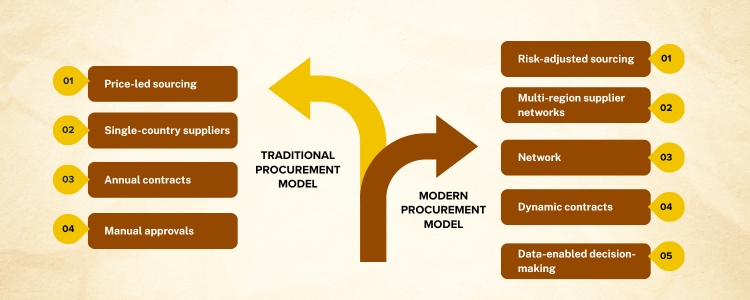
In 2026, supply chain instability is the single biggest concern for procurement teams. Disruptions caused by freight, regional conflict, and climate-related events continue to impact Supplier performance and lead times. Higher costs associated with being too dependent on a single geography are forcing organisations to rethink how they source from those same geographies.
Procurement Teams are utilising multi-supplier and multi-region strategies to better respond to these issues. Diversification and the ability to track Supplier performance in real-time, enable organisations to respond more quickly to a disruption. As such, creating contingency sourcing plans as part of the Procurement Process is now being considered a foundational competency rather than a reactive measure.
2. Why is Cost Control More Difficult Despite Advanced Analytics?
Even though digital technologies have enhanced transparency, cost volatility is still very high. The instability of raw materials, energy costs, and currency fluctuations has made static cost models less reliable due to fluctuating economic conditions (as indicated by the expansion into several factors previously described). Further, many traditional annual agreements do not adequately take into account rapidly changing market conditions.
Solution: Progressive organizations are implementing flexible pricing arrangements that are tied to market indices. Procurement teams can respond more quickly using scenario-based budgeting and shorter review cycles for contracts. By working closely with finance functions, cost decisions can be made with a greater focus on long term business resiliency instead of just short-term savings.
3. How Are Talent and Skill Gaps Affecting Procurement Outcomes?
Procurement roles have changed dramatically over the last decade. In addition to their longstanding traditional tasks of negotiation and purchasing, procurement teams need now to be skilled in data analysis, regulatory compliance, sustainability metrics, and geopolitical risk assessment; yet talent development has not kept up with these changing job requirements
Solution: Organizations are investing in formalized skills upskilling programs and cross functional assignments for procurers. Involving procurement professionals in strategy, finance and operations discussions can lead to better decision making. Using selected external procurement service provider can also assist in bridging capability gaps that would create an additional burden on internal teams.
4. Why is Supplier Risk Harder to Detect in 2026?
Supplier risk has gone from purely evaluating if a supplier has the financial stability to provide their services to include considering ethical practices, ready access to cybersecurity, environmental standards compliance, and political exposure when evaluating suppliers. In fact, most of these risks are latent until a supplier disruption happens.
To mitigate against these supplier risks, procurement companies are working to enhance supplier due diligence frameworks. The continuous monitoring of suppliers rather than just one-time supplier evaluations will allow for the early identification of emerging risk. There is an increasing requirement for suppliers to be fully transparent and willing to share data with procurement companies to form long-term partnerships.
5. How Does Sustainability Create New Procurement Pressures?
Sustainability commitments are now seen as mandatory and not voluntary. Regulatory requirements, investor expectations and scrutiny from customers are requiring procurement to be centre stage in attaining environmental and social governance. However, contrastingly, balancing the need for sustainable solutions while being cost and availability conscious is very difficult.
To ensure alignment with sustainability, it is now commonplace to incorporate sustainability criteria into sourcing decisions rather than treating them as an added benefit. It is becoming more common for procurement professionals to enter into long-term contracts with suppliers that have responsible sourcing practices to minimise the risk of constant fluctuations in supply and price. Also, the decision-making process for procurement professionals is beginning to incorporate the life-cycle impact of products as opposed to just the upfront purchase price alone.
6. Why is Digital Procurement Still Underperforming in Many Firms?
Even though procurement departments invested heavily into digital platforms, many are disappointed with their effectiveness. A fragmented set of systems, data quality issues, and lack of willingness to change all contribute to technology under-utilisation resulting in wasted potential.
Solutions: To properly complete a digital transformation, organisations must focus on integration as opposed to buying new tools. It’s critical to standardise and simplify data, train teams on to interpret and use the insights from data, etc. Digital procurement should enhance the decision-making process rather than replace professional judgement or relationships with suppliers.
7. How Can Procurement Align Better With Business Strategy?
The disconnect between the goals of professional procurement departments and the overall goals of enterprises is one of the greatest ongoing challenges. Procurement departments are typically measured on how much money they save, while the enterprise overall (including members of the executive team) are typically focused on growing, becoming more resilient, and providing better experiences to customers. Misalignment on this level will inherently weaken the decision making process.
Solutions:
Many procurement leaders have begun using outcome-based metrics to measure their departments, which allows these organisations to align with overall business goals. Additionally, early engagement by procurement during product development, new market entry, and planning for capacity allows them to be proactive by providing input into overall strategy rather than just reacting to what has already occurred. Working closely with Supply Chain Management organizations also improves cohesion between operational processes/activities.
What Do These Challenges Mean for the Future of Procurement?
Procurement is no longer just a transactional function, it is strategic, data informed and closely integrated into risk management and growth strategies of the organisation. Those organisations that view procurement as a back-office function will be at a competitive disadvantage in volatile market conditions.
In contrast, those organisations that invest in capability development, supplier collaboration, and developing adaptable frameworks will turn uncertainty into competitive advantage. The ability to thrive in complex environments (as opposed to avoiding complexity) will be the key to procurement success going forward.
1. Why are procurement challenges increasing despite better technology?
Because risks have become more complex and interconnected, requiring judgment beyond data visibility.
2. Is cost reduction still a priority in procurement?
Yes, but it is balanced with resilience, compliance, and long-term value creation.
3. How important is supplier diversification in 2026?
It is critical. Overreliance on single sources increases exposure to disruption.
4. Can small businesses manage these procurement challenges?
Yes, through selective outsourcing and focused risk management rather than scale.
5. Does sustainability increase procurement costs?
Not necessarily. Over time, sustainable sourcing often reduces volatility and risk.
6. What skills are most important for procurement professionals today?
Analytical thinking, risk assessment, cross-functional collaboration, and negotiation.

Diptanshu
Leading research and marketing at Inductus Global, Diptanshu drives the company’s vision to transcend traditional trading through thought leadership in import-export. He spearheads a research-driven approach that prioritizes quality over price arbitrage, positioning Inductus as a strategic sourcing partner rather than a transactional intermediary. His work spans market intelligence, supply chain innovation, and trade dynamics, while playing a key role in sales and business development.