

Why International Retailers Are Choosing Indian FMCG Suppliers
Why is a Walmart category buyer in Ohio now placing repeat orders with a spice processing unit in Ludhiana instead of a legacy supplier out of Guangzhou? Why is a Lidl procurement head in Berlin routing personal care SKUs through Nashik instead of Jakarta? The answer isn’t sentiment, it’s math.
Across boardrooms from Dubai to Dallas, FMCG Products Suppliers from India are no longer a category retailers casually browse, they’re a sourcing decision being made deliberately, line by line, contract by contract. Here’s what’s actually driving that shift, and what it means for the mechanics of your next sourcing cycle.
Here's to Know Everything About Indian FMCG Market
“The fast-moving consumer goods (FMCG) industry or consumer packaged goods (CPG) industry is mainly responsible for producing, distributing and marketing fast-moving consumer goods. The FMCG industry is the fourth largest sector in the Indian economy.” India’s FMCG market was valued at roughly USD 288 billion in 2025, with industry trackers projecting a compound annual growth rate near 17 percent through the next decade, among the fastest expansion rates of any major consumer goods economy. Food processing alone, a core feeder segment for FMCG exports, is on track to cross USD 535 billion by FY26 according to IBEF.
This growth isn’t domestic consumption alone. Indian manufacturers have shifted from a domestic-first playbook to an export-first one, retooling production lines to meet international packaging, shelf-life, and compliance standards from the outset. What does that mean for a retailer sitting across the negotiating table? Pricing power, backed by scale, not squeezed out of a supplier who can barely meet minimum order quantities.
Catering to The Global Demand: Indian FMCG Products
International shelves are already answering the demand question. Turmeric, basmati rice, ready-to-eat meals, and ayurvedic personal care lines are moving briskly across the Gulf, East Africa, and Southeast Asia, and increasingly into Europe and North America. Three forces are pulling Indian FMCG Products onto global shelves at once: a sizable diaspora population creating built-in demand for authentic sourcing, a price-to-value ratio few origin countries can match at comparable scale, and a fresh wave of clean-label, halal, and organic certifications opening retail corridors that were closed to Indian exporters a decade ago.
The real question isn’t whether FMCG Product Export From India is trending upward, it’s whether this marks a temporary pricing advantage or a structural rewiring of where global retail sources its shelf staples. The data increasingly points toward the latter.
Why International Retailers Are Choosing Indian FMCG Suppliers
Ask any procurement head who has greenlit an Indian supplier over an established Vietnamese or Latin American alternative, and the reasoning rarely comes down to a single factor, it’s a decision matrix. Cost sits alongside compliance, compliance sits alongside scalability, and scalability means little without a trade ecosystem that can execute on time.
Here’s the exact matrix international buyers are running today when evaluating FMCG Product Exporters out of India.
| Factor | Why It Matters | Indian FMCG Advantage |
|---|---|---|
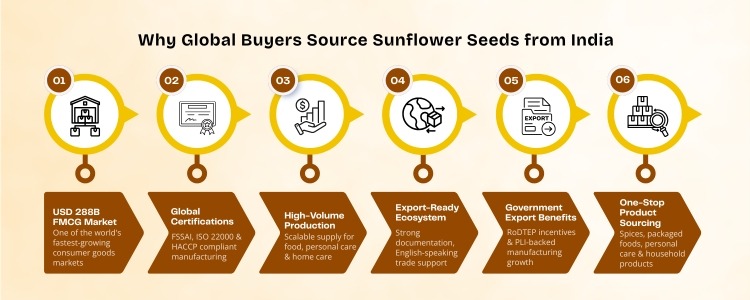
| Cost Competitiveness | Profitability depends on maintaining competitive landed costs while ensuring product quality. | Lower manufacturing costs, efficient production processes, and strong supply chains help reduce procurement expenses without compromising quality. |
| Compliance & Certification | Retailers and importers require products that meet international food safety and quality standards. | Many Indian FMCG manufacturers operate with FSSAI, ISO 22000, HACCP, BRCGS, GMP, and other globally recognized certifications. |
| Scalability | Buyers need suppliers capable of increasing production as demand grows. | India offers high-volume manufacturing capabilities across food, beverages, personal care, home care, and household products. |
| Trade Ecosystem | Efficient communication and documentation reduce delays, errors, and compliance risks. | Well-established export infrastructure, English-speaking trade professionals, digital documentation, and experienced logistics partners streamline global trade. |
| Government Incentives | Export-friendly policies help suppliers remain price competitive in international markets. | Government initiatives such as RoDTEP, PLI Scheme, and export promotion programs strengthen manufacturing and improve global competitiveness. |
| Category Diversity | Sourcing multiple product categories from one supplier simplifies procurement and supply chain management. | India offers an extensive FMCG portfolio, including food products, spices, beverages, snacks, edible oils, personal care, home care, cleaning products, and skincare, enabling consolidated sourcing from trusted partners. |
Guide For Smooth FMCG Product Export 2026
Finding Trustworthy Resources
Vetting an Indian FMCG supplier shouldn’t start with a search engine and end with a factory photo on a messaging thread. Serious buyers work backward from verified trade bodies, APEDA for agri-based exports, FIEO for broader trade credibility, cross-checking supplier claims against actual export history rather than sales pitches. Ask for prior shipment records, not just samples.
The red flags are consistent: no traceable export history, a factory address that doesn’t match registration documents, or paperwork that shifts between conversations. Trustworthy exporters welcome audits. The ones avoiding them are already telling you something.
Quality Verifications & Documentation
Paperwork isn’t bureaucracy; it’s the difference between a shipment clearing customs and one sitting in a bonded warehouse accruing demurrage fees. Non-negotiables include a valid FSSAI license, ISO 22000 certification, phytosanitary certificates for agricultural goods, a Certificate of Origin, and lab-tested reports confirming shelf-life and contamination thresholds.
A single missing certificate can hold an entire container at port, and repeated compliance gaps put both the supplier relationship and your retail timelines at real risk.
Building Stable Supply Chain
One clean shipment doesn’t make a reliable supplier. Buyers assessing long-term viability look past the sample order to production capacity audits, transparency around raw material sourcing, and whether a supplier maintains backup capacity for demand spikes.
Increasingly, established Indian FMCG suppliers are proposing multi-year supply agreements rather than one-off purchase orders, a signal of confidence in their own scalability, and a structure that gives retailers pricing stability and priority production slots during high-demand seasons.
Pre/Post Shipping Deliveries
The work doesn’t end at production. Pre-shipment inspection catches defects before they become returns, and packaging has to meet the shelf-display and labeling standards of the destination market, not just Indian retail norms. Perishables demand cold-chain or moisture-control handling, and the sea-versus-air freight decision hinges on shelf-life windows and margin tolerance.
Post-shipment, reliable suppliers offer clear defect-claim processes and predictable reorder cycles. Looking ahead through 2026, AI-assisted customs documentation and blockchain-based traceability are fast becoming differentiators rather than novelties.
Conclusion
So why is that Walmart buyer in Ohio still placing repeat orders out of Ludhiana? Because this was never a trend chasing lower costs, it’s a recalibration of where global retail believes reliable, compliant, scalable FMCG manufacturing actually lives.
The suppliers proving that, order after order, are rewriting the sourcing map in real time. For retailers ready to move beyond legacy supply chains, the opportunity is to partner with verified Indian FMCG suppliers before the rest of the market catches up. Reliable sourcing isn’t found, it’s built, one verified partnership at a time.

Pratibha Soni
I write where strategy meets storytelling. As a passionate writer and literary enthusiast, I craft business-focused content that transforms trading insights into compelling narratives. Drawn to global business ecosystems, I enjoy turning research, innovation, and ideas into content that informs, connects, and inspires. With an analytical mind and a creative soul, I bring curiosity, collaboration, and a sharp eye for detail to every project. Adaptable and growth-driven, I believe the right words do more than communicate; they leave an impression.