


How to Import Palm Oil from India to the USA: Complete Guide
What does it take to move a golden commodity from Indian ports straight to American shelves? Palm oil is the world’s most consumed edible oil, and a quiet but powerful trade corridor now connects India’s refining hubs to U.S. warehouses.
Palm oil export from India isn’t a single transaction; it’s a chain of trust, timing, and technical precision, link by link. This guide pulls that chain apart and lays it flat, one link at a time. No jargon, no guesswork, just the real playbook every serious buyer needs before a shipment ever leaves the dock.
India: Leading Manufacturer of Palm Oil
India doesn’t grow palm oil at scale, but it has quietly built something arguably more valuable: one of the world’s most sophisticated refining ecosystems for it. As one of the largest consumers of edible oil globally, India imports crude palm oil in bulk, then refines it into export-grade RBD palmolein through a mature, high-capacity processing industry.
That refining muscle is what turns raw material into a tradeable, standardized product, and it’s why palm oil suppliers based in India can offer consistent grades on competitive turnaround times. For US buyers, that means dealing with processors who understand global specifications, not producers still learning them.
Why Indian Palm Oil is Heavily Demanded in The USA
Why would a US buyer choose an Indian supplier over a Southeast Asian one? Cost is only part of the answer. Indian refiners operate at competitive processing rates without compromising on export-grade standards, which keeps landed costs attractive. English-language trade documentation and communication also remove a friction point that often slows down compliance-heavy transactions.
Add to that strengthening bilateral trade ties and steadily improving logistics corridors between Indian ports and US entry points, and it’s easy to see why palm oil import USA volumes from India have been climbing rather than plateauing. But demand alone doesn’t get a shipment to your warehouse; here’s how it actually happens.
Import Palm Oil from India to the USA: A Complete Guide
Finding Verified Sources
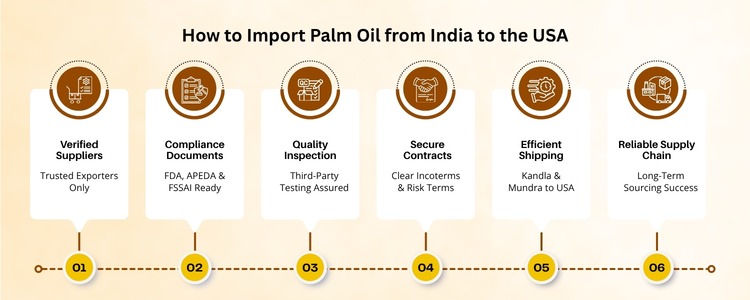
Trust, but verify. Most importers don’t lose money on tariffs, they lose it trusting the wrong supplier. Before you even discuss price, check three things: a documented export track record, valid FSSAI and APEDA registration, and references from other international buyers who’ve actually received shipments.
Any supplier hesitant to share these isn’t ready to buy palm oil from India from, full stop. Verification isn’t a courtesy step; it’s the foundation everything else gets built on.
Checking Licenses & Documents
Paperwork doesn’t feel exciting, until it’s the reason a shipment sits stuck at port. Before finalizing any deal, confirm these four essentials are in place: 1) a valid export license, 2) a phytosanitary certificate, 3) FDA prior notice filed on the US side, and 4) a certificate of origin.
Each document exists to answer a customs officer’s question before it’s even asked, and missing even one can hold a shipment at port for weeks. Treat this checklist as non-negotiable, and keep verified copies on hand well before the vessel is booked.
Overlooking Policies and Contract Drafting
This is where losses happen quietly, long before anyone notices something is wrong. A handshake doesn’t clear customs, a contract does. Get Incoterms unambiguous in writing: is it FOB or CIF, and who owns the risk at each stage of transit?
Build in penalty clauses for delivery delays, and define a clear dispute-resolution process for quality disagreements before they happen, not after a container is already at sea. Vague contracts don’t just fail buyers, they fail everyone involved.
Quality & Quantity Testing
Specs protect margins as much as they protect compliance. Insist on third-party inspection, SGS or Bureau Veritas-style checks, before the shipment ever leaves port. Pay close attention to free fatty acid content and moisture and impurity thresholds,
since these numbers directly affect grade classification and resale value down the line. Refined palmolein typically carries tighter FFA tolerances than crude grades, so know exactly which specification you’re buying before the contract is signed, not after the shipment lands on your dock.
End-to-End Shipping Sources
Picture the journey: tankers loading at Kandla or Mundra, cutting across open water toward US entry ports like Houston or Los Angeles. For bulk orders, dedicated tankers make sense; for smaller volumes, flexitanks or ISO containers offer more flexibility without sacrificing safety. The freight forwarder you choose should have documented experience specifically in edible oil logistics, this isn’t a category where general cargo experience is enough.
Pre/Post Logistics Verifications
Two checkpoints protect a shipment from real risk, and most buyers only remember one of them. Before the vessel departs, a pre-shipment inspection report confirms the cargo genuinely matches contract specifications, grade, quantity, packaging, all of it.
After arrival, post-arrival verification against FDA and customs clearance confirms the cargo is legally and physically cleared to enter the country. Skip either checkpoint, and you’re accepting the risk that a simple report could have caught early.
Forming Stable Supply Chain
One shipment is a transaction. A dependable pipeline is a strategy. Moving from one-off imports to a stable supply chain means negotiating longer-term supplier contracts and, ideally, diversifying across two to three vetted exporters to de-risk against shortages or disruptions.
Treat sourcing as a relationship, not a repeat purchase, the exporters who know your specifications, timelines, and standards will consistently outperform the cheapest quote on paper. A future-proof import strategy isn’t built on any single shipment; it’s built on the relationships behind it.

Conclusion
Importing palm oil from India isn’t a matter of luck, it’s a matter of process, done right, every single time. From verified sourcing to airtight contracts to end-to-end logistics checks, palm oil export from India rewards buyers who take each step seriously. If you’re ready to move beyond guesswork and connect with verified suppliers, the next shipment could be the first of many. Reach out to start the conversation.

Pratibha Soni
I write where strategy meets storytelling. As a passionate writer and literary enthusiast, I craft business-focused content that transforms trading insights into compelling narratives. Drawn to global business ecosystems, I enjoy turning research, innovation, and ideas into content that informs, connects, and inspires. With an analytical mind and a creative soul, I bring curiosity, collaboration, and a sharp eye for detail to every project. Adaptable and growth-driven, I believe the right words do more than communicate; they leave an impression.