

What is Procurement Policy: Complete Guide to Procurement Process 2026
The current business climate (characterized by disruption to supply chains; increased regulations; and higher-than-average cost increases), has changed the way that many companies view Procurement as an important aspect of Governance. Companies from all industries have begun to rethink how they buy products and services not only in terms of creating price savings; but also to reduce the risk of supply disruption and increase compliance with regulations and maintain business continuity. At the heart of this shift is an organization’s Procurement Policy, which outlines the processes and procedures to be followed to approve, execute and monitor all purchases made by the business.
This document will provide a structured and practical overview of a Procurement Policy. It will examine the definition of Procurement Process; What is the purpose of a Procurement Policy? What are the components of a Procurement Policy? And Why is it relevant in procurement services 2026? This guide is intended for leaders of businesses, Procurement professionals, and anyone who wishes to have greater clarity within a complex purchasing environment.
What is a Procurement Policy and why does it Matter?
A Procurement Policy is a formal document that defines the principles and procedures associated with the acquisition of goods and services for an organization. It defines who can procure items, from whom, at certain values, and how to achieve the appropriate approval processes for each product category.
The significance of a well-defined Procurement Policy is that it creates a consistent and accountable framework in which to operate. The absence of the Policy creates fragmented procurement processes, increasing the risk of financial leakage, supplier-related issues, and non-compliance with regulatory requirements. The presence of a properly constructed Procurement services allows for procurement activities to align with the Strategic Objectives of the organization and provides assurance that procurement activities are executed with a high level of transparency.
How has Procurement Policy Evolved in Recent Years?
Procurement policies have changed from simply controlling prices and making vendor selections historically, to now having a much broader scope. In 2026, modern procurement policies are much more comprehensive.
As businesses change due to things like supply chain disruptions, trade barriers, and environmental issues, businesses are evaluating and working with suppliers differently than in the past. Therefore, procurement policy not only serves to control the process, but it also acts as a strategic guide.
What are the Core Objectives of a Procurement Policy?
A procurement policy typically serves multiple objectives simultaneously:
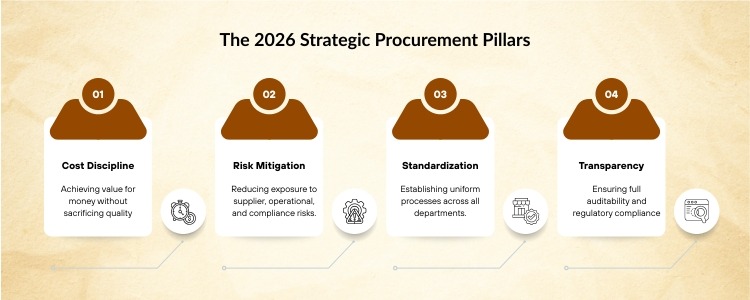
- Cost discipline: Ensuring value for money without compromising quality
- Risk mitigation: Reducing exposure to supplier, compliance, and operational risks
- Standardization: Creating uniform processes across departments
- Transparency: Supporting auditability and regulatory compliance
- Strategic alignment: Linking purchasing decisions to long-term business goals
When these objectives are clearly articulated, procurement becomes predictable and defensible rather than discretionary.
How does the Procurement Process typically work?
While processes vary by organization, most procurement frameworks follow a structured lifecycle:
- Requirement identification – defining what is needed and why
- Supplier evaluation – assessing capability, reliability, and compliance
- Approval and budgeting – ensuring spend authorization
- Contracting – formalizing commercial and legal terms
- Order execution – managing delivery and service performance
- Review and closure – evaluating outcomes and supplier performance
Each stage is governed by policy-defined thresholds and documentation standards, reducing ambiguity in decision-making.
What role does Governance Play in Procurement Policy?
Governance is the foundation for the discipline of procurement. A policy is established to specify the levels of authority for various functions within procurement, separate the roles/responsibilities of each involved party, and establish procedures for escalation. Establishing these items prevents conflicts of interest and ensures that no one person has control of the entire procurement process.
Procurement committees or oversight boards will also review the procurement process of large organizations, especially high-value or strategic purchases. By creating a layered governance structure, organisations will have greater accountability and build institutional trust in their purchasing decisions.
How do Organizations Manage Supplier Relationships within Policy Limits?
Policies for procurement do not take away flexibility; instead, they structure it. In many cases, companies encourage a long-term relationship with suppliers, as long as they perform and meet compliance benchmarks.
Companies are also putting greater emphasis on formalizing supplier onboarding, performance reviews and exit strategies as part of their procurement policy. This structured approach helps to maintain a steady business relationship with suppliers and provides opportunities for adjustments as the risk profile of suppliers changes. In some situations, companies may partner with a third-party sourcing agency to perform supplier discovery and due diligence in accordance with procurement policies.
How does Technology Influence Procurement Policy in 2026?
Digital procurement has changed the way in which procurement policies are enforced. Automated approval workflows, supplier portals and spend analytics embed policy requirements deep within the procurement function.
Technology provides more visibility into procurement. Procurement leaders are able to use dashboards that provide real-time insight into spending patterns, supplier concentration, and contract compliance, which allows for a proactive approach to governance versus a reactive approach to correcting problems.
What Challenges do Organizations Face when Implementing Procurement Policies?
Although procurement policies have many advantages, these policies are often met with resistance. The main causes of resistance to procurement policies are often related to a lack of understanding by users, an excessively bureaucratic process, and ineffective alignment of the procurement policy with realistic, day-to-day operations of the organization.
For procurement services to be successful within an organization’s operations, they must be both sound and effective; enforced but flexible in application; and the procurement department must provide regular training, communicate internally, and allow time for the procurement department to evaluate its procurement policy to maintain relevance and acceptance.
How does Procurement Policy interact with external Sourcing Models?
With many organizations now operating globally, there has arisen a greater reliance on external sourcing models. Many procurement policies now establish the guidelines or rules by which external vendors, intermediary vendors, and consulting firms are to be utilized.
For example, a procurement policy may state the circumstances under which procurement staff are permitted to utilize a third-party product intermediary; establish criteria for evaluating a sourcing agent in a country like India; or outline when a third-party sourcing service companies may be contracted. Establishing clear guidelines helps eliminate ad-hoc or subjective decision-making and creates a uniform standard across geographical markets
What should Organizations Prioritize in Procurement Policy for 2026?
In the future, procurement policies will need to address both the resilience of the supply chain as well as the efficiency of the procurement process. As such, organisations will begin to treat Supplier Diversification, Geopolitical Risk Assessment, and Sustainability Metrics as policy-level factors.
Organisations that view their Procurement Policies as living documents will have a significant advantage in terms of flexibility and control over their spending and risk profiles. These organisations also regularly update their Procurement Policies to keep them aligned with their overall strategic direction.
Conclusion: Why Procurement Policy is a Strategic Necessity
A Procurement Policy is more than simply “an administrative process” to be followed in 2026. It will serve as a Strategic Tool for organisations to interact with the marketplace, manage their risk profile, and provide Governance Standards.
With thoughtful design and consistent application of the Procurement Process, organisations will be able to grow systematically and create a predictable and sustainable business model while maintaining Institutional Credibility. In a rapidly changing global environment, the consistency in application of the Procurement Policy will be an advantage versus the competition.
1. Is a procurement policy mandatory for all organizations?
While not always legally required, it is strongly recommended for governance and audit readiness.
2. How often should procurement policies be reviewed?
Most organizations review them annually or when regulatory or market conditions change.
3. Can small businesses benefit from procurement policies?
Yes. Even simple policies help control costs and reduce operational risk.
4. Who is responsible for enforcing procurement policy?
Typically procurement heads, finance teams, and internal audit functions share responsibility.
5. Does procurement policy limit supplier choice?
It structures choice rather than eliminating it, ensuring suppliers meet defined criteria.
6. How does a sourcing partner fit within procurement policy?
Such partners are engaged under predefined rules covering scope, authority, and accountability.

Diptanshu
Leading research and marketing at Inductus Global, Diptanshu drives the company’s vision to transcend traditional trading through thought leadership in import-export. He spearheads a research-driven approach that prioritizes quality over price arbitrage, positioning Inductus as a strategic sourcing partner rather than a transactional intermediary. His work spans market intelligence, supply chain innovation, and trade dynamics, while playing a key role in sales and business development.