


Top 5 Product Sourcing Challenges US Companies Face in 2026
Introduction
As of 2026, the global trade landscape is more intricate than it has been in many years. Product sourcing has changed from a back-office function for US firms to one that is crucial to the boardroom. The global trade environment continues to change because of geopolitical shifts, changes in regulations, sustainability mandates, and technological disruptions at a rate few expected.
No longer are executives asking: “Where do we get our products?” At this point, businesses are challenged to find reliable, ethical and cost-effective product supply lines when there is so much uncertainty.
Although inflationary pressures have eased over the last few years, freight volatility, changes in trade policy, and regulatory compliance will continue to cause pricing difficulties for many businesses today. In this environment, businesses that have historically relied solely on a single region for sourcing their products are now aggressively diversifying.
Some companies are working with specialized sourcing agents to help them navigate diverse foreign supplier ecosystems while others are investing in data-driven technology intelligence to enable procurement. While these strategies are being implemented, challenges remain.
The following section provides an analysis of the five main sourcing issues impacting US companies in 2026.
1. Why is Geopolitical Volatility Still Disrupting Product Sourcing?
While there was earlier hope of a global economic stabilization occurring, since recent times, geopolitical factors remain major disruptors worldwide. Trade disputes, regional conflicts and changes in diplomatic relationships continue to affect trade tariffs, export control arrangements and cross-border compliance requirements.
For US companies that rely on foreign-manufactured products, even minor shifts in government policy can result in increased expenses or delays in receiving their product shipments. The global supply chain has been initially optimized only for efficiency; now they have to be optimized to be as efficient as possible, as well as resilient.
The most common strategy that companies are pursuing for mitigating concentrated risk is through diversifying their supplier base. They are doing this by sourcing from suppliers in Southeast Asia, Latin America and South Asia. Companies are also using sourcing agents based in India to develop new manufacturing clusters that can offer both competitive pricing and similar regulatory requirements.
However, diversification itself must be carefully managed by companies. Sourcing products from multiple countries creates challenges to ensuring quality control, coordinating logistics and enforcing contractual obligations between suppliers and customers. Therefore, the cost of mitigating risk becomes a part of the cost associated with sourcing products.
2. How Are Rising Compliance and ESG Standards Affecting Product Sourcing?
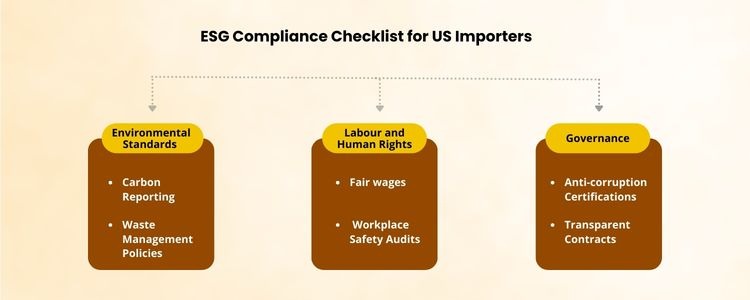
Environmental, Social and Governance (ESG) requirements have changed from being aspirational, to being driven by legal requirements as well as market expectations. In addition, US companies face many more stringent rules with regards to carbon emissions reporting, employment practices & working conditions, and sourcing & supply chain disclosures and transparency.
Violations can not only result in fines but can lead to substantial reputational harm and damage to a company’s perceived value. Institutional investors will now often include a sourcing analysis in their due diligence procedures.
Retailers are clearly under the microscope to implement sustainable sourcing policies that reduce the overall environmental footprint of retail and ensure that the production of their goods is socially acceptable (i.e., ethical). Examples of sustainable sourcing actions that are common include conducting audits of suppliers, measuring the life cycle of products, and certifying on-going compliance through third-party verification.
Although these actions may help to enhance the credibility of the retailer and increase consumer confidence, they also have an added cost to the operations of the retailer. A significant number of smaller suppliers may not be able to meet sustainability benchmarks, thus creating a situation where the retailer either needs to engage in greater investment in developing their suppliers or change partners altogether.
For those procurement leaders, the issue they are challenged with is how to achieve a balance between their obligations to their companies to operate sustainably and their obligation to their shareholders to act without a dilution of shareholder value due to the costs of achieving sustainability objectives.
3. Are Supply Chain Costs Becoming Unpredictable Again?
From 2026 onwards, shipping prices, prices for inputs into production, and exchange rates are once again prone to fluctuations. While not at the same levels of unpredictability as the pandemic, there is still a good amount of unpredictability occurring in more subtle ways compared to before.
For manufacturers in places like Europe and some countries in Asia, energy expenses continue to have an influence on cost of production, while natural disasters (like typhoons and droughts) and extreme weather events affect production and shipping scheduling occasionally.
For US importers, it has become increasingly challenging to budget for long-term contracts. Fixed-cost contracts have often been replaced by dynamic pricing contracts, usually based on cost indices.
More sophisticated forecasting and increased contractual protections will be required for companies navigating through the current financial uncertainty. Many businesses are working with a sourcing agency to negotiate flexible supplier agreements that also include provisions for contingency planning.
This means that when looking at strategic sourcing, companies will need to also have a good understanding of accounting as well as an understanding of logistics.
4. Is Quality Control Harder in a Diversified Sourcing Landscape?
As businesses grow their supplier network from one region to another, it is increasingly difficult to ensure a consistent level of quality.
Every manufacturing ecosystem has its own unique regulatory framework, labour practices and operational benchmarks; therefore, what one region sees as acceptable may require additional compliance adjustments when being manufactured in a different location.
While remote audits, digital inspection tools and third-party quality assurance services have become commonplace, there is nothing that can completely replace on-the-ground verification of a supplier’s quality.
More and more, US companies are using regional compliance teams or local representatives to perform surprise inspections and evaluate supplier performance, creating more accountability while increasing their operational costs.
In highly regulated industries (like electronics businesses, pharmaceutical manufacturers, or consumer goods manufacturers), even the smallest deviations in product conformity may result in recalls, fines and lawsuits; therefore, Quality Assurance is an essential element of a strategic sourcing plan.
5. Is Technology Both a Solution and a Challenge?
The use of technology is changing the procurement process and creating difficulties. Procurement is now using digital transformation to create ways to collect data about supplier risks (using AI), improve traceability (using blockchain), and provide visibility into shipments in real-time (using cloud-based dashboards). These changes have all improved transparency and speed of decision-making.
But implementing new technologies involves both a cost (monetary) and a change (organizational). Technology can make it difficult to combine old systems with new systems. Employees will require education/training to learn how to use the new systems. In addition, organizations must address cybersecurity risks of using digital technologies in the supply chain. In addition, placing too much reliance on automated insights can hide the fact that some supplier relationships rely on trust and negotiation.
Thus, many of the most effective sourcing strategies for 2026 will involve finding a balance between using digital intelligence and not ignoring human intelligence in decision-making.
1. What is the biggest sourcing challenge US companies face in 2026?
Geopolitical instability remains the most significant factor, influencing tariffs, trade regulations, and supplier reliability.
2. How can companies reduce sourcing risk?
Diversifying supplier bases across regions and implementing robust compliance monitoring systems can mitigate risk.
3. Is sustainability increasing sourcing costs?
Initially, yes. However, sustainable practices often lead to long-term efficiency gains and reputational benefits.
4. Why is supplier diversification important?
Relying on a single country or supplier increases vulnerability to disruptions, making diversification essential for resilience.
5. How does technology improve sourcing operations?
Technology enhances transparency, forecasting accuracy, and compliance tracking, enabling informed procurement decisions.
6. Should US companies work with external sourcing specialists?
In complex markets, external expertise can provide local insights, regulatory understanding, and negotiation leverage.

Diptanshu
Leading research and marketing at Inductus Global, Diptanshu drives the company’s vision to transcend traditional trading through thought leadership in import-export. He spearheads a research-driven approach that prioritizes quality over price arbitrage, positioning Inductus as a strategic sourcing partner rather than a transactional intermediary. His work spans market intelligence, supply chain innovation, and trade dynamics, while playing a key role in sales and business development.